Strait of Hormuz under fire: what the 1 September US strike on Iran actually tells us
President Trump announced US strikes on Iranian targets near the Strait of Hormuz on 1 September 2026, citing sea mines and missiles fired at a Jordan base. The framing is confident; the picture underneath is murkier.
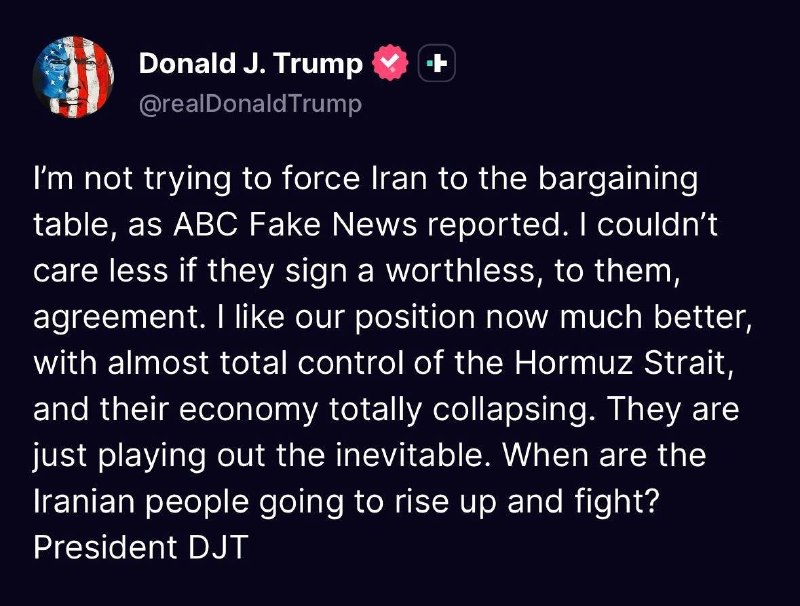
A Telegram post at 17:28 UTC on 1 September 2026 carried a Trump statement that the United States was "as we speak" striking Iranian targets near the Strait of Hormuz, in retaliation for sea mines and eight missiles fired at a base in Jordan. Reuters confirmed a new barrage around the waterway at 18:20 UTC. A separate Telegram item at 18:09 UTC relayed a Trump Truth Social post blaming "the Iranians' failed attempt at adding sea mines to the Strait." And at 18:24 UTC the Middle East Spectator Telegram channel ran a headline reading "Iran's response has begun."
What this picture actually shows is a propaganda contest more than a confirmed battlefield situation. The message from Washington is calibrated for maximum shock. The picture underneath is messier, and the gap between those two layers is where the real story sits.
What the available sources actually show
Strip the social-media packaging away and four discrete claims survive in the feed. The US struck targets in Iran near the Strait of Hormuz (Reuters at 18:20 UTC, Trump via Telegram). The trigger, per Trump's own posts, was sea-mines laid in the waterway and eight missiles fired at a Jordan base. The Middle East Spectator channel headline at 18:24 UTC reads "Iran's response has begun," which the channel asserts but which the available items do not independently corroborate with operational detail. And Trump, in remarks relayed via Telegram from a Fox News appearance, dismissed any future agreement with Tehran: "A deal with Iran is not worth the paper it is written on."
The Reuters wire confirmation at 18:20 UTC gives the bare fact of the strikes independent of the President's social feed. The targeting rationale, however, rests almost entirely on Trump's own statements. The available source items do not specify which Iranian sites were hit, the weapons used, the scale of the barrage, whether Iranian casualties occurred, or whether the Strait itself has been physically closed to commercial traffic. They also do not name the operator that fired the eight missiles at Jordan, nor specify which base. A war of this tempo usually produces a fog-of-war contest over the first 24 to 72 hours; today's fog is unusually thick, and most of what is being relayed is the administration's own framing of events, with the Iranian framing carried chiefly through a single Telegram channel headline.
Monexus analysis: the rhetoric is doing the work
Trump's statements do double duty: they are the announcement, the justification, and the deterrent, all in one. "Large and powerful" strikes, "they'll be no longer," "crazy and stupid," "not worth the paper it is written on." Read in isolation, each sentence looks like bluster. Read together, they telegraph an administration that has decided diplomacy with Tehran is over, at least for now, and is using language to lock in that posture publicly before any second round of negotiations can be reconstructed.
This is also, structurally, an old American pattern, and our reading of it is that when the costs of a sustained air campaign look daunting and the domestic appetite for a ground operation is thin, the White House has historically leaned on maximalist language to compress the political timeline. The corollary is that the same language becomes a constraint: a president who has publicly promised to end a regime's capacity to act is then measured against that promise, by allies and adversaries alike.
The counter-narrative is harder to read in real time because Iranian state media moves on a different clock. The available feed carries only the Middle East Spectator channel's headline that "Iran's response has begun," a claim whose operational content is unspecified in the available posts. Monexus assessment: the dominant US framing, that this is a punitive action calibrated to deter further provocation, is in tension with the equally plausible reading, that the strikes are intended to foreclose a diplomatic track that several intermediaries were still pursuing. Both readings can be true at once; which one prevails will depend on the next 48 to 72 hours of action, not on the messaging.
Monexus analysis: what the corridor is worth
The Strait of Hormuz is the right place to think about scale. Roughly a fifth of global oil shipments passes through it on any given day; even a partial disruption moves the price of crude and the cost of shipping insurance in real time. The available sources do not quote a price print or an insurance rate, and this article has not independently established whether traffic through the waterway has been physically interrupted. The choice of theatre is itself the signal: a US administration that wanted to degrade Iranian military capacity without affecting the corridor would have struck inland. Striking near the strait is, in Monexus's reading, a deliberate insertion of an economic variable into the military calculation, and it tells Tehran, and the Gulf monarchies, and Beijing and Tokyo and Seoul, that Washington is willing to weaponise chokepoint risk.
There is also a quieter structural point. Every prior escalation cycle between Washington and Tehran has been fought, in part, over who controls the narrative in Gulf and global-south capitals. When the messaging is this loud and the underlying sourcing this thin, the audience the administration is actually playing to is not the Iranian negotiating table but the governments now being asked, implicitly, to choose sides: to keep flights and shipping moving, to honour or unwind sanctions enforcement, to read the next 72 hours of statements and decide whether the new posture holds.
What the next week looks like
Three things to watch. First, confirmation of whether the Strait remains physically open to commercial traffic; Lloyd's and the Joint Maritime Information Centre will be the first authoritative voices on that, and this article has not independently established a current status. Second, any Iranian retaliation that lands on a US asset or a Gulf partner state, which would convert the current punitive framing into a sustained exchange; the Middle East Spectator channel asserts a response has begun but the available posts do not specify what, where, or against whom. Third, the rhetorical pivot: the moment Trump's language shifts from "they'll be no longer" to something more conditional is the moment the diplomatic off-ramp reappears.
None of these are predictions Monexus is making; they are the dates on the calendar where the evidence will thicken or thin. The sources available at publication do not specify casualty figures, the identity of the Jordan-base attacker, the exact targets struck, or the operational content of any Iranian response. They do show a president who has chosen escalation as his first public move and who has built his messaging accordingly, and an Iranian counter-framing being relayed chiefly through a single Telegram headline. The gap between the certainty of that messaging and the thinness of the underlying sourcing is itself the story of the day.
This article relied on Telegram channels and a single Reuters wire confirmation rather than on US or Iranian official briefings appearing in the source feed at publication. Where official accounts or additional reporting later contradict the framing above, Monexus will update. Readers seeking first-party statements from either capital should consult those governments' own channels directly.
Desk note: Monexus treated Trump's Truth Social and Fox News statements as primary text rather than third-party paraphrase, but flagged them as such throughout, because the alternative, sourcing the rationale only through opposition channels, would have stripped the reader of the framing the administration itself is projecting. The "Iran's response has begun" line is reported here as a channel headline, not as a confirmed military fact.
Wire provenance
This editorial synthesis draws on the following public wire/social posts:
- https://reut.rs/4h3vtiq
- https://x.com/Reuters/status/2094852813914313186
- https://t.me/Middle_East_Spectator/36187
- https://t.me/ClashReport/94548
- https://t.me/ClashReport/94562
- https://t.me/disclosetv/21803
- https://t.me/GeoPWatch/39323
- https://t.me/osintlive/568829