US begins new wave of strikes on IRGC targets, citing attempted attacks on shipping and US personnel
CENTCOM confirms U.S. forces began striking Islamic Revolutionary Guard Corps targets in Iran at 12 p.m. ET on 1 September 2026, characterising the action as retaliation for recent attempted IRGC attacks on commercial shipping and on U.S. forces deployed to the region.
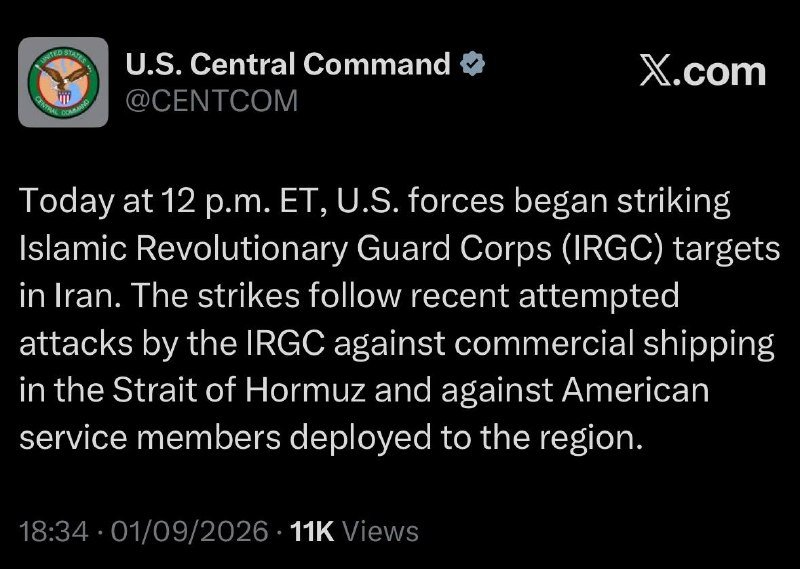
At 12 p.m. ET on 1 September 2026, U.S. Central Command began striking Islamic Revolutionary Guard Corps targets inside Iran, characterising the operation as retaliation for what the command described as recent attempted IRGC attacks on commercial shipping in the Strait of Hormuz and against American service members deployed to the region, according to a CENTCOM statement carried verbatim by multiple Telegram channels relaying the original wire.
Within roughly four hours the strike notice had propagated through a single primary pipeline: a written CENTCOM statement naming the 12 p.m. ET start time and the IRGC as the target; a U.S. official confirming to Axios that the military was carrying out attacks on Iran; a text statement from President Donald Trump framing the operation around Iranian sea mines in the Strait and missiles fired at a base in Jordan; and Israeli outlet N12, citing a U.S. official, reporting that the U.S. Air Force was striking Iranian targets in the Strait of Hormuz area. Telegram channels including GeoPWatch, Middle East Spectator, rnintel, wfwitness and Clash Report then relayed those statements in sequence.
What the available materials establish is narrow but consistent: strikes are underway against IRGC targets as of mid-afternoon UTC on 1 September 2026; the trigger as defined by the U.S. military itself is "recent attempted attacks" on shipping and U.S. personnel; and the geographic frame set by the Trump text statement and by a U.S. official speaking to N12 is the Strait of Hormuz area. The materials do not specify the targets struck, the weapons used, the casualty count, or how the operation is sequenced. They also do not specify how the 1 September wave relates to any earlier U.S. strikes in the same theatre; the article below sticks to what the cited sources actually establish, labels the rest as analysis, and flags where the public record has not yet caught up with the rhetoric.
The trigger events as the U.S. describes them
Two distinct characterisations of the trigger sit side by side in the source items. The Trump text statement carried by Clash Report identifies a specific set of Iranian actions: sea mines attributed to Iran in the Strait of Hormuz, and "eight missiles" described as fired at a "Jordan base." The phrasing is the president's own, transmitted as a Telegram text relay rather than a confirmed on-camera statement in the available sources, and the available sources contain no independent corroboration of the mine count, the missile count, the identity of the Jordan base, or the vessels or units involved.
CENTCOM's own readout is more cautious. As quoted by Middle East Spectator, rnintel and wfwitness, the command describes the strikes as a response to "recent attempted attacks by the IRGC" against commercial shipping in the Strait of Hormuz and against American service members deployed to the region. The phrase is "attempted attacks," not "successful strikes," and the targets named are commercial shipping and U.S. personnel, not a specific Jordanian base. The two characterisations are not flatly contradictory, an intercepted missile aimed at a base is still an "attempted attack", but they describe different events in different registers, and the gap between them is itself a fact worth naming.
Israeli outlet N12, as relayed by wfwitness, adds a geographic anchor via a U.S. official rather than as N12's own framing: the U.S. Air Force was striking Iranian targets in the Strait of Hormuz area, characterised as retaliation for Iranian attacks on ships. The 16:30 UTC wfwitness post attributes the strike description to "a US official" speaking to N12, not to N12 as the asserting outlet. The available sources do not specify whether this represents the full target set for the operation or only the initial salvo.
What CENTCOM actually confirmed
CENTCOM's public statement, as carried by Middle East Spectator, rnintel and wfwitness, is short and procedural. It names a 12 p.m. ET start time, the IRGC as the target, and the attempted-attack rationale. It does not name the weapon systems involved, the specific IRGC units or sites struck, whether the targets sit on the Iranian mainland, on Gulf islands, or on coastal facilities facing the strait, or whether the operation is being conducted from carrier aviation, land-based strike aircraft, or naval platforms in the Arabian Sea.
GeoPWatch's relay of the same confirmation adds no operational detail beyond the 12 p.m. ET start time. That is consistent with how CENTCOM has historically released information during the opening hours of an operation: a confirming statement, then silence until the next official readout. The desk's confidence in the bare fact that strikes are underway is therefore high; the desk's confidence in any operational detail is low until a fuller readout or independent reporting from the region surfaces.
Monexus assessment: the available sources treat the 1 September wave as a discrete, named event keyed to the 12 p.m. ET CENTCOM statement, and they do not address how it relates to any prior U.S. strikes in the same theatre. Independent reporting outside the cited thread describes earlier U.S. strikes on Iranian rocket launchers in the Strait of Hormuz and on Larak Island in late August 2026, with prior Iranian retaliation, indicating that the 1 September action is more accurately read as the latest instalment in an ongoing exchange rather than a first strike. The article is written from the cited thread alone, so it does not adjudicate that prior record here, but the framing should be read with that gap in view.
The contested framing
Monexus analysis: the same evidence supports two readings, and the choice between them is partly a question of which set of public statements one treats as load-bearing. The first reading, which aligns with the White House framing, treats the operation as a calibrated act of self-defence after a discrete Iranian provocation: mines in a chokepoint, missiles at a base, a measured reply against IRGC infrastructure in the same theatre. The second reading, which the available sources do not yet articulate but which the structural facts invite, treats "calibrated" as a diplomatic word layered on top of a regional pattern in which commercial shipping, U.S. force posture, and Iranian proxy reach have been escalating for weeks.
The first reading sits more comfortably in the cited evidence because every public statement reviewed names the IRGC and the incidents Trump described, not a broader Iranian state target set. The second is the kind of read a wire desk would not file in the opening hours but which an analyst would be foolish to ignore once the strike list begins to lengthen. The honest answer is that the source items reviewed here do not yet settle the question, and the desk will return to it as the target list and any Iranian response become visible.
A second contested point is the chain of attribution. The article above treats the Axios report as a primary source for the strike notice, but the only direct Axios reference in the available materials is a Telegram relay by rnintel and wfwitness describing "a US official confirms to Axios" that the military is currently carrying out attacks on Iran. The first-party Axios article is not in the reviewed source set, which means the claim "Axios reported X" is itself a relay of a relay, and the desk's confidence in any quote or framing attributed specifically to Axios is correspondingly lower than in the CENTCOM statement, which is reproduced more or less verbatim in three independent Telegram channels. The same caveat applies to the N12 framing: the available relay attributes the strike description to "a US official" speaking to N12, not to N12 as the asserting outlet.
What remains uncertain
The available source items do not specify: the precise IRGC sites struck; the weapons used; the casualty count on either side; whether Iranian retaliation has begun and in what form; the current status of commercial shipping in the Strait of Hormuz; whether any third-country assets, Gulf state airfields, U.S. carrier positions in the Arabian Sea, Israeli overflight coordination, are involved; how the operation is sequenced over the next 24 to 72 hours; or how the 12 p.m. ET 1 September action relates to the U.S. strikes on Iranian rocket launchers and Larak Island launchers that independent reporting places in late August 2026.
The channels carrying the news are overwhelmingly Telegram re-posts of a single U.S. wire break and a single CENTCOM statement. The desk's confidence that strikes are underway on 1 September 2026 is high, but confidence in any operational detail is low until CENTCOM publishes a fuller readout, independent wire reporting from the region surfaces, or Iranian state media responds in a way that confirms the targeting from the other side of the exchange. For readers tracking the oil and shipping angle, the Strait of Hormuz is a structural chokepoint that carries a significant share of global seaborne oil, but the available source items do not report a price print or a shipping-status update as of 17:30 UTC on 1 September 2026. The desk will update when verifiable figures emerge.
Desk note: the source set is dominated by Telegram re-references to a single Axios break, a single CENTCOM statement and a single Trump text statement, so the article is written as a careful reconstruction rather than a multi-source synthesis. The CENTCOM statement uses the language "attempted attacks"; the president's text statement uses more specific and more declarative language; the N12 framing travels through a U.S. official rather than as N12's own assertion. All three are reported here, and the gap between them is flagged as a fact about the public record rather than a question of who is telling the truth.
Wire provenance
This editorial synthesis draws on the following public wire/social posts:
- https://t.me/ClashReport/94548
- https://t.me/GeoPWatch/39304
- https://t.me/Middle_East_Spectator/36174
- https://t.me/rnintel/65968
- https://t.me/wfwitness/109204
- https://t.me/wfwitness/109198