US widens strikes across southern Iran, hitting ports, airports and telecom sites
A second wave of US strikes was reported across southern Iran on 1 September 2026, including Bandar Abbas, Qeshm, Chabahar, Jiroft Airport and Asaluyeh. President Trump warned that an Iranian response would bring a stronger US military reaction.
Strikes across at least five Iranian locations were reported between 18:39 and 19:24 UTC on 1 September 2026, including the port of Chabahar, Bandar Abbas, Qeshm Island in Hormozgan province, Jiroft Airport in Kerman province and Asaluyeh. Open Source IntelMAP said a second wave had been reported and listed the same broad southern Iranian geography. OSINTdefender separately described a new round of US airstrikes as likely underway in Bandar Abbas, Chabahar and Qeshm. The Cradle Media also reported attacks at Jiroft Airport, a fish powder production facility in Qeshm, Chabahar and Bandar Abbas, citing local sources.
Monexus analysis: the immediate significance is not the number of places named, because the available reports do not provide a verified strike count or casualty toll. It is the clustering of claims around Iran's southern transport and communications geography. Read together, the bulletins suggest that Washington may be widening pressure on a strategic coastline, while leaving the extent of the damage and the precise target set unresolved. The warning attributed to President Donald Trump raises the risk that a reported Iranian response could produce a further round of escalation.
What was reported
The Cradle Media's 19:16 UTC bulletin said local sources reported US attacks on multiple areas, including Jiroft Airport in Kerman province, a fish powder production facility in Qeshm, Chabahar and Bandar Abbas. Its list combined aviation, industrial, port and urban locations, but the report did not distinguish confirmed strikes from broader local accounts.
At 19:23 UTC, OSINTdefender said a new round of US airstrikes was likely underway, with strikes reported in Bandar Abbas, Chabahar and Qeshm Island. At 19:24 UTC, Open Source IntelMAP reported a second wave of US strikes and added Asaluyeh to the locations in circulation. Fotros Resistance, citing Tasnim, separately listed Konarak city in Sistan and Baluchistan province, Qeshm Island and Bandar Abbas as targeted locations at 18:45 UTC.
The available source items do not specify whether the locations were struck directly, what weapons were used, or whether the reports refer to one coordinated operation or several incidents. They also do not provide a verified number of casualties or damaged aircraft, port facilities or industrial sites. The location list should therefore be treated as a reported inventory, not a definitive account of the operation.
The communications claim
Open Source Intel relayed an Iranian report at 19:24 UTC that the Kuhestak telecommunications center in Sirik County, Hormozgan province, had been leveled. The post did not provide independent imagery, a damage assessment or a named official source in the available item. The claim is therefore materially weaker than the reports naming cities and facilities.
Even with that qualification, the report points to a second category of reported target: communications infrastructure in Hormozgan, near the coast. If the claim is corroborated, the strike map would cover more than ports and an airport. It could indicate an effort to disrupt local coordination or communications alongside the wider geographic pressure described by the other bulletins.
Monexus assessment: the communications claim is strategically suggestive but not yet independently established. A damaged facility, a disrupted network and a complete loss of command-and-control capacity are different propositions. The cited post establishes only that an Iranian report described the centre as leveled.
The warning before the reports
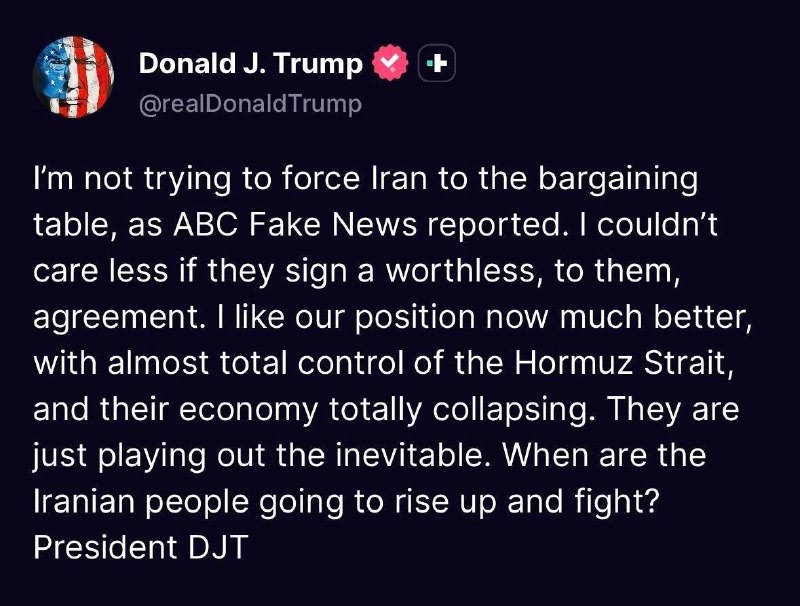
A report published by the War Fox Witness channel at 18:39 UTC said Trump told Fox News that Iran would face a "much stronger military response" if it responded to the latest US strikes. The item also carried his warning that Iran could be "totally wiped out" if it retaliated. The statement was reported before the later bulletins about the second wave.
The sequence matters. The warning was not a direct confirmation, in the available source item, of the locations subsequently named by the open-source accounts. It nevertheless supplied a political condition for interpreting them: the United States was publicly signalling that an Iranian response could bring additional military action. That makes the reported locations part of an escalation cycle, not merely a static list of damage sites.
The source chain also requires restraint. The strike locations were reported through open-source channels, an outlet citing local Iranian sources and a channel citing Tasnim. The Trump remarks were relayed through a separate Telegram account. The available items do not provide the full interview recording, a White House transcript or an independent US military statement confirming each named location.
A widening southern front
Monexus analysis: the common thread across the reports is geography. The named locations lie across Iran's southern coastal belt and its adjoining provinces, from Sistan and Baluchistan in the east to Kerman and Hormozgan in the south. Bandar Abbas and Qeshm are named in multiple reports, while Chabahar, Asaluyeh, Jiroft Airport, Konarak and the Kuhestak telecommunications centre appear in separate accounts.
That distribution makes the reports look broader than a single incident at one facility. It does not, on the evidence available, establish a single operational objective. A campaign can be described as geographically dispersed without the source material proving that every location was attacked, that the same command ordered the strikes or that the facilities shared one function.
The coastal concentration nevertheless gives the story its political weight. The reports put ports, an island, a communications site and an airport into the same public account of a widening US operation. If further reporting confirms that pattern, the immediate risk would be a cycle in which Iranian retaliation triggers another US wave, while uncertainty over damage and targets makes each side's public claims more difficult to verify.
What remains uncertain
The central facts are still contested by provenance. The available source items support the report that strikes were claimed across several named locations, but they do not establish the full target list, the damage, the number of aircraft involved or the casualty toll. The Kuhestak telecommunications-centre claim is especially dependent on a single relayed Iranian report. The available source items also do not specify the official US or Iranian position on the reported locations, so the dispute cannot be resolved from the thread alone.
The most important contradiction is not between the names on the lists. It is between the apparent breadth of the reported operation and the thinness of the verification record. The next useful evidence would be site-specific imagery, official statements from the parties involved, or independent reporting matching the reported locations to physical damage. Until then, the responsible conclusion is narrow: on 1 September 2026, open-source channels reported a second wave of US strikes across several parts of southern Iran, while the scale and consequences of that wave remained unclear.
Desk note: Monexus framed this as a reported expansion of a US strike campaign, with the location inventory treated as provisional and the communications-centre claim kept distinct from the more widely repeated city and facility reports.
Wire provenance
This editorial synthesis draws on the following public wire/social posts:
- https://t.me/osintlive/568897
- https://t.me/osintlive/568894
- https://t.me/osintlive/568890
- https://t.me/TheCradleMedia/67182
- https://t.me/FotrosResistancee/23563
- https://t.me/wfwitness/109252