Rezaei tells Washington its 'hellhole' is its own making, in coordinated SNSC messaging
Major General Mohsen Rezaei, secretary of Iran's Supreme National Security Council, used social media on 2 September 2026 to denounce US pressure in remarks amplified almost simultaneously by Iranian state media and Iran-aligned outlets abroad.
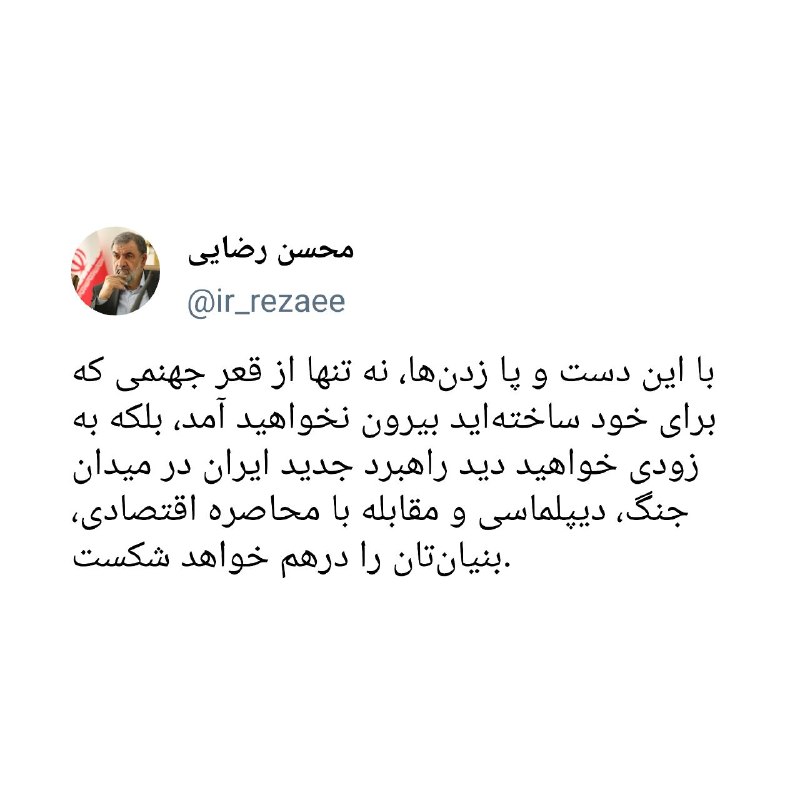
At 11:30 UTC on 2 September 2026, Iran's state-affiliated Press TV posted on Telegram that Major General Mohsen Rezaei, secretary of the country's Supreme National Security Council, had taken to social media to denounce Washington. The text, paraphrased by the channel, accused the United States of escalating pressure and warned of consequences; Iran's Tasnim news agency posted an English version of the same remarks at 11:20 UTC, the Beirut-based outlet The Cradle reposted them at 11:47 UTC, and a second pro-Iran channel, Witnesses of the Front, circulated its own version at 11:34 UTC.
What matters is not the heat of the language but the architecture of its release. A statement issued by the secretary of the SNSC, Iran's top security-policy body, and amplified within roughly half an hour across state media, a state-aligned foreign outlet, and a further Iran-friendly channel is the kind of footprint the country's messaging infrastructure produces when it wants a line on the record. The texts diverge only in idiom; the underlying claim does not.
What the texts actually say
The four available versions converge on the same core message. According to Press TV's paraphrase, the United States will not only fail to climb out of the situation it has created but will see the consequences fall on its own authors. Tasnim's English-lede distilled Rezaei's line as: "With such actions, not only will you fail to escape the hellhole you've created for yourselves, but you'll soon see your foundations will crumble." The Cradle reproduced the same wording, and Witnesses of the Front offered a near-identical translation.
The phrasing differs in tone between outlets but not in substance. Press TV alone frames the statement as a response to what it calls a "recent attack on Iran," without specifying the incident. The other three sources describe the trigger only in generic terms of "increasing pressure from the U.S." The available source items do not detail the underlying action further.
The choice of messenger
Rezaei's institutional position matters for how the line will be read. The Supreme National Security Council is the body through which Iran coordinates its most sensitive defence and foreign-policy files. That the SNSC secretary, rather than the foreign ministry or the regular military spokespeople, is the named author of a public English-language message suggests Tehran wants the framing attributed to its security-establishment core.
The Cradle, Tasnim and Press TV are not independent voices in this exchange: Press TV and Tasnim are Iranian state media, and The Cradle is an Iran-aligned outlet based in Beirut. Witnesses of the Front is also identified by its channel branding as pro-Iran. Reading the four posts together, the most natural interpretation, our assessment, is that the message was released through a planned distribution across official and aligned channels, designed to reach an English-language audience.
A counter-reading is plausible: that Rezaei, as a senior political figure with a domestic profile of his own, was simply using the platform he commands to make a statement, and that the cross-channel amplification followed automatically. The two readings are not mutually exclusive.
Where this leaves the picture
What the available source items establish is narrow but specific: on 2 September 2026, Iran's SNSC secretary publicly accused the United States of having created a "hellhole" for itself and warned, in the Tasnim gloss, that "your foundations will crumble." The text was amplified across Iranian state media and Iran-aligned channels within roughly twenty-seven minutes of the first post. The specific US action Press TV invokes as the trigger is not described in any of the four available items.
Independent reporting published elsewhere in late August and early September 2026 references active US strikes linked to Iran, including reporting on Iranian retaliation against Gulf neighbours and Iranian condemnation of a US strike on Hormuz Island, but none of those accounts is contained in the four source items this article draws on. Readers should therefore treat the specific trigger event as unconfirmed by the available evidence here, and treat the four posts as a record of how Tehran has chosen to frame the moment rather than as a confirmed account of the underlying event.
What they do establish is that Iran's security establishment, speaking through its secretary, is publicly telling Washington that the pressure will be reciprocated in kind, and that it wants the message received in English, on social media, before the day is out. That posture, more than any single sentence, is the news.
This article is built from four source items published between 11:20 UTC and 11:47 UTC on 2 September 2026. Because every available source is either Iranian state media or an Iran-aligned channel, the framing reflects Tehran's chosen message rather than an independent verification of the underlying US action. Independent wires had not, in the available material, published a contemporaneous account of the trigger event at the time of writing.
Wire provenance
This editorial synthesis draws on the following public wire/social posts:
- https://t.me/presstv/205213
- https://t.me/tasnimnews_en/33856
- https://t.me/thecradlemedia/67242
- https://t.me/TheCradleMedia/67242
- https://t.me/wfwitness/109446