Strike on Kfar Tebnit caps a day of Israeli escalation across Lebanon's south
An Israeli strike on the southern Lebanese town of Kfar Tebnit, reported within minutes of a low-altitude Israeli overflight of Beirut's southern suburbs, marks the most visible single point in a multi-theatre day of escalation along the Israel-Lebanon frontier.
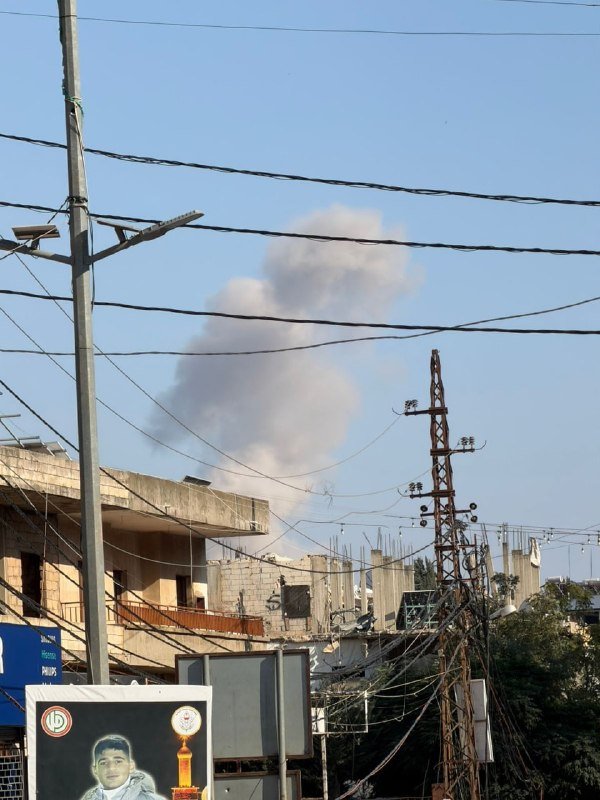
Three reports arrived within roughly ninety minutes of each other on 2 September 2026, and together they sketched the shape of a single operational day along the Israel-Lebanon frontier. At 12:08 UTC, the @wfwitness Telegram channel posted an eyewitness account of Israeli jets over the Dahieh, the densely populated southern suburb of Beirut, "at a very low altitude." At 12:34 UTC, Al-Mayadeen's south-Lebanon correspondent, relayed via @WarMonitors, reported that the Israeli military had carried out a "large explosion" in the town of Kfar Tebnit using ammonium nitrate. At 13:35 UTC, the Beirut-based outlet The Cradle carried the strike under a breaking-news banner, describing it as an Israeli strike on the town.
A fourth item in the same feed, timestamped 12:34 UTC, noted that Prime Minister Benjamin Netanyahu had visited Gaza the same morning. Monexus analysis: read in sequence, the three Lebanon dispatches describe a layered air operation rather than a single bolt from the blue. The 12:08 UTC sighting preceded the strike by roughly twenty-six minutes; the strike itself preceded The Cradle's headline by just over an hour. That gap is most plausibly editorial caution or the difficulty of confirming ground details from Beirut, rather than a late-arriving event. The Netanyahu Gaza-visit item is a separate dispatch on a separate front: Monexus assessment is that the timing is suggestive of a cabinet operating across two theatres in a single day, but the available thread does not establish coordination and this publication does not assert it.
A coordinated air picture
The three midday dispatches sit on a tight timeline. The 12:08 UTC eyewitness sighting of low-altitude jets over the Dahieh is one item; the 12:34 UTC strike on Kfar Tebnit is a second; the 13:35 UTC Cradle headline is the third. Two of the three (Al-Mayadeen's correspondent via @WarMonitors, and The Cradle) carry the strike itself; the third (@wfwitness) is a separate, earlier eyewitness post and should be read on its own terms. The Cradle's delay relative to Al-Mayadeen's southern correspondent suggests either editorial caution or difficulty confirming ground details from Beirut, rather than a late-arriving event; that reading is Monexus analysis, not a claim about The Cradle's editorial process.
The juxtaposition of a high-profile political visit to one front and an active strike package on a second front within the same 24-hour window is worth noting without overreading. Two theatres active on the same day is, on this thread, an observation, not a finding about a single coordinated decision. Monexus finds that the available items establish simultaneity, not causation.
What the dominant framing leaves out
Western wire reporting of the Lebanon front has tended to frame Israeli strikes as responses to rocket or anti-tank fire from non-state actors based in the south. That framing is not invented: it is the standard counter-fire narrative carried by Israeli and Western spokespeople and has been the dominant frame in mainstream coverage of the northern border. Monexus analysis: what that framing tends to elide in this case is the character of the target reported. The available source items describe the strike location as "the town of Kfar Tebnit" without specifying whether the munition struck a residential structure, a compound, a roadway, or an open area; that detail is not in the thread and this publication does not assert it.
The reporting from Al-Mayadeen and The Cradle, both outlets that consistently carry a southern-Lebanon and resistance-axis perspective, supplies the civilian-side view that wire coverage often omits. Their accounts are primary documentation of what was heard, seen and reported on the ground, not neutral adjudication of Israeli intent. They are also the only two named outlets in the available feed to have reported the strike at all on this timeline. The ammonium-nitrate claim in particular is sourced solely to Al-Mayadeen's south-Lebanon correspondent via @WarMonitors; The Cradle's breaking-news banner refers only to "an explosion" and does not specify the charge.
Structural read: a routine that has stopped being routine
Monexus analysis: the more telling pattern is the one that does not require external theory to name. On the available thread, three Lebanon dispatches from two named outlets and one eyewitness channel arrived inside ninety minutes; a fourth dispatch placed the prime minister on a separate front in the same morning window. None of the items alone is decisive; together, they describe a day on which the air activity was sustained across more than an hour and the political bandwidth was visibly split between two active operations. The escalation is not in any single strike on this thread; it is in the simultaneity of the Lebanon strike, the Dahieh overflight, and the Gaza visit. Whether 2 September is a single-day spike or the leading edge of a broader northern operation is not established by these items.
That reading has consequences the headlines do not capture on the available evidence. Monexus finds that the feed establishes only the air activity itself; it does not establish a casualty count, a target type, a Hezbollah response, or a Lebanese-government response on the record. UNIFIL, the UN peacekeeping force that operates along the Blue Line, is not referenced in any of the five thread items, and this article has not independently established whether it commented on the day's events.
Stakes and what to watch
The near-term question is whether 2 September marks a single-day spike or the leading edge of a broader northern operation. The available source items do not specify Israeli intent beyond the strike itself, and they do not contain any Hezbollah or Lebanese government response on the record. UNIFIL, the UN peacekeeping force that operates along the Blue Line, is not referenced in the feed, and this article has not independently established whether it has commented on the day's events. The most that can be said from these dispatches is that the air activity was sustained across more than an hour, that two distinct reporting chains (Al-Mayadeen's southern correspondent via @WarMonitors, and The Cradle's editorial desk) confirmed the Kfar Tebnit strike, that the eyewitness sighting of low-altitude jets over the Dahieh arrived in a separate @wfwitness post rather than as part of the Kfar Tebnit reporting chain, and that the timing overlapped with a senior political visit to a separate front.
The dispute over what was actually struck in Kfar Tebnit, and over what munition was used, will be settled, if at all, by satellite imagery and on-the-ground reporting that has not yet appeared in the feeds available to this publication. The political question for the day, as far as these five items allow a read, is that cabinet bandwidth was being used on multiple axes within the same 24-hour window. Monexus assessment: that is simultaneity, not a settled finding about coordination, and the thread does not authorise a stronger claim.
Monexus framed this piece around the strike itself and the cross-theatre air activity that bracketed it, rather than around a counter-narrative from Israeli sources. The available feeds on this timeline are dominated by southern-Lebanon and resistance-axis outlets; we have noted their perspective explicitly, separated the @wfwitness eyewitness post from the Al-Mayadeen correspondent's ammonium-nitrate claim, and have not asserted Israeli intent beyond the strike itself.
Wire provenance
This editorial synthesis draws on the following public wire/social posts:
- https://t.me/thecradlemedia/67258
- https://t.me/TheCradleMedia/67258
- https://t.me/WarMonitors/45436
- https://t.me/WarMonitors/45437
- https://t.me/wfwitness/109448