Netanyahu, on the ground in Gaza, says Israel holds 60% of the Strip and will not withdraw
Visiting troops near the Yellow Line on 2 September 2026, the Israeli prime minister said the military controls 60% of Gaza and will stay, framing an open-ended presence rather than a timed pullback.
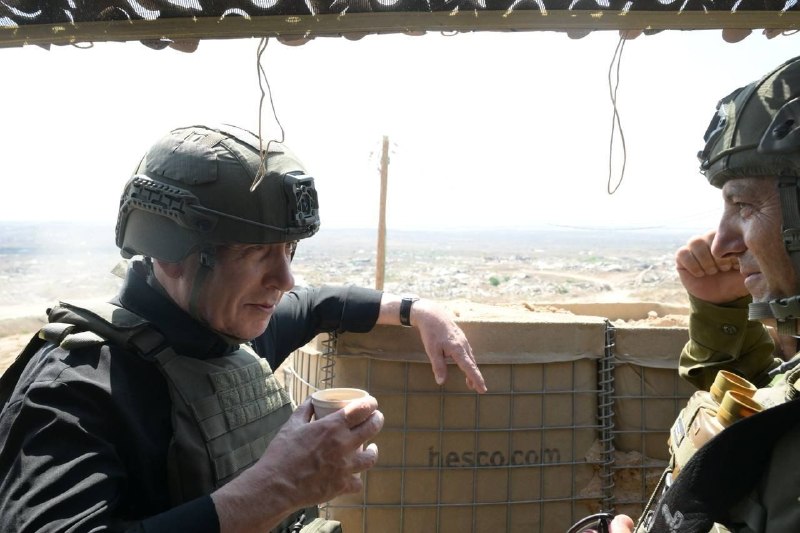
Benjamin Netanyahu visited Israeli troops near the Yellow Line inside the Gaza Strip on 2 September 2026 and told them the military already controls 60% of the territory and has no intention of pulling back. Video of the visit was relayed within minutes by open-source monitoring channels, and a clip was posted to X by user BowesChay. "We control the territory. We are not withdrawing. We are staying on this line," Netanyahu said, in remarks carried by Open Source Intel, ClashReport and the English-language aggregator abuali. "We control 60% of the Gaza Strip, and there is still more to come, because we are eliminating the terror."
The statement is the most explicit territorial claim the prime minister has made on the ground during this phase of the war, and it collapses the rhetorical distance between a temporary military operation and an indefinite presence. Israel is now openly asserting control over most of a strip it had previously framed as hostile ground to be cleared, not held. That shift reframes the diplomacy around hostages, humanitarian access and reconstruction: the question is no longer whether Israel leaves, but on what terms a residual presence is normalised.
What Netanyahu said, and where
The visit took place near the Yellow Line, the informal ceasefire demarcation referenced in the Gaza Alanpa relay. In footage amplified on X by BowesChay, the prime minister told assembled soldiers: "Yesterday, we took out Hamas's head of the Shin Bet. Gaza will no longer pose a threat to Israel." That line is Netanyahu's own phrasing as carried by the relays; the available source items do not name the individual he was referring to, and Monexus has not independently identified the figure. The phrase "head of Hamas's Shin Bet" reflects the prime minister's words, not an institutional title this article can confirm.
ClashReport posted a near-identical transcript of the prime minister's comments at 12:34 UTC on 2 September, the English-language aggregator abuali ran the same lines at 12:32 UTC, and Open Source Intel followed at 13:08 UTC. The convergence of three independent Telegram relays plus the BowesChay video gives the wording high confidence; the only variation across transcripts is minor phrasing around "more to come" and the framing of objectives as disarming Hamas and demilitarising Gaza, as carried by Gaza Alanpa.
The Yellow Line itself is not an internationally agreed border. It is a military demarcation inside the strip, referenced in the available relays as the forward edge of Israeli positioning, and it is not formally recognised as a permanent boundary in the thread evidence. By choosing it as the backdrop for the speech, the prime minister visually anchored his claim to the current forward edge of Israeli ground forces, not to any negotiated frontier.
What the relay ecosystem is, and is not, showing
The available source items are a mix of conflict-monitoring Telegram channels and one X post, all carrying the prime minister's remarks within minutes of each other. The framing available in those relays is that of analysts relaying a political statement, rather than a battlefield briefing. The 60% figure is a stated government claim, not a surveyed territorial fact, and the thread evidence does not contain independent ground-truthing of the proportion of the strip under active Israeli control.
What the relays do show, in their near-identical wording, is that the prime minister's office treated the 60% line and the "not withdrawing" line as a single message worth pushing in real time across multiple platforms. That is consistent with a communications operation aimed at a domestic audience: the Israeli public, already conditioned to hear progress in percentage terms, is being told that the war is entering a holding phase rather than a wind-down.
What "60%" actually means in the available evidence
The phrase "we control 60% of the strip" has been doing heavy lifting in the Israeli information environment, but in the thread evidence the figure appears only as a verbal claim by the prime minister on the ground. No operational definition of "control" is offered in the source items: whether it refers to area east of the Yellow Line where Israeli ground forces operate regularly, to towns and refugee camps cleared since the war began, or to a wider zone dominated by fire, is not specified in the relays. The remaining 40% of the strip, including much of the southern governorates, is not addressed in the thread evidence at all.
That distinction matters for the hostage file. Israel has framed hostage recovery as a central humanitarian justification for the war; in the relays, Netanyahu frames the capture he described as "Hamas's head of the Shin Bet" as proof of progress. The available source items do not contain evidence on whether hostage returns have tracked the territorial claim, so the link between the two cannot be drawn from this thread. What can be drawn is that the prime minister is using a counter-intelligence claim and a territorial percentage together, in one set of remarks, to argue that the campaign's objectives are being met.
Stakes and what to watch next
The political meaning of the visit is straightforward on the available evidence: the prime minister is preparing the Israeli public for an open-ended presence in Gaza, not a withdrawal. The diplomatic meaning is harder to read from the relays alone. Egypt, Qatar and the United States have publicly committed at various points to a framework in which reconstruction proceeds alongside or after a phased pullback; Netanyahu's "we are not withdrawing" line, as relayed, sits directly across that framework, although no mediator response is contained in the thread evidence.
Three dates will determine whether the speech becomes a pivot or a slogan. First, any Israeli cabinet decision to formalise the Yellow Line as an administrative boundary, which would convert a tactical position into policy; the thread evidence does not specify whether such a decision is pending. Second, the next round of hostage negotiations in Doha, where the 60% claim will be tested against mediator demands for a pullback in exchange for releases. Third, the UN General Assembly debate in late September, where Palestinian state recognition is once again on the agenda and an Israeli prime minister who has publicly claimed most of Gaza by posture will be a hard partner for any Western government still claiming a two-state horizon.
For now, the available source items do not specify whether the prime minister's territorial claim has been challenged by the IDF general staff, by the war cabinet, or by Israel's principal mediator, the United States. Monexus will update this article when those responses are on the record.
Desk note: Monexus frames the 2 September visit as a stated government claim of territorial control, not as a measured fact on the ground. Netanyahu's reference to a captured "head of Hamas's Shin Bet" is reported as his own phrasing as relayed; the available source items do not name the individual, and identification lies outside this thread. Israeli security concerns are reported at face value as carried by the relays, and the open-ended occupation question is treated as the political core of the story.
Wire provenance
This editorial synthesis draws on the following public wire/social posts:
- https://t.me/osintlive/569169
- https://t.me/ClashReport/94708
- https://t.me/englishabuali/78655
- https://t.me/gazaalanpa/24926
- https://x.com/BowesChay/status/2095144756820992151