Trump disowns an Iran deal in real time, claiming US 'almost total' control of the Strait of Hormuz
In late-night posts on 1 September 2026, the US president publicly rejected a deal on Tehran's terms and asserted naval dominance over the world's most critical oil chokepoint, leaving the negotiating posture in limbo.
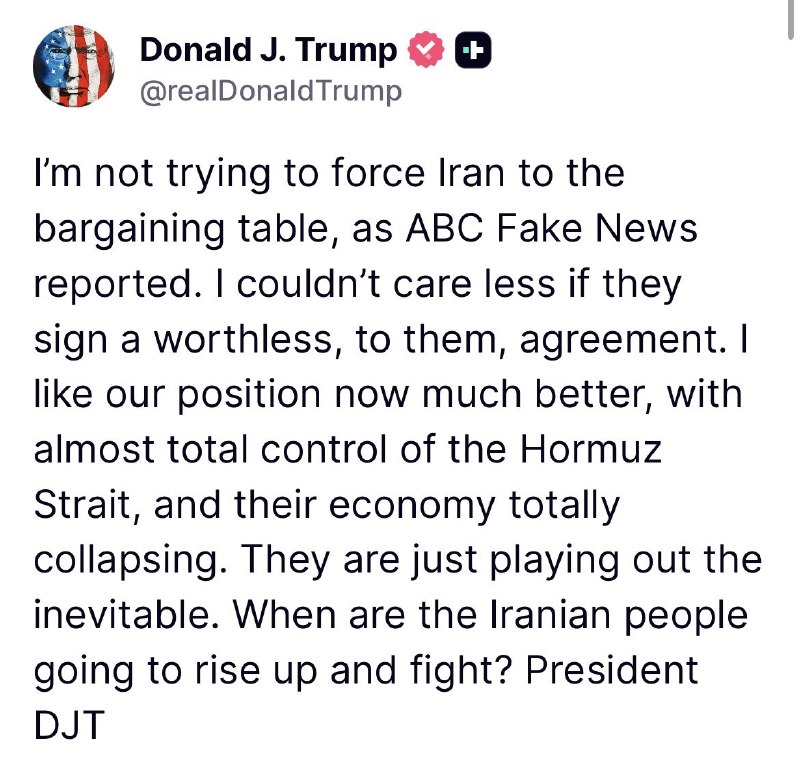
At 01:14 UTC on 2 September 2026, a flurry of identical text began propagating across Telegram channels that track geopolitical open-source intelligence. The posts carried a statement from US President Donald Trump, distributed within minutes of issuance and reproduced verbatim by channels including Warfront Witness, GeoPolitical Watch, Russian-intel aggregator RN Intel, Middle East Spectator, and the OSINTdefender network.
Trump's words, quoted across at least five independent Telegram relays, were unambiguous: "I'm not trying to force Iran to the bargaining table, as ABC Fake News reported. I couldn't care less if they sign a worthless, to them, agreement. I like our position now much better." The president then added that the United States holds "almost total" control of the Strait of Hormuz, and asked: "When are the Iranian people going to rise up and fight?" The question mark is rhetorical. The intent is not.
What the president actually said
The text reads as a three-part message, packaged in the cadence that has become characteristic of Trump's Truth Social and cross-posted commentary: a denial of intent, a dismissal of the negotiating counterpart, and a claim of strategic leverage. The denial targets an ABC News report that the administration was attempting to coerce Tehran back to talks. The dismissal is directed at Iran itself, framed as an actor whose signature on an agreement would, in the president's phrasing, amount to nothing. The leverage claim is geographic. By asserting near-total control of the waterway through which roughly a fifth of seaborne oil transits, the post converts geography into a coercive asset.
Middle East Spectator's relay, timestamped 01:20 UTC, framed the message as the president "crashing out" on Iran, while RN Intel and GeoPolitical Watch led with the Strait-of-Hormuz formulation. OSINTdefender's two near-simultaneous posts, at 01:33 UTC, foregrounded Trump's question about whether the Iranian people would "rise up and fight", language that goes beyond routine pressure-talk and into explicit appeals to regime change by an incumbent head of state.
The chokepoint, in plain numbers
The Strait of Hormuz is the narrow passage between Iran and the Arabian Peninsula through which Persian Gulf crude reaches global markets. The available source items do not specify current throughput figures or transit volumes, but the chokepoint's strategic role is well established: it is the single most consequential oil transit lane on the planet. A US claim of "almost total" control is therefore a claim about something materially significant, not a rhetorical flourish.
The strategic question Tehran will be weighing overnight is whether "almost total" is operational or aspirational. US naval presence in the Gulf has been substantial for decades. Iran has invested in asymmetric capabilities, fast-attack craft, anti-ship missiles, mining capacity, explicitly designed to contest that presence. The available source items do not specify the current force posture or any recent incident in the waterway, which means the gap between Trump's claim and the on-the-water reality cannot be verified from these posts alone.
Why now: a deal on Tehran's terms
The "worthless agreement" the president dismisses is the unfinished business of the diplomatic track that ran through spring and early summer 2026. The available source items do not specify the text of that deal or its provenance, so any account of its substantive terms must wait for primary documents. What the posts make clear is that the administration has decided, at least rhetorically, that a deal whose value flows disproportionately to Iran is worse than no deal at all, a posture closer to maximum pressure than to the negotiated settlement that had been the implicit end-state of earlier rounds.
This is not unusual in US-Iran posture cycles. The pattern is well-rehearsed: a diplomatic opening, a maximalist Iranian counter-offer, a public walkaway, a return to sanctions and force deployments, and a later resumption of talks under different terms. What is unusual about this round is the public delivery mechanism. By issuing the rejection as a Truth Social-style statement amplified through Telegram relays rather than through the State Department or the special-envoy channel, the president has made the posture presidential and personal simultaneously, narrowing the room for technocratic re-entry.
What it sets up
Three near-term pressures follow from the posts as written.
First, the negotiating track is effectively suspended until either Tehran escalates to force the US back to the table or Washington re-issues a more conciliatory formulation. The available source items do not specify which Iranian officials, if any, have responded, and Monexus has not independently established whether Iran's foreign ministry or the office of the supreme national security council has issued a counter-statement.
Second, oil-market positioning will respond to the Strait-of-Hormuz claim. The "almost total" phrasing is a signal, not a guarantee, but markets price signals. The available source items do not contain price prints, so the market reaction will need to be tracked through separate reporting.
Third, the regime-change language raises the cost of any future climb-down. Having publicly asked when the Iranian people will rise up, the president has made a deal framed as rewarding the current order in Tehran politically awkward at home, regardless of its merits abroad. That is a constraint on US flexibility as much as on Iran's.
Monexus assessment: read the posts as a posture reset, not as a policy document. The administration is signalling that it prefers the leverage of geography and sanctions over the leverage of a signed deal on terms it judges unfavourable. The Strait of Hormuz line is the substantive content; the regime-change question is the political wrapper. Both are aimed at a domestic audience as much as at Tehran, and both narrow the off-ramp that existed forty-eight hours ago.
Desk note: the wire coverage of this exchange is at this writing limited to the Telegram relays of Trump's statement and to his own posts. We have flagged the absence of an Iranian official response and the absence of a State Department or Pentagon corroborating statement as the two open items to watch in the next 24 hours.
Wire provenance
This editorial synthesis draws on the following public wire/social posts:
- https://t.me/wfwitness/109382
- https://t.me/GeoPWatch/39401
- https://t.me/rnintel/66004
- https://t.me/Middle_East_Spectator/36248
- https://t.me/osintlive/569063
- https://t.me/osintlive/569064