Trump proposes "Trump Strait" for Hormuz as tanker blast raises fresh questions over corridor control
A Truth Social post floats renaming the Strait of Hormuz after the US president two days after an oil tanker hit a naval mine in the waterway, killing two crew members.
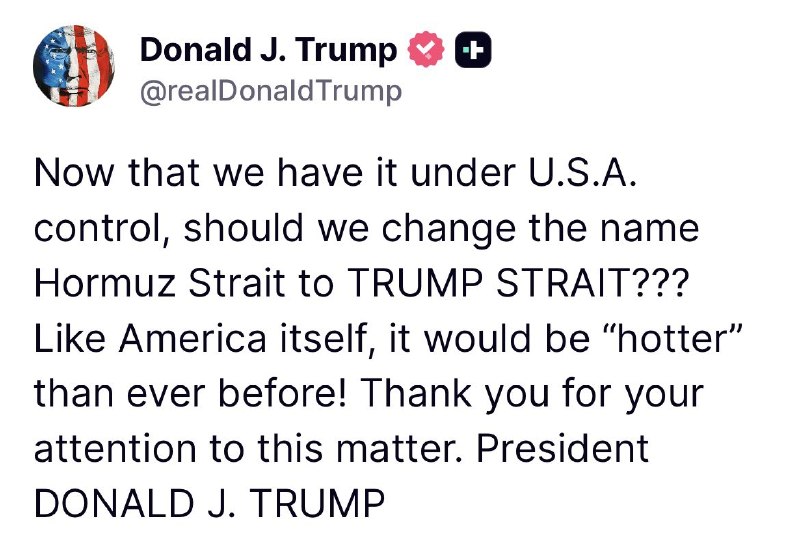
At 17:11 UTC on 2 September 2026, the open-source intelligence account OSINTdefender reposted to Telegram a Truth Social message from US President Donald Trump in which the sitting president suggested renaming the Strait of Hormuz the "Trump Strait." The post was framed on the platform as likely a joke. It arrived two days after an oil tanker detonated on a naval mine inside the waterway and killed two crew members, according to a separate Telegram channel that posted the incident at 16:42 UTC the same day.
The Strait of Hormuz is the narrow chokepoint between Iran and the Arabian Peninsula through which roughly a fifth of global seaborne oil normally transits. On 2 September 2026, Trump took to Truth Social to argue that, with the corridor now under US control, its name ought to change. Two days earlier, an oil tanker had hit a naval mine in the strait. The juxtaposition is the story: a rhetorical claim of dominion laid on top of an unresolved military fact on the water.
What Trump actually wrote
According to the post captured by Middle East Eye and amplified by the Telegram channel English Abuali, Trump's Truth Social message reads in part: "Now that the strait is under U.S.A. control, should we change its name Hormuz Strait to the Trump Strait??? Like America itself, it will be 'hotter' than ever before." Middle East Eye, reporting on the post, noted that control of the waterway "remains contested amid the US war on Iran." The OSINTdefender Telegram account reposted the same item at 17:11 UTC on 2 September 2026, flagging the post as "likely a joke." The geography channel GeoPWatch added, also at 16:41 UTC, that the rename proposal is contingent on the US claim that the strait "already is under U.S.A. control."
The framing matters because the post equates a contested military situation with a settled property fact. Renaming a corridor is the sort of move governments undertake when they consider control durable. Declaring that a corridor is "under U.S.A. control" while a vessel can still strike a mine inside it is a different category of statement.
The mine strike, and what is known
At 16:42 UTC on 2 September 2026, the Telegram channel Megatron Ron posted a breaking item with a US–Iran flag composite: an oil tanker had "exploded after hitting a naval mine in the Strait of Hormuz 2 days ago, resulting in two deaths among the crew." The same post noted that Trump "has stated several times that all mines have been cleared."
That tension is the load-bearing fact of the day. If the waterway has been cleared to a standard the US commander-in-chief is willing to assert publicly, a tanker strike on a live mine inside the strait is an operational failure with a body count. If the waterway has not been cleared to that standard, the rhetorical claim of control overstates the underlying reality. The cited posts do not specify which ship was hit, its flag, its cargo, or which crew members died; nor do they identify the source of the mine or attribute the strike. They record only that two crew died, that a mine was the instrument, and that the incident occurred roughly two days before Trump's post.
Counter-read: the joke frame
The most natural reading of the post, advanced explicitly by OSINTdefender and implied in the headlines chosen by Middle East Eye and English Abuali, is that the renaming is rhetorical theatre, not policy. American presidents have, at various points, floated name changes for geographic features as political signalling rather than legal process. The Board on Geographic Names, the federal body that adjudicates such matters domestically, has no jurisdiction over international waterways.
A second reading is more uncomfortable: that the joke is itself the message. The post tells domestic and foreign audiences that the US considers the corridor its sphere of operation in a way that allows for branding it. Whether or not the rename is pursued through any formal channel, the rhetorical claim of dominion is on the record. Iranian state media have, in past coverage of US-Iran tensions, framed any unilateral renaming as a provocation; the cited posts do not specify an Iranian response to this specific post.
What this sits inside
The Strait of Hormuz has been the world's most consequential oil chokepoint for a half-century. Past confrontations, including the 1980s tanker war and the 2019 seizure of commercial vessels, have shown that even limited disruption inside the strait moves global crude prices within hours. The cited posts do not provide pricing data; they do not specify a current benchmark move. What they show is a specific pattern: a US administration comfortable asserting control in declarative form, an Iranian-aligned mine-laying capacity that can still inflict casualties, and a news environment that processes the contradiction through the lens of a name-change joke.
There is a longer game visible beneath the surface. The US-Iran track has, in recent weeks, included reports of a "peace accord" signing scheduled for Friday in Geneva, flagged in Middle East Eye's coverage of 2 September 2026. A unilateral American claim of dominion over the strait, even framed as humour, would sit uneasily alongside a peace-deal tableau in a European capital. The cited posts do not specify whether the rename post and the Geneva process are coordinated, or whether they are in tension. The simplest reading is that the post is a domestic-audience artefact that has not been cleared with negotiators.
Stakes and what to watch
If the strait genuinely is under US operational control to a standard that prevents further mine incidents, the 31 August tanker strike is a single failure with two fatalities and no strategic content. If it is not, then the rhetorical claim and the operational reality are diverging, and the divergence will widen until either a fresh incident forces a clarification or a verified clearance regime is published. The benchmark to watch is whether the Trump administration publicly reconciles the "all mines cleared" line with the 31 August strike, and whether Iran's official channels respond to the rename proposal. The Friday Geneva signing cited in Middle East Eye's coverage is the next fixed event in the calendar; any inconsistency between the rhetoric of dominion and the diplomacy of peace will become visible there, or in the run-up to it.
The available source items do not specify the tanker's flag, owner, cargo, or the identity of the deceased crew. They also do not specify the provenance of the mine. Those gaps are the limits of what this article can responsibly assert.
Desk note: Monexus read the situation as the contradiction it is, not as either a clean claim of victory or a clean joke. Wire headlines leaned on the rename angle; this publication held space for the mine strike and the two dead crew, because that is the harder fact in the room.
Wire provenance
This editorial synthesis draws on the following public wire/social posts:
- https://x.com/MiddleEastEye/status/2095185607651729652
- https://www.middleeasteye.net/live/live-us-and-iran-confirm-peace-accord-signing-set-friday-geneva
- https://t.me/englishabuali/78667
- https://t.me/osintlive/569237
- https://t.me/GeoPWatch/39421
- https://t.me/megatron_ron/16658