U.S. tanker strikes in Hormuz and a disputed civilian-casualty claim out of Kuhestak collide on a single 2 September timeline
Two Iranian government tankers were struck in the Strait of Hormuz under a new "tanker for tanker" policy, while Iranian officials said a U.S. strike hit a wedding in Kuhestak, killing four including a child. Both landed inside a five-hour window on 2 September 2026, alongside a Trump call for Iranian uprising.
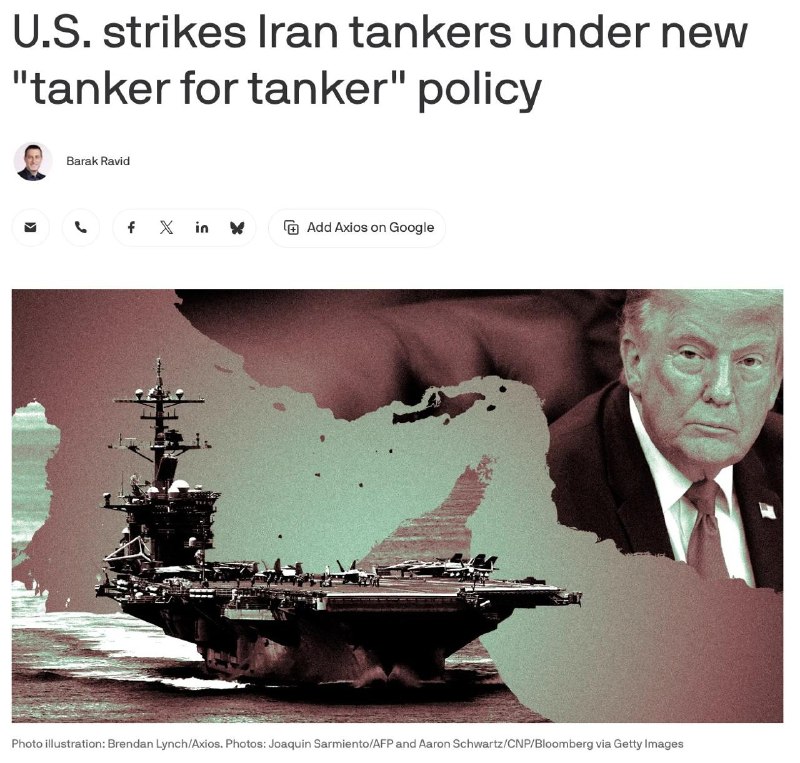
The U.S. military struck two Iranian government tankers in the Strait of Hormuz on Tuesday under a newly declared "tanker for tanker" policy that matches Iranian vessel losses against any commercial ship Iran or its proxies hit in the waterway, according to "U.S. officials" as relayed by the ClashReport Telegram channel at 04:45 UTC on 2 September 2026. Hours later, the same channel, citing the New York Times, reported at 05:08 UTC that Iranian officials said a U.S. strike had hit a wedding in Kuhestak, killing four people, including a child, and wounding 53 others. The same news cycle carried President Donald Trump publicly asking, "When are the Iranian people going to rise up and fight?" and dismissing the idea that he is trying to drive Tehran to a deal.
Two claims, two different sourcing chains, and one short news cycle. The tanker strike sits in a relay chain from "U.S. officials" via a Telegram channel. The Kuhestak casualty count sits in a relay chain from Iranian officials via the New York Times via Telegram. Neither has been independently established by the cited items alone, and independent reporting cited elsewhere on the same event gives materially different numbers. Monexus reads the 2 September 2026 timeline as the moment a declared maritime doctrine was used in daylight, the moment a contested civilian-casualty claim attached to it, and the moment a sitting U.S. president publicly urged the Iranian public to revolt, all within roughly five hours.
The Hormuz operation
The "tanker for tanker" framing, as relayed by ClashReport at 04:45 UTC on 2 September 2026, is symmetrical on its face: each time Iran or its allied forces damage a commercial ship in the strait, a corresponding Iranian government vessel is hit. The two Iranian government tankers struck in this action are described in the cited item as the first explicit applications of the rule, though the body of the relay does not specify the strike outcome or the time of impact. The 04:45 UTC publication time is the Telegram relay time, not a confirmed weapons-release timestamp.
The operational signal that can be read from the cited items is plain. The Strait of Hormuz is one of the world's most economically sensitive oil corridors, and any sustained attrition against Iranian government tonnage compresses Tehran's tolerance for risk in the waterway, because Iran's own tanker fleet carries cargo the rest of the world is already reluctant to touch. By naming the doctrine publicly, the U.S. side, per the relay, is also signalling to commercial insurers, shippers and Iran's oil customers that the operation is meant as a campaign, not a single raid. The available source items do not specify which U.S. command element directed the strike, do not confirm the operational outcome against the two tankers beyond the word "struck," and do not specify whether Iranian retaliation has been recorded since the relay. Those gaps are flagged, not filled.
The Kuhestak strike
The Kuhestak incident arrived on the same channel six minutes after the tanker relay, at 05:08 UTC, citing the New York Times, with the casualty figures (four dead, including one child; 53 wounded) and the target description (a wedding) attributed to Iranian officials. Those figures and that target description are Iranian-official claims at this stage and should be read as such.
Where the draft previously placed Kuhestak "on the Iranian side of the strait," the cited thread items do not in fact specify that geographic relationship. The supplied relay states only that Iranian officials said the strike hit Kuhestak, without naming a province, coordinates or proximity to Hormuz. Independent reporting cited elsewhere on this event gives materially different casualty counts from the same window (outlets reporting two killed, others reporting five killed and an injury count around 50 rather than 53). The four-and-53 figure therefore cannot be treated as established, and Monexus treats the Iranian-official count as a claim with explicit sourcing caveats, not as a verified tally. The available source items do not specify whether U.S. Central Command has acknowledged any strike at Kuhestak, whether the strike is paired with the tanker doctrine, or what U.S. platform, if any, was involved.
The political weight, regardless of the targeting review, is that civilian-casualty claims against U.S. forces are now attached to the same news cycle as a named maritime doctrine and a presidential call for Iranian unrest. That sequence is what makes the 2 September 2026 window consequential, not any single casualty number in isolation. The narrative cost falls on Washington even before the underlying facts are established, and the Iranian side now has a ready-made civilian-harm frame to attach to whatever the verified count turns out to be.
The political line from Washington
Trump's own framing, posted in the early hours of 2 September 2026 UTC and relayed by both the ClashReport and Open Source Intelligence Telegram feeds, makes no pretense of restraint. "When are the Iranian people going to rise up and fight?" the post reads. He then explicitly denies trying to force Iran to a deal, says he "couldn't care less if they sign a worthless, to them, agreement," and describes his position as preferable because of recent U.S. military gains. The phrasing collapses the two halves of the U.S. posture, kinetic escalation and political subversion, into a single rhetorical package.
The structural cost is that any future Iranian leadership, even one inclined to negotiate, will have to treat Washington as a power that openly demands its population revolt. That raises the political price of any deal and narrows the space in which a stable settlement could be struck. The available source items do not specify whether the uprising call reflects a formal U.S. policy decision or the president's personal preference; they do specify that the words were posted under his name, and they do not include any walk-back from a senior U.S. official in the cited channels.
How Tehran is reading it
Iranian state media is reading the same set of events as a coordinated regime-change operation rather than a maritime dispute. A Tasnim News English post at 02:18 UTC on 2 September 2026 framed Trump's posture as evidence that "military attacks and economic blockade have failed," described Trump as calling for "chaos and rebellion," and characterised the U.S. line as a mix of "false claims" and "usual bluster." That framing is state media and should be treated as such, but the structural reading is consistent across the Iranian information space: the tanker strike, the Kuhestak strike and the regime-change rhetoric are read as components of one campaign, not three unrelated events.
Two reads now compete for the dominant frame. The first is that the U.S. is running a coercive campaign with a defined ceiling: tighten maritime pressure, push Iran's revenue down, and hope internal politics produce a more pliable leadership. The second is that the ceiling has been removed: tanker strikes, a contested civilian-casualty claim, and explicit calls for uprising together amount to maximum pressure with no diplomatic off-ramp. The cited thread does not specify which read is correct. What it does specify is that the U.S. government, in its own public words on 2 September 2026, is no longer holding out the possibility of a deal as the goal of the current operation, and that Iran's information apparatus is now operating on the assumption that the campaign is unlimited.
What the cited items do not establish
Monexus analysis: the relay-only provenance of the tanker strike ("U.S. officials" via Telegram) and the Kuhestak claim (Iranian officials via the New York Times via Telegram) means the article cannot assign strike outcomes, casualty counts, or platform attributions as confirmed facts. The thread does not state that the two tankers were sunk, only that they were struck; it does not specify which U.S. element conducted the strike; it does not place Kuhestak geographically relative to the Strait of Hormuz; it does not include a U.S. military acknowledgement of any Kuhestak strike; and it does not specify whether Iranian retaliatory action has been recorded in the hours since the relays. Each of those gaps is left as a gap, not papered over.
The next binding test is independent corroboration on three questions: what happened to the two struck tankers, what happened on the ground in Kuhestak, and whether the U.S. side acknowledges any involvement at all. Until at least one of those gets a primary-source confirmation, the 2 September 2026 window is a relay-cycle story on both sides, and the headline facts should be quoted with their attribution chains attached.
Desk note: Monexus treated this as a single escalation timeline rather than three separate stories because the thread places the tanker strike, the Kuhestak incident and Trump's regime-change rhetoric inside a roughly five-hour window on 2 September 2026. A previously drafted geographic claim placing Kuhestak "on the Iranian side of the strait" has been removed because the supplied relay does not specify that relationship. The Kuhestak casualty figures remain Iranian-official via a New York Times relay and have not been independently verified by this publication; independent outlets cited elsewhere on this event report different casualty counts for the same window, and the article reflects that divergence rather than asserting a settled number. Iranian state-media framing is included at the same structural weight as U.S. framing, with explicit sourcing caveats.
Wire provenance
This editorial synthesis draws on the following public wire/social posts:
- https://t.me/ClashReport/94645
- https://t.me/ClashReport/94639
- https://t.me/ClashReport/94638
- https://t.me/tasnimnews_en/33782
- https://t.me/osintlive/569065