In one news cycle: G20 legitimises digital assets, SEC moves on tokenised rails, and a bond rout runs underneath
Within a 19-hour window, G20 finance chiefs formally recognised digital assets as part of economic growth, the SEC published a transfer-agent rule that contemplates blockchain settlement and a 24-hour-trading agenda, and a Reuters-sourced wire reported a global bond selloff pushing yields to multi-decade highs. The same feed also carried US military strikes on Iran.
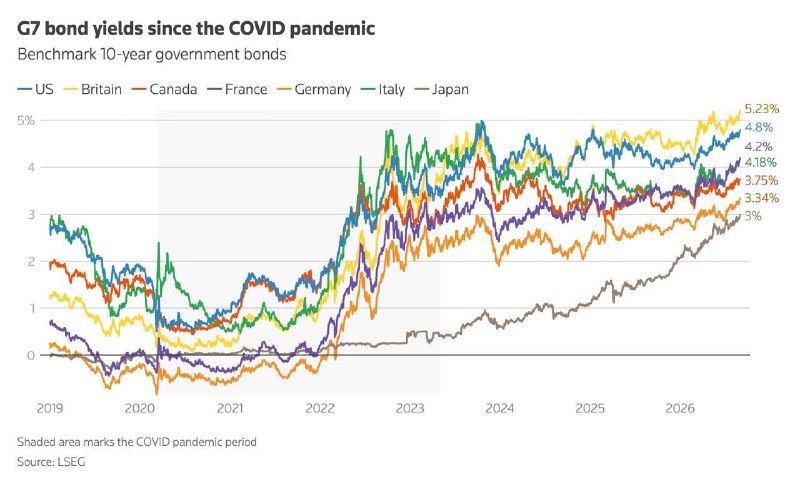
At 11:00 UTC on 2 September 2026, a Cointelegram wire carrying Reuters reporting crossed the terminals: a global bond selloff had pushed yields to multi-decade highs on inflation fears. The previous G20 finance chiefs' communiqué, logged by the same feed at 01:35 UTC on the same day, had formally recognised digital assets' role in economic growth and pledged clearer regulatory pathways and improved cross-border payment systems. Between those two wires sits the SEC, which on 1 September 2026 both proposed modernising transfer-agent rules to accommodate blockchain use in securities offerings and share transfers (16:06 UTC) and published the agenda and panellists for a 17 September 2026 roundtable on preparations for 24-hour trading (21:40 UTC). The same feed also carried an AP-sourced report at 16:55 UTC on 1 September 2026 that the US had carried out military strikes targeting Iran as the conflict flared again. Five wires, one news cycle, all of them consequential for crypto markets, and all of them running through the same Telegram channel from a single publisher.
The political centre of gravity on digital assets is shifting, and the G20 line is the clearest marker. The body's finance-ministry communiqués have, in prior cycles, treated digital assets as adjacent to the formal agenda. The 01:35 UTC wire characterises the new formulation as operational: recognition of a role in growth, with the deliverable being regulatory clarity and payment interoperability. Read alongside the SEC's two announcements on 1 September 2026, the policy perimeter is being drawn in the same direction by both a multilateral political body and the principal US market regulator. The question is no longer whether digital assets enter that perimeter. It is whether the perimeter is built fast enough to be coherent before the next stress event in sovereign debt tests it.
What the G20 wire actually says
The 01:35 UTC wire is precise about the language ministers used: recognition of a role in economic growth, a commitment to clearer regulatory pathways, and a pledge of improved cross-border payment systems. The available source items do not specify whether this is the first time the G20 finance track has used this formulation, nor do they compare it to prior communiqués. What the wire does support is the observation that the language moves from monitoring to operational endorsement, and that emerging-market ministries which take their cues from G20 working-group vocabulary now have cover to license rather than restrict.
The structural frame, expressed in plain editorial terms: when a multilateral body with this kind of membership shifts from caution to language of integration, the resistance from legacy gatekeepers tends to harden, not soften. Banks and exchanges that profit from the friction of moving value across borders are not going to quietly cede the rails. Monexus analysis: the most natural reading of the wire is that ministers now treat the asset class as too operationally important to leave in a grey zone; the alternative reading is that G20 communiqués regularly compress under media pressure and that the prior cycle of G20 statements on crypto delivered less than the language implied. The dominant reading holds because the wire ties the recognition to specific deliverables (regulatory pathways, payment interoperability) rather than to aspirational language.
The bond market is not waiting
The Reuters-sourced selloff sits at 11:00 UTC on 2 September 2026, the same Cointelegraph feed as the G20 line, and the juxtaposition is the point. When sovereign yields move in a coordinated direction across the major curves, the message is that the marginal buyer of government paper is no longer confident that inflation will return to target on a horizon that matters for asset allocation. That is the environment in which gold rallies, in which stablecoin demand spikes, and in which every institution that runs a treasury starts asking whether the operating liquidity buffer should sit partly in tokenised form.
The available source items do not specify why ministers would prefer a particular direction for bond yields, nor do they attribute preference to any named ministry. Monexus assessment: the speculative link the diplomatic story does not make explicit is that a coordinated move by G20 finance chiefs to legitimise digital-asset regulation is functionally a recognition that the alternative financial architecture is becoming load-bearing in moments of stress. The alternative reading is that the bond rout and the G20 statement are independent wires that happened to land in the same feed on the same day, and that the ordering is editorial, not substantive.
The SEC is rewriting the rails
The transfer-agent rule proposal landed the same news cycle, at 16:06 UTC on 1 September 2026. The wire states the proposal contemplates electronic recordkeeping, communications, and blockchain use in securities offerings and share transfers. Read carefully, it is the SEC signalling that the plumbing of US securities settlement can move on-chain, on its own terms, and that the existing transfer-agent perimeter is being redrawn to accommodate it. That is the long-pending step that converts a crypto policy debate into a market-structure debate, with consequences for every issuer weighing whether to come to market through a tokenised instrument.
The 21:40 UTC wire on the same day, four hours after the bond rout and a Reuters-sourced strike report on Iran had already crossed, publishes the agenda and panellists for the SEC's 17 September 2026 roundtable on preparing US markets for 24-hour trading. A market that never closes needs rules about error handling, dissemination, and clearing that have never had to operate across time zones at retail scale. The technical work is unglamorous. The politics are not, particularly when the same news cycle is carrying a Reuters bond rout and an AP-sourced military action.
What this means for the rest of the year
The combined signals point to a market that will be more regulated and more interoperable by the end of 2026 than it was at the start, and to a macro backdrop that keeps pressure on the legacy order. The operative risk for crypto markets, on the evidence in front of us, is no longer political illegitimacy in the major economies. It is execution slippage, the gap between the policy perimeter being drawn and the operational standards actually being enforced. The September SEC roundtable, the transfer-agent comment window, and the G20 implementation track all converge on the same window. Watch for concrete rule releases between now and the November IMF meetings, where finance ministries will be asked to demonstrate that their digital-asset commitments have produced measurable change on the ground.
The counter-narrative is straightforward and worth naming. None of this delivers the legislative clarity the industry has asked for; communiqués and rule proposals are not statutes. A future administration could slow-walk the rulemaking, the G20 language could prove rhetorical rather than operational, and the bond rout could resolve with yields normalising and the urgency fading. The available source items do not specify how durable the current policy window is, nor do they characterise the durability of the US-Iran escalation flagged by the AP-sourced wire. What the sources do support is the observation that, within a 19-hour window on 1 to 2 September 2026, finance ministers, a major market regulator, and the headline macro tape all produced consequential signals in the same direction on digital assets while sovereign-debt markets did the opposite of what those ministries would prefer if they wanted cheaper financing. That coordination of signals is the story. The omitted wire, on US strikes on Iran, is a reminder that the same cycle that legitimised the rails also lit up another, older kind.
Desk note: Monexus treated the G20 statement and the two SEC announcements as the policy spine of this week, with the Reuters bond rout as the macro context, and flagged the AP-sourced US-Iran strike wire as part of the same news cycle rather than a separate story. The wire framing on most crypto outlets has run the bond story as the lead and the G20 as the sidebar. The ordering here is editorial, not substantive, but we think the policy signal travels further, and we would have been misleading by omission had we left the strike wire out.
Wire provenance
This editorial synthesis draws on the following public wire/social posts:
- https://t.me/cointelegraph/71899
- https://t.me/cointelegraph/71893
- https://t.me/cointelegraph/71892
- https://t.me/cointelegraph/71885
- https://t.me/cointelegraph/71887