German Navy test-fires Israeli Lora missile in the North Atlantic; naval laser programme revealed hours earlier
A 500-kilometre Israeli strike missile fired from a German warship in the North Atlantic, and a naval laser aimed at drones: Berlin is quietly redrawing what its order of battle can do.
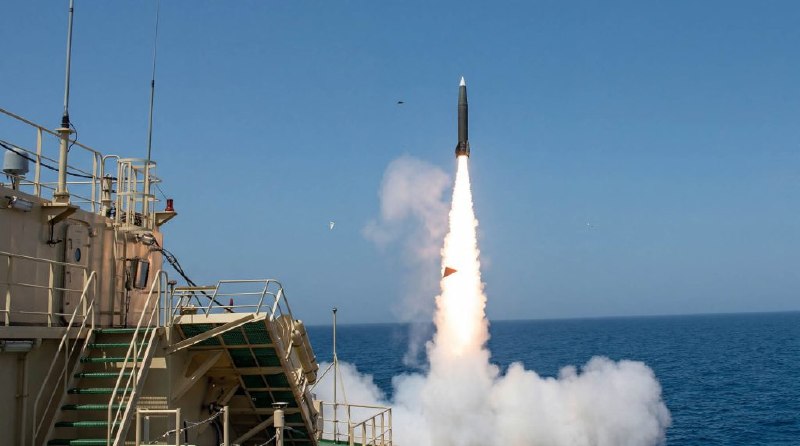
The German Navy test-fired the Israeli-built Lora long-range strike missile in the North Atlantic, OSINTdefender reported on 3 September 2026 at 01:33 UTC, a firing that puts a 500-kilometre-class weapon in Bundeswehr hands according to the channel's framing. Roughly two hours earlier, on 2 September 2026 at 23:27 UTC, the same channel posted that Germany is developing a naval laser anti-drone system expected to enter service by 2029. Read together, the two items describe a fleet being retooled, fairly quickly, for high-end fights on the seaward flank of an increasingly unstable continent.
What changes with the Lora is not the number of missiles Germany can buy, but what it can credibly threaten. A 500-kilometre surface-launched strike system, as cited by the channel, turns German frigates and corvettes from coastal escorts into ships that can reach deep inland from their patrol boxes. For a navy that spent the post-Cold-War decade hunting mines in the Baltic and policing migration lanes, that is, on the evidence of the two cited posts, a different kind of fleet.
The missile in plain terms
Lora is named in the OSINTdefender post as an Israeli system with a stated range of over 500 kilometres. That range is what makes the cited test interesting: it puts ships in the central North Atlantic inside the engagement geometry of targets far inland. The channel frames the test as a step change, and that framing is the load-bearing claim in the public record available here. The cited posts do not specify the manufacturer beyond "Israeli," the launch platform (hull-mounted cell versus shore-based rig versus barge), the firing ship, the warhead type, the target set, or which German or partner agencies were involved. The available source items do not specify those details.
What the posts do specify is that the test took place and that the channel characterises it as a significant advance. The engineering provenance, the warhead, and the doctrine are questions the cited reporting leaves open.
The laser, and the layer it belongs to
Two hours before the Lora post, on 2 September 2026 at 23:27 UTC, OSINTdefender reported that Germany is developing a naval laser anti-drone system expected to enter service by 2029. Directed-energy weapons are pitched in public discussion as cheap per shot, deep-magazine alternatives to surface-to-air missiles against the slow, low, plentiful threats that have swarmed sea lanes since 2022. A Bundeswehr programme aimed at the drone problem is, in operational terms, a programme aimed at the problem Western navies have actually faced in the Red Sea, the Black Sea and the Baltic. The cited posts do not specify the industrial base, the contractor, the power source, or the engagement envelope; they name only the mission (anti-drone) and the date (service entry by 2029).
Put the two items next to each other and a layered fleet emerges in the channel's framing. At the cheap end, lasers handle the attritable threat. At the expensive end, a long-range strike missile handles the high-value target set. In between sit the existing arsenals that would do most of the work in any real tasking. The Lora test, and the laser programme, bookend that stack. This publication's reading is that the near-simultaneous publication of the two items is itself the story: a navy being asked, in real time, to span the threat ladder from attritable drone to hardened land target.
Why Berlin, why now: Monexus assessment
The procurement pressure on Germany is well documented in the wider public record, but the two cited posts do not specify a procurement timeline, a budget line, a Bundestag vote, a contract value, or a delivery schedule. The 100-billion-euro special fund announced in 2022, and any subsequent allocation to the navy, is not referenced in either item. The posts name the weapons and the test; they do not name a programme of record. Where the wider European rearmament cycle and Berlin's stated ambition to take on a larger share of NATO's conventional burden fit into that picture is an analytical inference, not a fact the channel asserts. Monexus assessment: taken together with the wider reporting environment on German defence spending, the two items are consistent with a navy being pushed into a band of capability it has not occupied in living memory. The cited posts alone do not establish that. Independent confirmation from the Bundeswehr, the German defence ministry, or a wire service is the next thing to wait for.
The Israeli angle is also worth flagging, with the same caveat. The channel names Israel as the source country of the Lora. It does not address Berlin-Jerusalem political dynamics, the Gaza context, Bundestag politics, or why Israel rather than a Franco-Italian or transatlantic supplier was chosen. Those are questions a reader would reasonably ask; they are questions the cited posts do not answer. Monexus assessment: a German hull firing an Israeli system is, on its face, a procurement choice with political exposure, but the cited posts carry no information about that exposure, and we decline to characterise it further on this record.
The NATO arithmetic is similarly underdetermined. The cited posts do not rank Germany against the United States and France, do not describe German surface-fleet growth plans, and do not situate the Lora inside any alliance concept of operations. Monexus assessment: the read that this gives NATO a credible second-threat axis in the Baltic or the High North is plausible, and consistent with the wider direction of European naval procurement, but it is an inference, not a fact the cited posts support.
What remains unclear, and what to watch
Three things are not in the cited reporting and would change the read on this if they emerged.
First, integration. The OSINTdefender post frames the firing as a successful test; it does not specify whether the shot came from a shore-based launcher mounted on a deck, a barge or a dock, or from a hull already fitted with the production system. The difference is meaningful, because Lora is named in the post as an Israeli system with a 500-kilometre range, and naval integration of a land-origin strike system is not trivial: launch cells, fire-control integration, datalink changes, magazine handling, certification. The cited posts do not address any of that.
Second, doctrine. A 500-kilometre missile on a German frigate implies a target set, a chain of command, and rules of engagement. None of those are public on the cited record. Whether the weapon is meant for territorial defence in the Baltic, for out-of-area strike as part of a European maritime task group, or for both, is a policy question the cited posts do not address.
Third, timing of the laser programme. Service entry by 2029 is a target, not a delivery. Directed-energy weapons have a long history of slipping, and the cited posts do not specify what industrial base the German programme is being built on. Whether 2029 holds depends on work the public record has not, in these items, documented.
The reasonable reading of the two items, taken together and labelled as such, is that Germany is using the current procurement window to push its navy into a band of capability it has not occupied in living memory. The cited posts support the weapons, the test, and the dates. They do not support a doctrinal, budgetary or alliance-level narrative, and this article has not independently established whether those narratives hold.
Desk note: this piece is built from two Telegram posts by OSINTdefender published on 2 September 2026 at 23:27 UTC and 3 September 2026 at 01:33 UTC; the channel is treated as an event relay, and no claim about the primary test event has been sourced beyond what the posts themselves state. Independent confirmation from the Bundeswehr, the German defence ministry, or a wire service is the next thing to wait for.
Wire provenance
This editorial synthesis draws on the following public wire/social posts:
- https://t.me/osintdefender/20118
- https://t.me/OSINTdefender/20118
- https://t.me/OSINTdefender/20116
- https://t.me/osintdefender/20116