London gets its first robotaxis, and the rollout begins with safety drivers in every car
Uber and Britain's Wayve put 15 self-driving taxis on London streets with safety drivers in the front seat, a tightly licensed debut that turns the capital into a proving ground for European AV ambition.
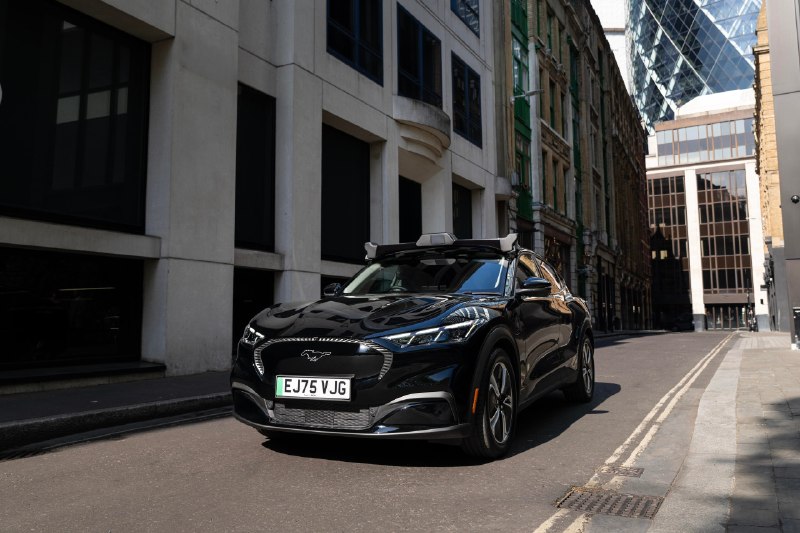
Fifteen self-driving taxis began accepting Uber fares across London on 3 September 2026, with a human in the front seat of each car able to take over if the system falters. The Guardian reported that morning that the vehicles had been licensed for hire in London, that they were available through the Uber app, and that human operators sat in front in case intervention was needed. The fleet sits inside a hired-vehicle market the same Guardian report put at more than 100,000 private-hire vehicles, with the wider platform's London rider base running in the same order of magnitude.
The vehicles run on an AI driving model developed by Britain's Wayve. The political weight of that detail is hard to miss: London is now the second city in Europe where Uber offers robotaxis, after Zagreb, and the UK has spent recent years pitching itself as a permissive third path for AI-enabled mobility between the US and the EU.
What London actually got
The fleet size is small by design. The Guardian specified a 15-vehicle cap, with each car carrying a human in front who could intervene. Reuters confirmed on 3 September that Uber launched the London autonomous service using Wayve's technology, making the capital the second European city after Zagreb where Uber offers robotaxis.
The cap matters because it sets the terms of the experiment. Fifteen cars is a number small enough for engineers to triage every intervention in real time, and a human in every vehicle converts what could read as a transport product into a supervised trial. Until that human presence is removed, the data the service generates is best understood as evidence about the AI model in supervised use, not about how an unsupervised fleet would behave in London traffic at scale.
Counter-narrative
Read uncritically, the launch sounds like a coronation for British AV ambitions. Read against the European field, it is closer to a controlled experiment with a long observation window. Zagreb, where Uber launched robotaxis earlier in 2026, is a tidier street network than central London, and is a useful but limited proxy for what happens when Wayve's model meets an older street network retrofitted around the modern car.
The sceptical read is that this is a regulatory and public-relations event first and a transport product second. The available reporting does not specify how long the initial licence runs, under what conditions Transport for London would allow expansion, or when the human front-seat presence might be removed, which is the milestone that would convert the pilot from a demonstration into a commercial product. The cited items do not address the labour question that hangs over every robotaxi launch: what a fleet expansion would mean for the existing London driver workforce is not specified.
Structural frame
The interesting pattern is not the cars. It is the supply chain. Wayve is a British firm; the operating layer is Uber's marketplace; the regulator is Transport for London, working inside a UK framework that has actively positioned the country as a permissive third-path jurisdiction for AI mobility between the US and the EU. The vehicle hardware is conventional, the sensor suite is conventional, and the routes the fleet is licensed to run are not described as unusual in the cited reporting. The differentiation is the AI model and the rule book that authorises it.
That matters for two reasons. First, it gives London a chance to export regulatory templates: if a British-trained model performs credibly under British traffic and British liability law, that record travels into negotiations with other mid-sized capitals considering AV pilots. Second, it concentrates commercial leverage in a small number of firms. Wayve and Uber now sit on the critical path for any city that wants to follow London's lead, and the more cities follow, the harder it becomes for a municipal buyer to negotiate against them. Monexus analysis: the more consequential variable over the next year is not how the car behaves on the road, but whether TfL's licensing terms travel abroad intact or get diluted by cities that want to move faster.
Stakes
If the London pilot holds, the next twelve months will test whether British AV policy becomes a competitive advantage or a cautionary tale for the broader UK sector. A clean incident record opens the door to fleet expansion, route widening and, eventually, removal of the front-seat human. A serious incident, particularly one involving a pedestrian or cyclist, returns the technology to the slow lane of UK regulatory caution and hands pole position back to established American and Chinese operators.
For Uber, the calculus is about optionality on a stack it does not own, in a market where ride-hail margins are thinnest. For Wayve, the calculus is bigger. Monexus finds that a credible London deployment is the most valuable piece of commercial evidence the company can take into its next fundraising round and into negotiations that will shape whether it ends up as an independent European champion or as the autonomy arm of a larger platform.
What remains uncertain
The available reporting does not specify the duration of the initial licence, the conditions under which TfL would allow expansion, the financial terms of the Uber-Wayve partnership, or any target date for removing the human front-seat presence. The cited items do not name the precise operating zone, the pricing structure relative to a standard Uber ride, or the compute hardware underlying Wayve's model. Those are the questions that will define whether 3 September 2026 is remembered as a turning point or a footnote.
This publication treats the launch as a regulated pilot, not as a transformation: fifteen cars with a human in the front seat is a beginning, not a verdict on whether London's streets are ready for autonomy at scale.
Wire provenance
This editorial synthesis draws on the following public wire/social posts:
- https://reut.rs/4ct5IWd
- https://x.com/Reuters/status/2095378783301779555
- https://www.theguardian.com/technology/2026/sep/03/london-first-self-driving-taxis-for-hire-wayve-uber
- https://www.investing.com/news/stock-market-news/uber-launches-autonomous-rides-in-london-with-wayve-ai-93CH-4886872