Sánchez Walks Back Morocco Line, but Ceuta's Streets Are Not Convinced
Spain's prime minister says intelligence found no 'solid proof' Moroccan authorities orchestrated July's deadly Ceuta border rush. Tens of thousands of protesters aren't buying it.
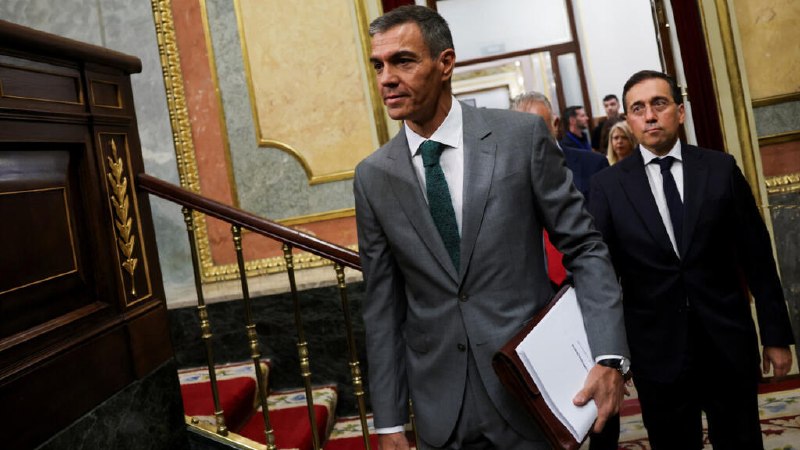
Tens of thousands of Spaniards poured into city centres on Wednesday 3 September to denounce the government's handling of the Ceuta migrant crisis, a street-level rebuke to Prime Minister Pedro Sánchez just four days after he ruled out Moroccan orchestration of the July border rush that killed at least one person and pushed more than 70,000 people across the frontier in a matter of hours.
Sánchez's position, restated in a Thursday interview carried by France 24, is that Spanish intelligence has found no "solid proof" that Moroccan authorities planned, directed or carried out the surge into the North African enclave. The framing lands at the intersection of two uncomfortable truths: the diplomatic relationship with Rabat cannot be allowed to snap, and the optics of blaming a neighbouring monarchy for a mass drowning at a fenced beach are politically radioactive. Both are now being litigated in the streets.
What the government actually said
In remarks quoted by France 24 on Thursday, Sánchez told the broadcaster that intelligence services had so far ruled out state actors including Morocco, Russia and Israel as the organising hand behind social-media posts that urged crossings at the Ceuta frontier. A Reuters wire on the same interview, timestamped 08:35 UTC on 3 September, carried the same line: Spain has "found no evidence" that July's deadly border rush was orchestrated by Moroccan authorities. The August statement, reported by Africanews on 31 August, made the same point in slightly different language: no evidence of Moroccan involvement.
This is a calibrated position, not a full exoneration. Sánchez's office is drawing a line between orchestration by a state and the broader pattern of permissive enforcement that allowed thousands to wade across. The distinction matters because Morocco's border posture is, in normal conditions, one of the more active in the western Mediterranean, and its withdrawal of routine patrols around the Ceuta crossing in July has been widely documented. Spanish police reports, cited by France 24, point to "multiple failings" by Moroccan officers in the days before the surge. Sánchez's political project depends on not naming Rabat as the culprit while still acknowledging that something failed across the border.
The street read
The protest movement, by contrast, is uninterested in diplomatic nuance. Africanews reported on 3 September that demonstrators across Spanish cities blamed Sánchez personally for the humanitarian fallout in Ceuta, demanding concrete policy responses rather than the investigative patience the prime minister is asking for. The scale, described as tens of thousands nationwide, signals that the political cost of the July surge has not faded with the calendar.
Spain's migration politics were already strained. Ceuta, the Spanish autonomous city on the North African coast, is a jurisdiction of roughly 85,000 residents. The arrival of more than 70,000 migrants over a single weekend is a demographic event on the scale of a medium-sized Spanish province relocating to a single enclave in 48 hours. The strain on reception infrastructure, healthcare and policing was immediate, and the human cost, including the drownings off the Ceuta beach that prompted the original "deadly rush" language in the wire reporting, has not been fully enumerated in the available source material.
Why the Morocco line matters
Morocco is not a peripheral player in Spain's foreign policy. It is the senior partner on western Mediterranean migration management, the indispensable interlocutor on counter-terrorism cooperation, and the kingdom whose posture toward the Ceuta and Melilla borders determines, more than any Spanish decision, who gets across. A formal accusation of orchestration would have triggered a cascade: Rabat's retaliation against Spanish trade interests, against the readmission agreements that govern returns of irregular migrants, against joint maritime patrols. The economic and human consequences would be swift.
That asymmetry is the unspoken architecture of Sánchez's caution. Spain needs Morocco's cooperation more than Morocco needs Spain's goodwill. The prime minister's position, in plain terms, is that the cost of a public accusation exceeds the political benefit of satisfying a protest movement that does not yet have a coordinated policy programme of its own.
What the evidence does and does not say
The wire reporting is consistent on one point: Spanish intelligence has not closed the file on Moroccan involvement. It has, in Sánchez's telling, provisionally ruled out state-actor orchestration. That is a narrower claim than the protests are demanding and a more conditional one than Spanish police assessments, which France 24 reports flagged for "multiple failings" on the Moroccan side. The available sources do not specify how those police assessments weight against the intelligence-community read, whether the social-media organising traffic has been traced to identifiable accounts, or whether third-party technical analysis (open-source investigators, platform takedown records) has surfaced evidence the Spanish government is not yet disclosing.
Monexus analysis: the gap between "no solid proof of orchestration" and "no Moroccan involvement at all" is the political fault line the protests are walking along. Spanish officials have chosen the more diplomatic formulation. The street is reading the more expansive one. Until the government either publishes a fuller account of the intelligence findings or commissions an independent inquiry that the opposition will accept as credible, the contradiction stays open and the protests have a constituency.
The next pressure point is procedural. A parliamentary accounting is likely; the opposition has the political incentive to demand one. Whether Spain also opens a bilateral file with Rabat, asking formally for an explanation of the July 18-19 patrol posture without accusing the kingdom of orchestration, will be a quieter but more consequential test. The wire reporting does not specify whether such a diplomatic step is in train.
This piece walks a tighter line than the wire copy. Mainstream coverage of the Ceuta surge has framed Spain as the affected party and Morocco as a regional partner under pressure. The street read, and the police assessments cited by France 24, push in a different direction. Monexus reports both and notes the contradiction explicitly rather than papering it over.
Wire provenance
This editorial synthesis draws on the following public wire/social posts:
- https://www.france24.com/en/europe/20260903-spanish-pm-sanchez-says-no-solid-proof-morocco-planned-ceuta-migrant-rush
- https://reut.rs/4gyIAYT
- http://www.africanews.com/2026/09/03/tens-of-thousands-in-spain-protest-ceuta-border-crisis/
- http://www.africanews.com/2026/08/31/spain-pm-pedro-sanchez-rules-out-moroccan-role-in-ceuta-migrant-surge/
- https://t.me/france24_en/18466
- https://t.me/osintlive/569423
- https://www.france24.com/en/europe/20260903-spanish-pm-sanchez-says-no-solid-proof-morocco-planned-ceuta-migrant-rush
- https://reut.rs/4gyIAYT
- http://www.africanews.com/2026/09/03/tens-of-thousands-in-spain-protest-ceuta-border-crisis/
- http://www.africanews.com/2026/08/31/spain-pm-pedro-sanchez-rules-out-moroccan-role-in-ceuta-migrant-surge/
- https://t.me/france24_en/18466
- https://t.me/osintlive/569423