Trump's off-ramp: the rhetoric of a short Iran campaign, and the strikes still landing
Two messages inside three hours: Trump tells reporters the renewed US campaign against Iran will not last long, then says strikes can resume 'anytime we want.' The contradiction is now policy.
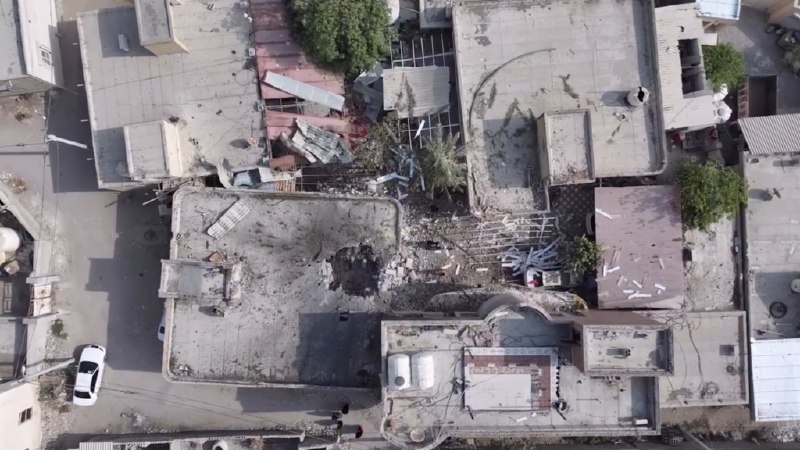
At 03:00 UTC on 3 September 2026, Reuters posted that Donald Trump had told reporters the renewed US campaign against Iran would not last long. At 01:45 UTC the same morning, Al Jazeera's English wire ran a competing line: Trump threatening more strikes, with the Iranian death toll from US strikes at 18, including, the network reported, civilians at a wedding party that Tehran framed as a war crime. Trump, the same wire noted, said the United States could hit Iran "anytime we want." Two hours of US headlines, two opposite postures, on the same war.
The arithmetic the White House cannot fully control is the one on the ground in Iran. The rhetoric it can. Reading across the five items in this cluster, what the morning produced is a US president publicly compressing the operation's timeline while privately, on the available reporting, exploring whether to declare it over. The signals do not cancel each other out. They are the same message, written twice.
A campaign that won't say its own name
The administration's vocabulary has been deliberately loose. "Campaign" is the working word in Trump's on-camera remarks. "War" is the word US officials used when speaking privately, according to a Telegram relay from OSINT Live at 02:49 UTC on 3 September, citing @alexbward reporting and US officials speaking on condition of anonymity: Trump is having discussions with senior aides about whether to declare the Iran operation over, the relay said, noting Trump has said he favours the idea. The "declaring war over" reporting rests on a single anonymous-sourced Telegram relay rather than an on-record confirmation from a tier-1 wire. Monexus treats it as a credible lead, not as established fact.
That ambiguity is doing real work. A formal declaration of victory would foreclose the freedom of action the air operation was designed to preserve and would invite immediate scrutiny over what it achieved. A formal declaration of duration would commit the administration to a tempo of strikes the domestic audience has not been asked to sustain. The posture the cluster points to is the third one: a permanent present tense, strikes when politically useful, denials of war when politically convenient. The available source items do not contain a public on-record statement from the President confirming or denying that an exit declaration is being drafted.
The bodies on the ground, and the ledgers that disagree
The arithmetic of the operation is harder to control than the vocabulary. Al Jazeera's English wire at 01:45 UTC on 3 September put the Iranian death toll from US strikes at 18 and reported, per Tehran, that civilians at a wedding party were among the dead. The available source items do not specify the location of the wedding-party strike or an independent casualty verification beyond the figures carried by Al Jazeera. Reuters, in the cited posts, has not published a parallel Iranian casualty count.
Monexus reads the 18-figure as an early snapshot, not as the final ledger. Strikes that hit populated areas rarely produce a complete civilian count inside 24 hours; the figure carries one source's reporting and one government's framing. Iran's information environment is controlled enough that initial numbers tend to move in one direction once verified, but the direction is not predictable from this cluster alone. The headline that an Iranian wedding party was hit is itself consequential: the optics of a civilian gathering destroyed by a foreign air force will outlast any count of the dead.
Trump's response to that arithmetic, in the Al Jazeera wire, was to threaten more strikes and to assert that the US could resume bombing "anytime we want." That posture is incompatible, on its face, with telling reporters the campaign will not last long. It is not incompatible with using both messages simultaneously: one for the domestic audience that wants the operation wound down, one for the Iranian audience that needs to believe more strikes are coming unless the political ask is met.
The messaging split, by audience
The Reuters cluster transmits the same line twice. At 22:45 UTC on 2 September, Reuters posted that Trump said the renewed US campaign against Iran would not last long. At 03:00 UTC on 3 September, Reuters posted the same line again. This is the duration claim the domestic audience will hear.
The international audience gets a harder line through the Al Jazeera wire: more strikes threatened, casualties rising, the "anytime we want" formulation standing as both capability statement and conditional threat. The structure is familiar. The home audience is sold a short war with an off-ramp in sight. The target state's leadership is sold the credible threat of resumption unless its behaviour changes. Both audiences are addressed, in different registers, by the same operational tempo.
What this cluster does not resolve is what the air campaign is meant to produce. The stated purpose, on the President's own description, is degradation of Iranian nuclear and missile infrastructure. The stated end, on the same description, is when Trump says so. Between those two declarations sits whatever wreckage the air operation has produced, the diplomatic bill it has run up, and the political dividend the administration expects to collect at home before the news cycle moves.
Monexus analysis: a media-cycle instrument
Monexus analysis: what the cluster of 2 and 3 September wires describes is a US military operation being run as a media-cycle instrument, calibrated to two audiences simultaneously, with the domestic audience hearing compression and the Iranian audience hearing threat. The contradictions in Trump's own messaging are not contradictions to be resolved. They are the operating logic. The campaign is short because the President wants it short. The campaign is also open-ended because no end-state has been named that, once achieved, would force its conclusion. The contradiction does the work of both messages, and the contradiction is the policy.
The structural pattern is the gradual detachment of US military action from any declared political end-state. Operations are launched with rhetorical ceilings ("won't last long"), run without exit criteria, and wound down when the political return at home exceeds the political cost of continuing. The 2018 withdrawal from the JCPOA, the maximum-pressure sanctions architecture, the limited 2025 episode, and the present operation all sit inside that pattern. Each step takes the bite out of the last, and each step is choreographed for a specific news window rather than a specific strategic outcome.
The next window worth watching is whether a formal declaration of "operation over" materialises, and on whose terms. The cluster points in that direction without confirming it. Until then, the available reporting supports a single read of the present: the bombs keep falling while the President's words say they are about to stop, and that gap is the operation.
Desk note: Monexus is treating this cluster as a single event-window and reading across the three Reuters posts, the Al Jazeera wire, and the OSINT Live / @alexbward Telegram relay. The 18-figure is Al Jazeera's as carried in the cited headline; the "declaring the Iran war over" reporting is a single Telegram relay of an anonymous-sourced US official, not an on-record tier-1 confirmation. The cluster contains no Iranian MFA briefing, no Mehr News / Tasnim / PressTV wire, and no Chinese, Russian, or Global-South outlet on the US-Iran question; the Iran-side framing here therefore rests on Tehran's own statements as carried by Al Jazeera. A follow-up piece should pull the Iranian MFA statement and Mehr News / IRNA reporting directly, seek an Axios or Washington Post on-the-record confirmation of the "declaring war over" reporting, and verify the wedding-party strike location and casualty count against UN OCHA or ICRC field reporting.
Wire provenance
This editorial synthesis draws on the following public wire/social posts:
- https://reut.rs/4gRFAFZ
- https://reut.rs/3UzBhHR
- https://www.aljazeera.com/news/2026/9/3/trump-threatens-more-strikes-as-death-toll-in-iran-rises-to-19?traffic_source=rss
- https://t.me/osintlive/569403
- https://reut.rs/4zUFwOl