Polish and Latvian fighters cycle into the air as Russian strikes shake Ukraine's western shoulder
Poland and Latvia scrambled combat aircraft on the evening of 21 September 2026 after a Russian drone attack on Ukraine spilled alerts across the border, exposing how thin the air-policing margin is on NATO's eastern flank.
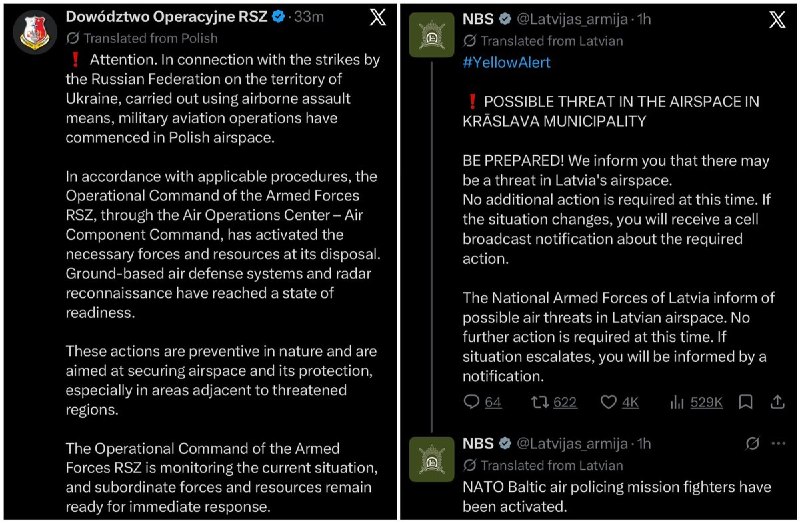
At 20:47 UTC on 21 September 2026, residents of Poland's Lublin Voivodeship received an RCB emergency alert warning that Polish military aviation was operating in national airspace. Within the hour, NATO Baltic member Latvia followed suit, scrambling its own fighters. The proximate cause, according to Polish officials cited in operational channels, was a Russian drone attack on Ukraine unfolding close enough to the border to force a defensive posture on the alliance's eastern flank.
The episode is small in tactical terms, a few hours of heightened readiness, and large in what it reveals. Poland and Latvia are not at war with Russia. Both countries sit deep inside the NATO air-policing envelope. Yet a routine Russian strike package aimed at Ukrainian targets was sufficient, on this occasion, to put two allied air forces on the launch line and to push an emergency SMS to Polish civilians in border communities. The threshold has moved, and it is worth asking where it is heading.
What actually happened
The sequence is reconstructable from open-source monitoring channels. At 20:47 UTC, the Telegram channel intelslava carried a short report noting that authorities in Lublin Voivodeship, Poland's easternmost province and the one that abuts Ukraine, had issued an alert about possible collateral damage from an ongoing Russian attack. A minute later, the channel noel_reports posted that Poland had scrambled military aircraft in response to a Russian drone attack on Ukraine and confirmed the RCB warning.
By 21:13 UTC, the OSINTdefender account, citing the Polish framing, reported that fighters had been scrambled in both Latvia and Poland, with Poland attributing the move to Russian strikes in Ukraine. A subsequent Latvian release, relayed in the same post, indicated that Latvian fighters operating under NATO's Baltic Air Policing mission had been the asset tasked. By 21:43 UTC, alerts in both countries had ended, though the precise trigger remained undisclosed.
The available source items do not specify how many aircraft were launched, the type of the drones involved, the targets struck inside Ukraine, or whether any object crossed into Polish or Latvian airspace. The framing offered by Warsaw, that this was precautionary and tied to Russian operations in western Ukraine, has not been publicly contradicted by NATO's Allied Air Command in the cited material.
Why Lublin matters
Lublin is not a symbolic posting. The voivodeship stretches from the Bug river, which forms the Polish-Ukrainian border, west toward Warsaw, and it contains the southeastern corner of Polish airspace where Polish and Ukrainian flight-information regions abut. During previous Russian strike packages, Lublin has absorbed the largest share of Polish alert activity precisely because long-range Russian drones, when launched from occupied territory or from airspace over the Black Sea, can fly geometry that ends in Polish warning volumes even when their intended target sits well inside Ukraine.
Polish alert doctrine reflects this. The RCB system, the government's cellular emergency broadcast infrastructure, is built for short, specific warnings, and its use here suggests that Warsaw judged a non-trivial risk of debris, straying airframes, or a miscalculated flight path. There is no public indication that any Russian system entered Polish sovereign airspace during this episode, but the decision to push an emergency alert is itself a policy signal: Poland is treating the western Ukrainian border as a defence line, not a distant front.
The Latvian leg
Latvia's involvement is the more analytically interesting half of the episode. Riga does not border Ukraine. Its contribution to the evening's alert posture came from NATO's Baltic Air Policing mission, the standing rotational tasking that has watched the Baltic skies since the alliance absorbed the airspace sovereignty of Estonia, Latvia and Lithuania. A Latvian scramble inside that mission is, on its face, routine.
What is not routine is the simultaneous timing. Two allied air forces, in two different regional postures, responding inside the same hour to the same Russian strike package, implies a coordination rhythm that goes beyond national commands. Monexus analysis: this is the operational signature of an alliance that has spent four years integrating Ukrainian strike-warning data into eastern-flank decision cycles. The benefit is speed; the cost is that any large Russian strike on Ukraine now produces a federated alert effect across at least two NATO members, regardless of where the actual weapons land.
Stakes on the eastern flank
The forward question is what happens next time the package is bigger. The events of 21 September involved drone strikes, the lowest-cost and most numerous layer of the Russian air order of battle. A future episode involving cruise missiles, particularly those launched from airspace closer to Polish or Lithuanian borders, would stress the same alert architecture harder and on shorter notice. Polish and Baltic planners have been preparing for that scenario since at least 2023, but preparedness on paper is not the same as a quiet evening in Lublin.
The political stake sits underneath the operational one. Warsaw has spent two years arguing, inside the alliance, that NATO's forward defence must be credible enough that Russian planners do not write off the eastern members as expendable. Episodes like this one are the visible proof of that argument. They are also the moments where the risk calculus of escalation is set, by both sides, in real time. The sources reviewed here do not record any Russian comment on the Polish or Latvian posture, and this publication has not independently established whether Moscow issued a statement of its own.
What the record does show is a quiet, deliberate tightening of the alliance's nervous system, executed without ceremony and almost entirely outside the public's attention until an SMS lands on a phone in Lublin. The threshold has moved. The question worth tracking is whether it moves again the next time Russian aircraft sortie over the Carpathians.
Desk note: Monexus treated this as a NATO air-policing story with a Ukrainian frame, not as a speculative escalation story. Where the cited channels reported only the alert and the scramble, the piece reports only the alert and the scramble; uncertainty about the underlying Russian strike package is named, not papered over.
Wire provenance
This editorial synthesis draws on the following public wire/social posts:
- https://t.me/noel_reports/52997
- https://t.me/intelslava/95074
- https://t.me/osintlive/574268
- https://t.me/osintlive/574273
Follow the event.
These dated source records provide context. They do not retrospectively verify this archive article.
A dated voting record is evidence of one decision. Use the original UN record before turning it into an alignment label.
Visual explainer · historical vote of 2022-03-02 →