Trump at the UN: Hormuz, hostages, and a deal-or-else ultimatum to Iran
At the UN on 22 September 2026, Trump coupled a billion-barrel Hormuz escort claim with a one-line warning to Tehran. The market hasn't priced the second half yet.
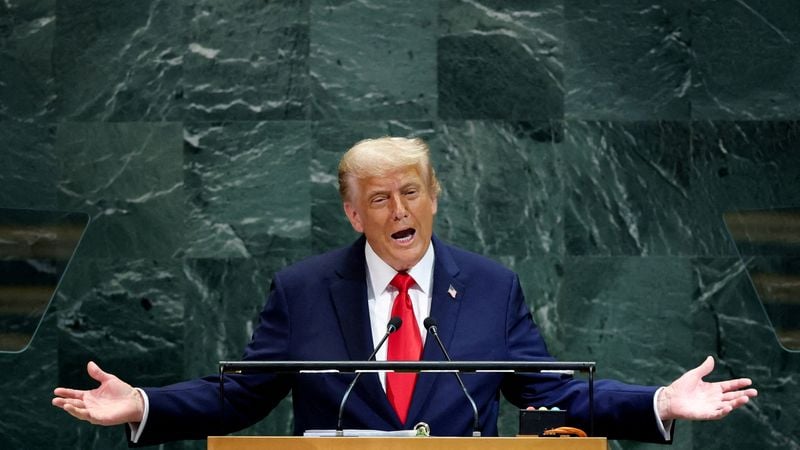
Donald Trump stood at the United Nations on Tuesday 22 September 2026 and, in the space of a single speech, told the world that the U.S. Navy has just escorted more than one billion barrels of oil out of the Strait of Hormuz and warned Tehran that it would "get it done one way or the other" with the United States. The two statements are connected, and the connection is the story.
The president's remarks, delivered at the UN General Assembly in New York, blended a salesman's boast about energy security with a diplomatic ultimatum that has been the through-line of his second-term Middle East posture. The market heard the first half. The second half has not been priced.
A billion barrels, and counting
The Hormuz figure is the headline. "The United States Navy has recently escorted more than one billion barrels of oil out of the Strait of Hormuz," Trump told the chamber, "and more oil is flowing than at any point since the start of the war." The claim, telegraphed by pro-Trump accounts through the early UTC afternoon and relayed by Telegram channels including War Footage Witness and Clash Report, is the kind of statistic that does two jobs at once. It positions the United States as the indispensable guarantor of Gulf shipping, and it frames Iran's residual capacity to disrupt that flow as the friction point around which any deal must turn.
Investors have been waiting on this framing for months. Freight insurers have repriced war-risk premiums on Gulf transit multiple times since the fighting began, and the benchmark Brent contract has spent the better part of 2026 in a band that traders describe, with some understatement, as "politically sensitive." A U.S. administration that can credibly claim to be physically moving crude out of the world's most important chokepoint is, by definition, also the administration that sets the terms on which that flow continues.
Monexus analysis: the figure does important rhetorical work, but it should be read as a political claim before it is read as an operational one. One billion barrels over the relevant period is roughly two-to-three million barrels a day of escorted tonnage, a real number, and a politically useful one. It does not, on its own, establish who was shooting at whom during those transits.
The deal-or-else
The other half of the speech was shorter and sharper. "The United States and Iran will definitely get it done," Trump said, per a Telegram relay of his remarks. "We will get it done one way or the other. It's going to be done. It's going to be done fast." The line is vintage late-stage negotiation rhetoric: vague enough to keep a channel open, certain enough to be read as a deadline.
The diplomatic run-up supports that read. Investing.com's wire preview on the same day noted that Trump is set for a "whirlwind" of UN meetings, with both the Iran war and the Ukraine war on the agenda. That two-front framing matters. Tehran is negotiating, if it is negotiating at all, against the backdrop of an American president who is simultaneously trying to lock down a Ukraine settlement, and who has demonstrated a willingness to use UN resolutions as political theatre.
Trump used exactly that instrument in the speech. He thanked the UN Security Council for "voting overwhelmingly to pass a resolution condemning Iran's despicable" behaviour, language that does double duty as a thank-you and a reminder that the council, having spoken, has legitimised whatever comes next. Telegram relays of the address, distributed through channels including War Footage Witness, captured the framing in real time. The resolution gives Washington a multilateral wrapper for measures that might otherwise look unilateral.
What Tehran hears
The Iranian calculation is the part of this story that the Western wire coverage tends to flatten. Tehran is not dealing from a position of indifference. Its regional proxies have been degraded; its nuclear programme has been set back; its oil customers have spent two years learning to use Chinese refineries and shadow-fleet tankers as workarounds. A regime under that kind of strain does not, in the historical record, capitulate to a deadline. It either negotiates from the smallest possible concession, or it slows everything down and waits for the other side's domestic politics to move.
The counter-narrative in regional outlets and on Iranian state-linked channels is that the U.S. framing of "maximum pressure plus maximum escort" is itself the obstacle to a deal, because it converts a diplomatic track into a sanctions-plus-protection racket. That read is worth taking seriously, even by readers who find the Iranian government's broader posture indefensible. The Hormuz escort programme, on this reading, is not a confidence-building measure; it is a permanent deployment that the United States can dial up or down to set the price of Iranian compliance.
Why the market hasn't fully moved
Brent and the dated Brent–Dubai spread have responded to the Hormuz escort claim with a modest relief bid, and war-risk premia on VLCC transit have eased from their summer peaks. The reason the response has been measured is that traders are not yet treating the second half of the speech, the "one way or the other" warning, as the binding constraint. They should be. The escort figure tells you how much oil is moving today. The warning tells you who decides how much oil moves three months from now.
The structural read, in plain terms, is that the United States has converted energy transit through the Gulf into a managed commodity. The escort operation is the visible half. The sanctions architecture, the UN resolution, and the bilateral threat are the invisible half. Together, they let Washington decide, case by case, whose barrels move and on what terms. Iran is the immediate counterparty, but the precedent travels: any exporter that relies on Hormuz shipping is now transiting a corridor whose rules are written in Washington, not Geneva.
What to watch next
Three dates will tell us which way this breaks. The first is the next round of UN Security Council procedural votes, which will reveal whether the resolution Trump thanked the council for is the start of a cascade or a one-off. The second is the next OPEC+ technical meeting, where the Iranian delegation's posture toward its own quota will signal whether Tehran is preparing to deal or to dig in. The third is the next quarterly Iranian presidential press conference, where the domestic political cost of any concession will become legible.
What remains genuinely uncertain, on the evidence available, is the operational substance behind the billion-barrel claim. The figure is politically load-bearing, and Telegram relays of the speech do not specify the counting window, the escort methodology, or which tankers the Navy is formally protecting. This publication has not independently verified those details, and the cited posts do not specify them either. Until they are, the escort number should be read as a credible political claim by a sitting U.S. president, not as an audited shipping statistic.
The other open question is whether "one way or the other" means a negotiated nuclear and missile constraint, or something else. The available source material does not specify which, and the next 72 hours of diplomatic traffic will narrow it.
Desk note: Monexus framed the UN speech as a single integrated message, Hormuz escort plus deal-or-else ultimatum, rather than treating the energy and diplomatic threads as separate stories. The wire coverage on the day leaned heavily on the procedural UN-meeting angle; the market-and-energy frame is ours.
Wire provenance
This editorial synthesis draws on the following public wire/social posts:
- https://www.investing.com/news/world-news/trump-set-for-whirlwind-un-meetings-with-wars-in-iran-ukraine-on-agenda-4909864
- https://t.me/ClashReport/97659
- https://t.me/ClashReport/97651
- https://t.me/megatron_ron/16885
- https://t.me/wfwitness/112486
- https://t.me/wfwitness/112485
- https://t.me/wfwitness/112482