Phosphorus at the Edge of Zawtar al-Sharqiya
Two regional Telegram channels and one Iranian state outlet converged on the same Lebanese town within sixteen minutes on Tuesday. Monexus assesses what the convergence says, and what it does not.
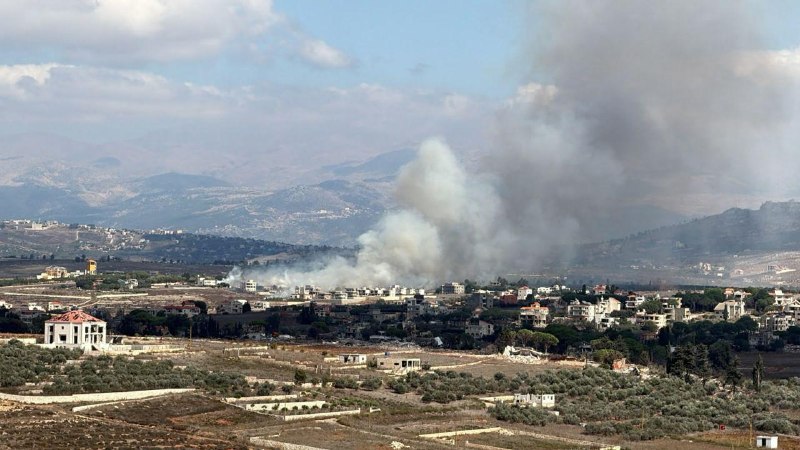
At 11:31 UTC on 23 September 2026, a Lebanon-Palestine news account flagged Israeli army movements inside the village of Zawtar al-Sharqiya in southern Lebanon. Twelve minutes later, Iran's Tasnim news agency framed the same village as the target of a strike it characterised as using prohibited phosphorus bombs. By 11:57 UTC, The Cradle had published a third version of essentially the same event, attributing the use of white phosphorus munitions to "Israeli occupation forces" and sourcing the claim to "local reports." Within twenty-six minutes, one small town on Lebanon's southern edge had acquired three different framings, in three different registers, from three different political vantage points.
Monexus analysis: what makes this convergence worth examining is not the event itself (a single report, unverified in the available sources) but the speed and structural similarity of the relay. The same location, the same weapon-class allegation, the same window of time. The pattern is the news.
Three bulletins, one town
The earliest item in the cluster, posted at 11:31 UTC by Gazaalanpa, described the episode as "movements by the Israeli army" inside the village. It carried no weapon specification and no casualty claim; it functioned as a geolocation alert for a Telegram audience already tracking southern Lebanon [1]. Twelve minutes later, Tasnim's English channel published the same geography reframed as a deliberate strike, attributing to "the Israeli regime's army" the use of what the post called "prohibited phosphorus bombs" against Zoutar Al-Sharqiya [3]. A further fourteen minutes on, The Cradle, a Beirut-based outlet that frames Israeli operations in occupied-territory language, published the third iteration: phosphorus munitions at the "outskirts" of the town, attributed to "Israeli occupation forces" and "local reports" [2, 4].
The sequence is a working example of how a frontline event is currently assembled on the open channel layer: a locator, a state-aligned characterisation, and an analytical frame, each amplifying the previous and each adding one further interpretive commitment that the prior post did not contain.
What the wire layer does not yet contain
Monexus audited the available source items for the conventional confirmations an international news desk would expect on a strike report: an Israeli military spokesperson statement, a UNIFIL or Lebanese Armed Forces communique, named casualty figures, the specific munition type, and the time of impact. The cited posts contain none of these, and this article has not independently established whether any of them now exist. The absence matters: phosphorus allegations carry specific legal weight under Additional Protocol III of the Convention on Certain Conventional Weapons, where civilian-population airbursts are restricted. A claim of that gravity that moves across three Telegram channels in under half an hour, without an IDF read-out or a UNIFIL situational report attached, is not yet a fact in the sense an editor can stand behind. It is, at best, an early-stage accusation carrying the structural weight of a verified report.
Why the relay looks the way it does
Read together, the three posts map a familiar information geometry. A Lebanon-Palestine solidarity channel sets the location. A regional state outlet converts the location into a weapon allegation with a strong moral adjective ("prohibited"). An analytical outlet that routinely uses occupation vocabulary absorbs and broadens the claim, citing "local reports" in a way that gives the assertion a provenance it does not in fact possess. Each step is, on its own, defensible editorial practice. Combined, they produce a single piece of breaking-news copy that has travelled further than it has been corroborated. This is not unique to any one of these outlets; it is the structural shape that breaking frontline news currently takes on the open channel layer when no wire agency has yet arrived on the scene.
What to watch in the next forty-eight hours
Three things will determine whether 23 September 2026 becomes a discrete entry in the south Lebanon casualty ledger or a contested data point. First, an IDF read-out: the Israeli military's routine on phosphorus allegations is either to dispute the munition classification (smoke / illumination rounds versus incendiary) or to acknowledge targeting and contest the civilian-population characterisation. Second, a UNIFIL situational report: the UN peacekeeping force operating along the Blue Line routinely publishes positional updates after strikes in its area of operations. Third, on-the-ground press in Tyre or Nabatieh governorate: local stringers and outlets such as Al Jazeera's Lebanon bureau and L'Orient Today typically reach the site within twelve to twenty-four hours and produce named, datelined reporting. Until one of those three arrives with an independent confirmation, the cluster above is a working hypothesis about an event, not the event itself.
Desk note: Monexus framed this as a study of how an unverified strike report propagated across three ideologically distinct channels inside a single half-hour window, rather than as a confirmed use-of-weapons story. The wire has not yet arrived; we will update when it does.
Wire provenance
This editorial synthesis draws on the following public wire/social posts:
- https://t.me/gazaalanpa/25569
- https://t.me/thecradlemedia/68317
- https://t.me/TheCradleMedia/68317
- https://t.me/tasnimnews_en/38170
Follow the event.
These dated source records provide context. They do not retrospectively verify this archive article.
Separate what the nuclear watchdog reported from what it could not determine after the June 2025 strikes.