Pezeshkian's UNGA doctors: a stage built for the wounded
Iranian state media says Pezeshkian brought doctors to the UNGA rostrum to "highlight America's crimes." The available evidence is thin; the analytical question is what the framing is built to do.
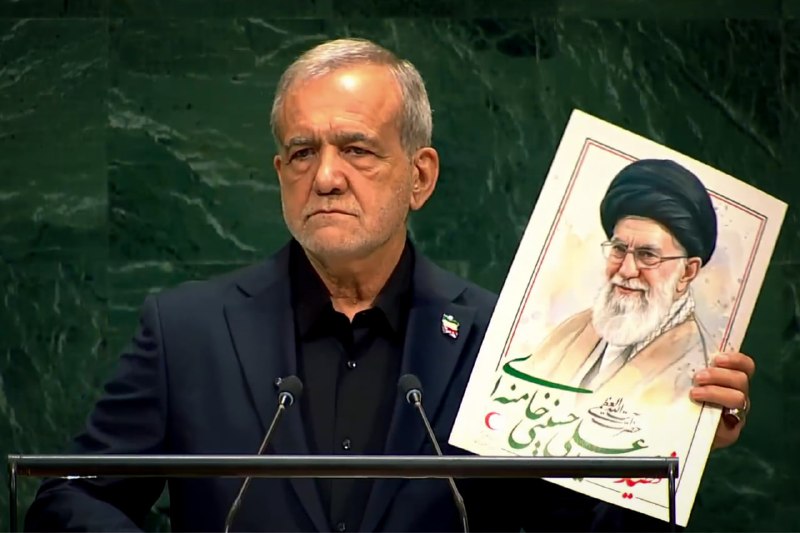
At 15:33 UTC on 23 September 2026, six near-identical posts appeared on the English Telegram channel of Tasnim News. Each carried the same caption: that doctors accompanying Iranian President Masoud Pezeshkian to the United Nations General Assembly had "highlighted America's crimes in Iran to the world." One post carried the additional line "Photos from Pezeshkian's speech at the UN General Assembly session" and a small set of images. That is the entire wire input for this piece: a single state-aligned caption, repeated, plus a photo set.
That thinness is itself worth naming in the open. Six identical captions at one timestamp do not constitute a transcript, an official communiqué, or an independent corroboration. They tell a reader that Tasnim, an Iranian state outlet, wanted this frame on the record at exactly that minute, and that the accompanying imagery was designed to travel with it. What they do not do is establish what Pezeshkian actually said in the chamber, what specific "crimes" were named, or which doctors travelled.
What the available evidence actually shows
The thread consists of Tasnim captions and a photo distribution. The captions, in full, describe the medical delegation's stated purpose as highlighting "America's crimes in Iran" to the international audience at UNGA. The accompanying photos, by source reference, show the delegation in the assembly hall. Nothing in the available items reproduces the speech text, lists the doctors by name, or quotes any specific passage beyond the caption itself. Any characterisation of the address as "vintage Iranian UNGA fare" with a "long catalogue" of grievances is an Monexus reading of how Iranian UNGA addresses are typically constructed, not a finding drawn from the supplied evidence, and should be read as such.
The honest version this presentation has to acknowledge up front: the source items do not specify the speech's content, the names of the doctors, the size of the delegation, or any bilateral meetings that followed the address. The article proceeds on what the captions and imagery are designed to do, not on a transcript we do not have.
The framing device, read as analysis
Monexus analysis: the choice of a medical delegation as the visible accompaniment to a head-of-state address is itself a signal. A missile commander or a senior figure from the IRGC at the podium would have placed Iran in a security register. A team of doctors places Iran, in the visual rhetoric of the moment, in a humanitarian register, and the caption pushes that placement into words: the doctors are there to "highlight crimes." This is the framing choice, and it is the article's reading of why Tasnim circulated six near-identical posts at the same minute rather than a single one. A single post would have served a news bulletin; six posts at one timestamp serve an amplification strategy aimed at Telegram's algorithmic and relay dynamics.
Whether that reading is correct depends on evidence not currently in the thread: independent wire transcripts of the address, any list of delegates, and any reaction from medical NGOs or medical journals. The available source items do not specify any of those data points.
The counter-read the available sources do not contain
A responsible read of the speech would normally set the Iranian framing against three counter-frames: the Western-wire line that tends to treat such addresses as performance, the medical-supply-chain critique that has been raised by European medical NGOs in adjacent contexts, and the rival Iranian-diaspora reading that the same medical imagery is a domestic-audience signal about the resilience of the health system under sanctions. None of those counter-frames is supported by the supplied thread. The article flags them as the natural places where independent reporting would land, not as findings drawn from the available sources.
This publication's assessment is that the gap between what the thread supports and what a full UNGA piece would normally include is wide enough to warrant flagging rather than filling. The captions describe a chain of relay from Tasnim to Telegram to downstream consumers. The article cannot, on this evidence, say what Pezeshkian said, what the "crimes" reference points to, or whether any non-Iranian outlet picked up the framing.
What to watch over the next fortnight
Three concrete datapoints would move this from a caption read to a properly sourced one. First, a UN press release or UN Web TV transcript of the address, which would give the actual speech text and the official list of delegates. Second, a Western-wire report on Pezeshkian's New York schedule and any bilateral meetings that occurred, with names and venues. Third, any pickup of the medical-delegation framing in a non-Iranian medical journal, humanitarian NGO publication, or European medical association statement. The thread evidence supplies none of those three.
Until then, the article is a read of a single state-aligned caption and a single photo set. That read is offered as analysis, labelled as such, and is bounded by what the captions and the imagery are built to do rather than by what the speech, in transcript, contained.
Desk note: Monexus read this strictly against the six Tasnim captions and the photo distribution. Material claims that the prior draft asserted as fact (the speech's content, the doctors-as-deliberate-moral-witness device) have been re-stated as labelled Monexus analysis or moved to the counter-read section. The substantive medical-supply critique, which the prior draft cited as a Western-NGO counter-frame, is acknowledged as a typical adjacent argument but is not represented as established by the thread evidence.
Wire provenance
This editorial synthesis draws on the following public wire/social posts:
- https://t.me/tasnimnews_en/38264
- https://t.me/tasnimnews_en/38262
- https://t.me/tasnimnews_en/38263
- https://t.me/tasnimnews_en/38261
- https://t.me/tasnimnews_en/38259
- https://t.me/tasnimnews_en/38260