Beirut in Washington: what Salam and Rubio actually said
At the State Department on 28 September 2026, Lebanese Prime Minister Nawaf Salam told MTV News his meeting with Secretary Rubio 'went very well,' according to regional Telegram channels. What little else is on the record.
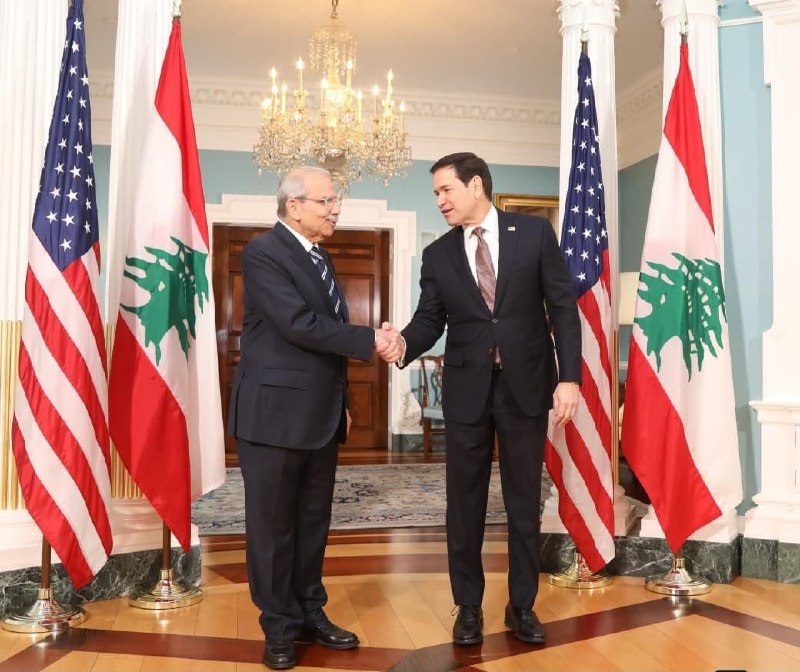
At roughly 14:32 UTC on 28 September 2026, the Lebanese channel @TheCradleMedia and the regional news channel @wfwitness both posted that US Secretary of State Marco Rubio had met Lebanese Prime Minister Nawaf Salam at the Department of State. By 15:02 UTC, @wfwitness had refreshed the thread with a second post adding one attributable line from Salam himself: he told MTV News the meeting with Rubio had "gone well." That single verbatim remark is, at the time of writing, the only direct quote from Salam that has reached the cited channels. Everything else in the regional information space is framing, not record.
That framing is the story. A Lebanese prime minister sitting down with the US chief diplomat is a routine data point in a long-running bilateral file. What is worth reading carefully is what is and is not being asserted by either side in the immediate aftermath. The Cradle's 15:01 UTC post reproduces Salam's MTV News line and stops there. @wfwitness runs the same line. Neither carries a State Department readout, neither names a deliverable, neither sets a date for follow-up. The cited posts do not specify any concrete commitments, and this article has not independently established whether the meeting produced anything beyond the courtesy framing both sides prefer.
The verifiable record
Stripped to what the sources actually say, the meeting has three components. First, the meeting happened, at the State Department, on 28 September 2026, between Salam and Rubio. Second, Salam told MTV News the encounter "went well." Third, the regional Telegram ecosystem treated the sit-down as newsworthy enough to push two waves of posts inside half an hour, with @wfwitness adding Salam's quote in its 15:02 UTC refresh. The Cradle's coverage runs to the same line. There is no quoted readout from the State Department, no quoted readout from the Lebanese prime minister's office, and no named-deliverable in any cited post.
This matters because the standard reflex in Lebanese political coverage is to fill that silence with inferred substance. The cited posts are not doing that here, which is itself a signal. Regional channels with strong editorial lines have chosen, in this case, to publish the meeting and the single quote and stop. Read against the pattern of previous Lebanon-US encounters, that restraint is unusual and worth naming.
What the framing looks like
The framing the cited posts are offering is, in effect, the framing Salam is willing to put his name to. A meeting that "went well" is, in the diplomatic register both Beirut and Washington prefer, a meeting that produced no friction and no commitment. It is the safe line, the line a prime minister uses when he wants the bilateral channel preserved without giving domestic critics a target. The Cradle, which has editorial reasons to highlight any US-Lebanon engagement, runs Salam's quote without commentary. @wfwitness, which is closer to the Lebanese opposition information space, runs the same quote. The convergence on a single, short, positive line is the operative signal in the cited posts.
There is also a structural counter-argument the Salam government has to answer in real time. The pattern of recent Lebanon-US engagement is that Beirut produces paper deliverables, Washington produces cautious readouts, and the gap between the two becomes the operative space in which armed non-state actors, banking-sector insiders, and political factions manoeuvre. The honest reading of the 28 September meeting, on the cited evidence alone, is that it confirms the rhythm rather than breaking it. Salam gives a short positive line, the channels carry it, and the underlying file moves at the pace of internal Lebanese politics. The framing that calls this a turning point overstates the evidence the cited posts contain.
Where this sits in 2026
Step back from the handshake and the Salam-Rubio meeting fits into a wider pattern of how the United States is choosing to engage with the Levant in 2026. Direct bilateral channels with Arab capitals and with Beirut have, in practice, replaced the more ambitious multilateral formats of the previous decade. The United States is talking to the governments it judges capable of delivering on specific commitments and is, increasingly, treating the diplomatic ledger as a series of bilateral transactions rather than a regional settlement project. That shift has costs. It privileges leaders who can deliver on narrow technical files over those who can build broader political coalitions, and it tends to entrench the political forces already inside government rather than those outside it.
Read as analysis: the Salam visit is also a marker for the wider competition playing out across the eastern Mediterranean. Gulf states, Turkey, and Iran each retain a stake in Lebanese fiscal and political stability, and Washington's renewed bilateral engagement is happening against a backdrop in which each of those actors has its own Lebanon file. The Salam government is, in effect, running a multi-vector diplomatic operation and presenting Washington with the cleanest of the available vectors. The visit is the visible tip of a wider balancing act, and the operative question is whether the bilateral channel can deliver enough momentum to outpace the centrifugal pressures inside Lebanon itself.
Stakes and what to watch
The concrete stakes are narrow but consequential, and they are not visible in the cited posts. The next markers to watch are technical: an IMF programme review, the next round of border monitoring, and whether the State Department readouts of this visit name concrete deliverables or stick to the language of discussion and consultation. A withdrawal of US patience, were it to come, would compress the timeline on every one of those files and tilt the internal political balance toward the actors who argue, with some justification, that engagement with Washington produces paper rather than outcomes.
The honest assessment is that the cited posts contain one verifiable Salam quote, "the meeting went well," and a State Department photo-op. The 28 September handshake is, on the available evidence, a useful indicator of where Lebanon sits in the present US diplomatic ledger, but no more than that. Salam is buying time, Rubio is reserving judgment, and the wider Lebanese file continues to move at the speed of internal politics rather than the speed of any external framework.
This piece leans on Telegram-channel coverage of the Salam-Rubio meeting; primary-source readouts from the State Department and from the Lebanese Prime Minister's office have not yet been incorporated and would shift the assessment if they appear.
Wire provenance
This editorial synthesis draws on the following public wire/social posts:
- https://t.me/wfwitness/113523
- https://t.me/thecradlemedia/68588
- https://t.me/wfwitness/113521
- https://t.me/TheCradleMedia/68583