Wicknell Chivayo's last ledger: a Southern African patronage parable, according to Mutuma Mathiu
Zimbabwean businessman Wicknell Chivayo died in a helicopter crash days after publicly cataloguing the presidents, prophets and ministers he had stood beside. The Daily Nation's Mutuma Mathiu reads the life as a continental parable, not a local one.
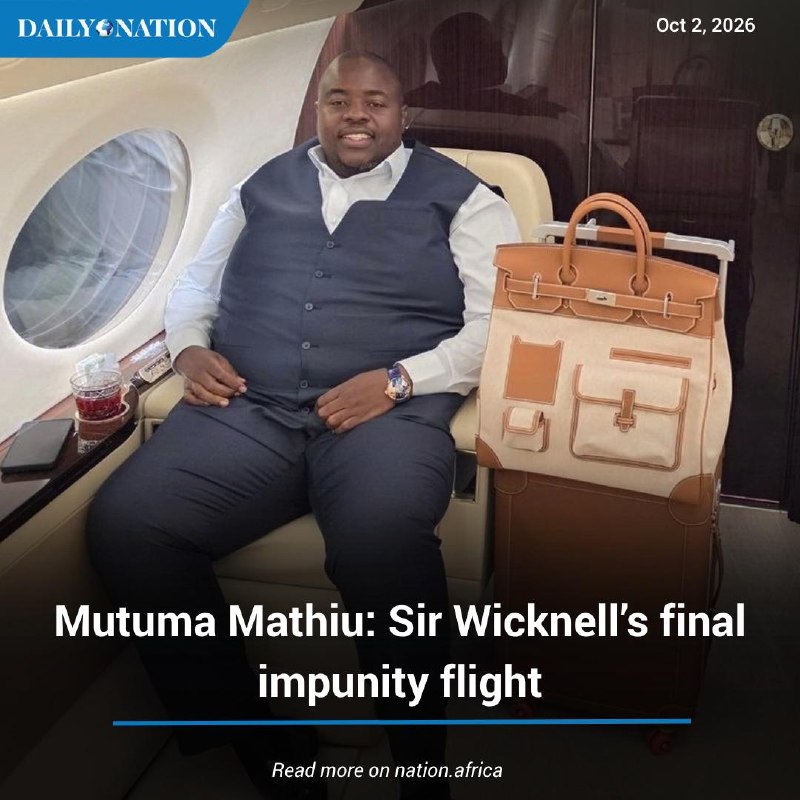
Three days before he died in a helicopter crash, Wicknell Chivayo appeared to take stock. In a final public reflection carried by the Daily Nation on 2 October 2026, the Zimbabwean businessman catalogued the presidents he had been photographed with, the powerful men of God whose homes he had visited, and the circle of powerful figures he had managed to orbit. The Daily Nation reported the death in the same 2 October 2026 cycle, framing Chivayo's last act as an inventory of the relationships that had defined him. The juxtaposition, Nation Africa columnist Mutuma Mathiu wrote in a companion column the same day, is the point: that inventory is now the closest thing to a forensic record of the man's career.
Mathiu's argument, carried in the Daily Nation on 2 October 2026, is that the temptation to read Chivayo's life as a uniquely Zimbabwean morality tale is precisely what allows the underlying pattern to persist. The mechanic he embodies, proximity to power converted into private access, religious and political elites photographed into complicity, relationships that move across borders as easily as capital does, is recognisable from Nairobi to Lusaka to Gaborone. The personalities change. The architecture does not. The reading pushes against a comfortable regional reflex: that this kind of accumulation is somebody else's problem, contained within somebody else's borders, and addressable through somebody else's elections.
The final inventory
What separates the Chivayo case, on the evidence available, is the volume of self-documentation. According to the Daily Nation's 2 October 2026 retrospective, in his last public reflection Chivayo listed the presidents he had been photographed with, the powerful men of God whose homes he had visited, and the powerful figures he had managed to orbit. Presidents, ruling-party figures and senior figures appear in that ledger, often with a caption that doubles as a receipt. In a region where political proximity is the dominant currency, the photographs are not vanity. They are the currency itself. They are what is being traded.
The Daily Nation reporting on 2 October 2026 does not itemise the underlying state contracts, does not enumerate the fleet of luxury vehicles associated with Chivayo in wider public discussion, and does not specify which presidents, prophets or ministers appear in the final inventory beyond the broad categories Mathiu uses. The authoritative reconstruction of his commercial life is, as Mathiu's column implicitly concedes, a task for a tribunal that has not yet been convened. What the sources do establish is that the final reflection functioned as a public ledger, and that Mathiu read that ledger as evidence of a system rather than a man.
A continental reading
Mathiu's framing, carried in the Daily Nation on 2 October 2026, treats the life as less a Zimbabwean morality tale than a continental one. The Daily Nation's headline on the column makes the register explicit: Sir Wicknell, the paper called him, and the final impunity flight. The argument runs that the relationships Chivayo brokered, the access he converted, and the elites he drew into his orbit, are not legible as a single country's pathology. They are legible as a regional one. The money, the proximity, and the photographs all moved across the same porous boundaries that the rhetoric of sovereignty claims to defend.
If that reading holds, the remedy cannot be confined to a single anti-corruption commission, however loudly advertised. A man whose reach extended across multiple State Houses is not undone by a single jurisdiction's audit. The continental reading, in other words, demands a continental response. The available Daily Nation material does not specify what form that response would take, or which institution would be plausible to lead it. It does specify that Mathiu believes the current national-scale framing is inadequate to the scale of the pattern.
Why the photographs do the work
In much of Southern Africa, the formal instruments of accountability (courts, parliaments, auditor-general reports) operate slowly and visibly. The informal instruments (who is seen with whom, who attends whose wedding, who funds whose church) move faster and reach further. Mathiu's column, as carried in the Daily Nation on 2 October 2026, notes that the final inventory of presidents, prophets and ministers was, in effect, a public ledger of who had accepted proximity. The implication, which the column leaves to the reader, is that the ledger now exists whether or not any of those named parties wish it to. Proximity, once photographed, does not retract.
This is the part of Mathiu's argument that travels. It does not depend on the specific contracts, the specific vehicles, or the specific dollar figures. It depends on a documented pattern of self-presentation, and on a public record that, in his reading, indicts not only the man who compiled it but the officials who consented to appear in it. The Daily Nation's 2 October 2026 reporting does not specify whether any of the named parties have responded to the inventory. What it does establish is that the inventory itself has entered the public record, and that Mathiu considers that entry the most consequential act of Chivayo's final days.
What the sources establish, and what they do not
The available Daily Nation material on 2 October 2026 establishes that Chivayo reflected publicly on his life three days before he died in a helicopter crash, and that Mathiu framed the death as a continental rather than purely Zimbabwean parable. The sources do not specify the financial scale of the state contracts at the centre of his public reputation, do not itemise the vehicles or property holdings associated with him in wider discussion, do not name the specific presidents, prophets or ministers in the final inventory beyond the broad categories Mathiu uses, and do not record any official response from the institutions or individuals named. Readers looking for a forensic account of the underlying deals, or for institutional statements, will not find them in this material. The reconstruction of Chivayo's commercial life remains, on the available evidence, a task for an inquiry that has not yet been announced.
Desk note: Monexus has framed Chivayo's death through the Mathiu reading in the Daily Nation on 2 October 2026, foregrounding the structural pattern over the personal spectacle. Wire coverage of the underlying contracts, the helicopter crash, and the institutional responses is not in the available source items and is therefore not paraphrased here.
Wire provenance
This editorial synthesis draws on the following public wire/social posts:
- https://nation.africa/kenya/blogs-opinion/opinion/sir-wicknell-final-impunity-flight-5616520
- https://t.me/DailyNation/145604
- https://nation.africa/kenya/news/chivayo-extraordinary-life-5616310
- https://t.me/DailyNation/145594