A morning of strikes in central Gaza: what six wire items say, and what they don't
Six Telegram wires between 06:19 and 07:22 UTC on 4 October 2026 describe an Israeli drone strike on a vehicle south of Deir al-Balah and a separate shooting of a six-year-old in Wadi al-Sabaa. Here is what they confirm, and what they do not.
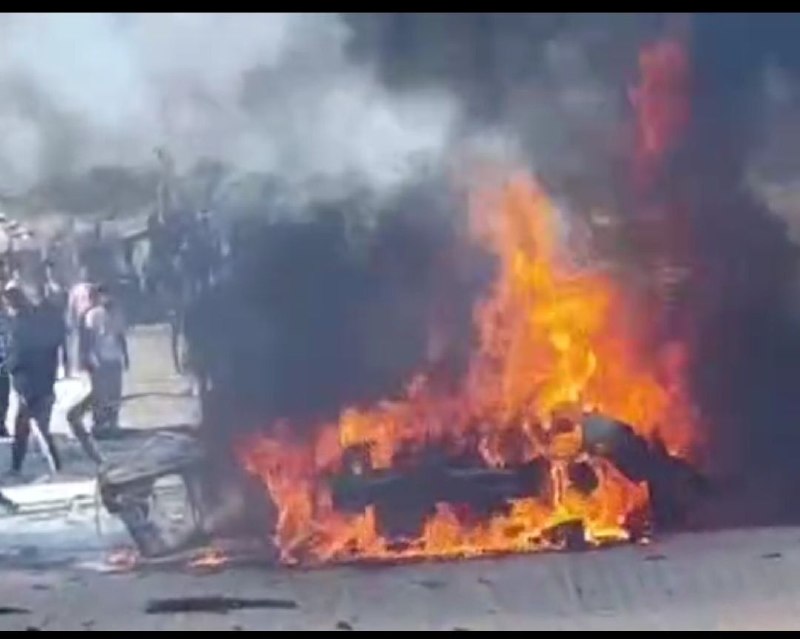
At 06:19 UTC on 4 October 2026, Al-Alam Arabic's Telegram channel posted a single line: an airstrike by occupation aircraft had targeted the vicinity of the Al-Hawouz area, south of the city of Deir al-Balah, in the central Gaza Strip. By 07:22 UTC, the same morning's wire had expanded into something more specific and more disturbing: a separate report that a six-year-old girl, named as Suha Muhammad Nasser, had died of wounds sustained when she was shot by occupation forces inside a displacement tent in Wadi al-Sabaa. Two incidents, one hour apart, on the same central front, carried by six Telegram posts from three different channels. Read carefully, they are also a lesson in what these wires do, and do not, establish.
This article reads those six posts side by side. It catalogues what they confirm, flags what remains uncorroborated, and is honest about where the evidence stops. The aim is not to litigate the morning in a single sentence. It is to show the reader how thin, and how partial, the on-the-ground record is when only regional wire channels are available, and what that thinness implies for the picture the rest of the world's press will inherit.
Two incidents, one front, six wires
The first incident is the better documented of the two, simply because it generated more posts in less time. At 06:19 UTC, Al-Alam Arabic reported the airstrike in the Al-Hawouz area south of Deir al-Balah, with no casualty figure attached. Two minutes later, at 06:21 UTC, the Gaza Alanpa channel posted an update naming an Israeli drone strike on a vehicle near Al-Hawouz and reporting injuries. At 06:41 UTC, the same Gaza Alanpa account carried an attribution to "a source with Gaza's ambulance and emergency services" saying one person had been killed and ten others injured in an Israeli airstrike targeting a vehicle south of Deir al-Balah. The same minute, AMK Mapping, an open-source channel that aggregates incident reports, independently described an Israeli "targeted assassination drone strike" on a jeep in Deir al-Balah, with the same one-killed, ten-injured toll.
The second incident is, on the face of it, harder to verify. The 07:22 UTC Al-Alam Arabic post attributes the death of Suha Muhammad Nasser to "local sources" and places the shooting inside her family's displacement tent in Wadi al-Sabaa, attributing the gunfire to "occupation forces." No other channel in the six-item cluster reports this incident. No ambulance service, no international wire, and no Israeli military spokesperson reference appears in the available items.
What the wires actually say
Stripped of headline language, the verified core of the morning's reporting is narrow but specific. An Israeli drone or airstrike hit a vehicle in the Al-Hawouz area, south of Deir al-Balah in central Gaza, at approximately 06:19 UTC on 4 October 2026, leaving one person dead and ten injured. A six-year-old Palestinian girl, Suha Muhammad Nasser, died after being shot by what the citing channel describes as occupation forces inside a displacement tent in Wadi al-Sabaa, with the time of death reported as 07:22 UTC. The instrument in the first case is described variously as a drone strike and an airstrike. The instrument in the second is described only as gunfire.
Two specific words warrant scrutiny. AMK Mapping's 06:41 UTC post uses the phrase "targeted assassination drone strike." That wording is the channel's own framing, not a confirmation of the target's identity. It describes the method (a drone strike against a specific vehicle) and a claimed intent (assassination), but it does not name who was in the vehicle, what affiliation they held, or whether any party outside the channel has corroborated the targeting. Gaza Alanpa, by contrast, sticks closer to the language of the ambulance-service source it cites: airstrike, vehicle, one killed, ten injured. The two wordings are compatible in the sense that a targeted drone strike on a specific vehicle is a plausible description of a strike that produced one fatality, but the channels are not, in this cluster, corroborating each other so much as paraphrasing the same original source from different angles.
What we verified, and what we could not
This article is built entirely from six Telegram posts. That is the available record, and the ledger below names what those posts do, and do not, support.
Verified against the cited posts:
- An airstrike or drone strike hit a vehicle south of Deir al-Balah at approximately 06:19 UTC on 4 October 2026, with the strike attributed to Israeli forces by every channel reporting it.
- The casualty toll of one killed and ten injured is reported identically by Gaza Alanpa (citing the Gaza ambulance and emergency services) and by AMK Mapping.
- A second, separate incident is reported: the death of a six-year-old Palestinian girl, named as Suha Muhammad Nasser, inside a displacement tent in Wadi al-Sabaa, attributed to gunfire by "occupation forces."
- The time of the second report is 07:22 UTC on 4 October 2026.
Not verified, and not in the available record:
- No Israeli military statement, no IDF Spokesperson briefing, and no Israeli media report on either incident is included in the six-item cluster.
- No international wire (Reuters, Associated Press, Agence France-Presse, BBC, Al Jazeera English) is included in the six-item cluster.
- No United Nations Office for the Coordination of Humanitarian Affairs (OCHA) flash update is included in the six-item cluster.
- No identification of the vehicle's occupant or occupants is present. AMK Mapping's use of the word "assassination" is not corroborated by any independent source in the cluster.
- No medical-facility name is given for where the ten injured were treated, or for the body of the deceased.
- The relationship, if any, between the two incidents is not addressed by the wires. The cluster does not specify whether the airstrike and the Wadi al-Sabaa shooting are connected, sequential, or coincidental.
- The Wadi al-Sabaa shooting is reported by a single channel. The other five posts in the cluster concern the Al-Hawouz strike.
The verification ceiling is the verification ceiling. The article does not claim more than the six posts support.
How to read the framing
The channels in this cluster, taken together, read less like a coordinated newsgathering operation and more like a relay. Al-Alam Arabic breaks the news of the airstrike; Gaza Alanpa, citing a single ambulance-service source, layers on a casualty count; AMK Mapping repeats the same count with sharper framing. The structure is familiar from other rounds of Gaza coverage: an early flash, a single humanitarian-services attribution that gets repeated, and a parallel mapping channel that adds interpretive language ("targeted assassination") without naming a primary source. The repetition of a figure across channels that are likely drawing on the same upstream source is not, on its own, independent confirmation. It is, at best, a single piece of information with a wider distribution.
The cluster also illustrates what does not travel well through this kind of wire. A strike that produces a defined casualty count from a named emergency service, in a named district, with a named weapon system, is the kind of event that propagates fast. A child killed inside a displacement tent, with no institutional source attached, is the kind of event that can be reported once and then orphaned. The asymmetry is structural, not editorial. It does not mean one incident is more real than the other. It means one of them is more legible to the channels that pick up the original posts and pass them on.
What is at stake
If a reader outside the region sees only the headline "airstrike south of Deir al-Balah," they will read it as one event. The cluster contains two events, of different kinds, in different places, at different scales, with different evidentiary foundations. The first is a strike on a vehicle in a named district, with a single-source casualty count that has been repeated by parallel channels. The second is the death of a child inside a tent, carried by a single channel and no other available source. Both are serious. Neither has yet been independently corroborated beyond the cluster. The Monexus assessment is that any reporting built on this cluster should treat the two incidents as separate, label the casualty figures as originating with Gaza's ambulance and emergency services, and treat the Wadi al-Sabaa report as a single-channel claim awaiting independent verification.
The next forty-eight hours will be the test. If a Reuters or AFP dateline confirms the Al-Hawouz strike with on-the-ground reporting, the cluster's core finding will hold. If the IDF publishes a statement naming the target of the vehicle strike, the "targeted assassination" language will acquire independent backing. If the Wadi al-Sabaa shooting is picked up by an international wire, the death of Suha Muhammad Nasser will enter the wider record. If none of those things happens, the morning's picture will be the picture drawn from these six posts, and only from these six posts. That is the constraint this article operates inside, and it is the constraint named here so the reader can see it.
How Monexus framed this: the article treats the six Telegram posts as the entire available record, separates verified from unverified claims in an explicit ledger, and declines to use either Israeli or Palestinian framing as a stand-alone factual basis. The aim is to let the reader see the morning's evidence the way the wires themselves present it.
Wire provenance
This editorial synthesis draws on the following public wire/social posts:
- https://t.me/alalamarabic/507753
- https://t.me/gazaalanpa/25828
- https://t.me/gazaalanpa/25830
- https://t.me/AMK_Mapping/38597
- https://t.me/gazaalanpa/25837
- https://t.me/alalamarabic/507782