U.S. military MH-60R squawks 7700 over Red Sea near Yanbu, vanishes from ADS-B
An MH-60R helicopter squawked 7700 west of Yanbu on the evening of 5 October 2026, dropped to zero altitude on tracker feeds, and then disappeared from ADS-B, according to five open-source flight-watch posts. Four of the items call it a U.S. Navy airframe; one tags it USAF. No official statement has been verified.
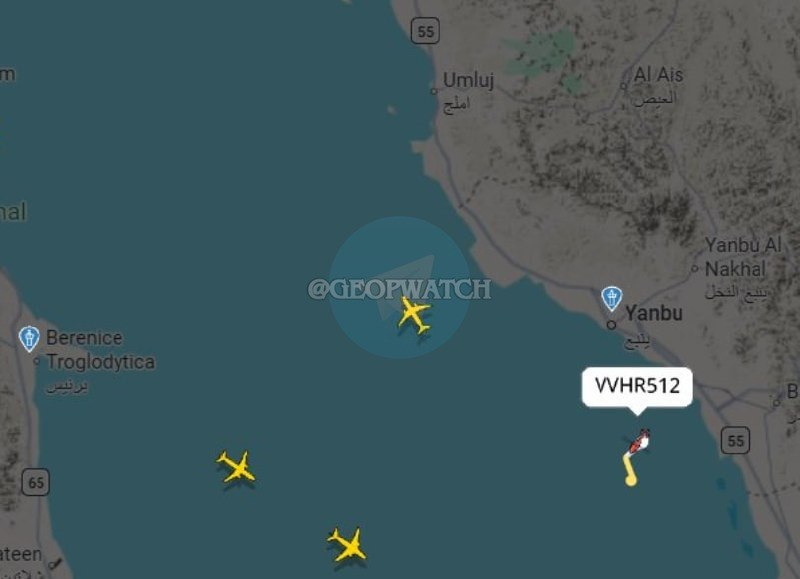
At 21:31 UTC on 5 October 2026, the open-source flight-watch account Middle East Spectator flagged an MH-60R helicopter squawking 7700, the international in-flight emergency transponder code, in the Red Sea off the Saudi port city of Yanbu. A follow-up post from the same account at 21:34 UTC described the helicopter, in informal language, as having "crashed." Within minutes, other OSINT channels picked up the trace, and by 22:16 UTC a fifth post had aggregated the same track under the same headline.
The narrow factual footprint, as logged by five open-source items, is this: an MH-60R declared an emergency over the Red Sea near Yanbu, its altitude read "zero before the aircraft disappeared from tracking" according to one of the posts, and the airframe was not subsequently recovered on commercial-grade trackers. Service branch is not settled. Four of the five posts call the airframe U.S. Navy; one, from GeoPWatch at 21:53 UTC, tags it "USAF." No U.S. Navy, U.S. Air Force, U.S. Central Command or Saudi official statement has been verified in the available items.
What the five items actually say
Read in sequence, the five posts describe one event, not two or three. The first item, from Middle East Spectator at 21:31 UTC, established the squawk and the location. The second, from the same account at 21:34 UTC, escalated the language to "crashed." The third, from intelslava at 21:47 UTC, described the event in the most operational terms of the set: an MH-60R squawking 7700 with, in the post's own words, its altitude reading "zero before the aircraft disappeared from tracking." The fourth, from GeoPWatch at 21:53 UTC, named the airframe, the transponder code, the loss of the ADS-B signature, and the same general area; this is also the post that departs from the others on service branch, labelling the helicopter "USAF." The fifth, from megatron_ron at 22:16 UTC, summarised the same track as a "crush[ed]" airframe off the coast of Yanbu.
The accounts are independent in the sense that they were posted by different operators. They are not independent in substance. They are working from the same underlying ADS-B feed and the same transponder code, which means the items corroborate each other's timing rather than each other's underlying observation. The substance is the open-source feed itself, re-described five times.
What the sources do not specify
A few important limits are worth stating plainly. The available items do not specify how many people were on board, whether the airframe has been recovered, whether the helicopter was operating from a U.S. Navy vessel, an aircraft carrier, or a land base, or whether Saudi Arabia's Royal Saudi Naval Forces or any other regional partner was involved. The available items also do not specify a cause: no mechanical failure, no hostile action, no weather factor is named in any of the five posts. "Crashed" and "crushed" appear in three of them, but the words are the posters', not an investigator's.
The service-branch split also matters. Three of the items that name a branch say U.S. Navy; one says U.S. Air Force. Without an official release, this branch cannot resolve that. MH-60R Seahawks operate from U.S. Navy carrier and surface-combatant decks; the type is not a standard U.S. Air Force inventory helicopter. That structural fact makes the Navy attribution the more plausible read of the available evidence, but it is a read, not a confirmation, and the four-versus-one split is worth flagging rather than smoothing over.
This matters because 7700 is a distress call, not a verdict. Aircraft squawk 7700 for engine failures, hydraulic loss, fuel exhaustion, bird strikes, controlled descents after gear issues, and, in some cases, after crew-initiated precautionary descents when a transponder problem makes further flight inadvisable. The transponder code tells the watching world that the crew is in trouble; it does not tell the watching world why.
The compressed gap between signal and verdict
Monexus assessment: there is a pattern worth naming. Open-source flight tracking has become fast enough that the gap between an aircraft declaring an emergency and a public claim that it has crashed has collapsed from hours, a decade ago, to minutes, today. That compression is genuinely useful for families, for search-and-rescue coordination, and for accountability. It also produces a specific failure mode: a single phrase, posted early, can harden into the public record before any official has spoken.
In this case the early phrase was "crashed," used by the second item in the sequence and echoed by the fifth. The accurate formulation is narrower, and it tracks the evidence: an MH-60R squawked 7700 over the Red Sea near Yanbu, registered an altitude of zero on the open-source feed according to one of the posts, lost its ADS-B signature, and has not reappeared on the open-source feed. Four of five open-source items identify it as a U.S. Navy airframe; one identifies it as U.S. Air Force. No U.S. military or Saudi statement has been verified.
What to watch next
Two signals will resolve the uncertainty in the next 12 to 48 hours. The first is a U.S. Navy or U.S. Central Command release naming the airframe, the operating unit, the number of personnel involved, and the status of the airframe and crew; that release is also the signal most likely to resolve the Navy-versus-Air Force attribution question. The second is a U.S. Coast Guard, U.S. Air Force, or Saudi-led search-and-rescue activation notice, which would indicate the scale of the response and, by implication, whether a recovery operation is underway. Absent both, the picture stays where the open-source trackers left it: a distress code, a descent, a lost signal, and a service-branch attribution that the five sources do not agree on.
The structural point is that incidents in the Red Sea basin, where U.S. military helicopters operate routinely as part of the Central Command posture, will increasingly surface first through OSINT channels rather than through official ones. That is not a problem on its own. It becomes a problem when the gap between the two is allowed to collapse before verification arrives, and the second-hand word travels further than the first.
Desk note: Monexus carried the open-source tracking claims to the published factual floor and stopped there, declining to repeat the word "crash" in the lede. Where wire outlets have framed the loss as confirmed, the editorial line here is narrower: distress code, altitude reading zero on the open-source feed, lost ADS-B signature, no official statement verified. The four-say-Navy, one-says-USAF split is flagged in the body rather than smoothed.
Wire provenance
This editorial synthesis draws on the following public wire/social posts:
- https://t.me/Middle_East_Spectator/37427
- https://t.me/Middle_East_Spectator/37428
- https://t.me/intelslava/95782
- https://t.me/GeoPWatch/40447
- https://t.me/megatron_ron/17076