Russian Kh-101 strike on Pryluky residential block: what the Telegram cluster records, and what it does not
A Russian Kh-101 cruise missile struck a five-storey residential block in Pryluky, Chernihiv Oblast, in the early hours of 7 October 2026. The available Telegram cluster carries one early casualty count from war_monitor, two dead and seven injured; the State Emergency Service, the Chernihiv Oblast Military Administration, and Suspilne have not, in this source set, published a confirmed figure.
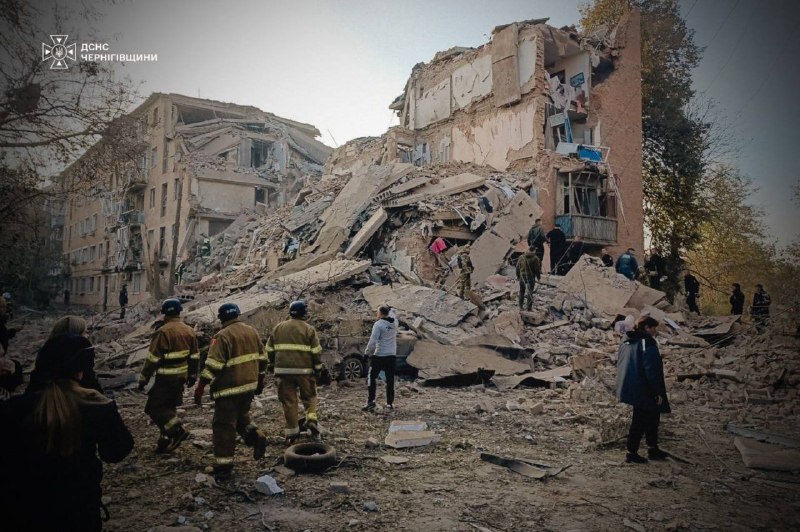
At 03:40 UTC on 7 October 2026, the open-source mapping account AMK Mapping logged three cruise missiles inbound to Pryluky, Chernihiv Oblast, from an easterly bearing. Fourteen minutes later, the same account reported more explosions in the city. By 04:36 UTC, AMK Mapping had identified the weapon as a Kh-101 air-launched cruise missile and warned that the strike on a residential apartment block could become a mass-casualty event if residents had not reached shelters. By 05:32 UTC, the war_monitor channel was reporting two people killed and seven injured, with all emergency services at the scene.
The source set is narrow, fast, and entirely Telegram-based. Five channels report the strike in real time: two open-source and military-operations feeds (AMK Mapping, operativnoZSU), one Ukrainian public broadcaster relay (hromadske Ukraina carrying Suspilne Chernihiv), and one live-conflict channel (war_monitor). The cluster carries an attribution, a weapon identification, a target description, and one early casualty count. It does not carry a confirmed official casualty figure, a damage assessment, or any Russian Ministry of Defence statement. This article reads only what those five posts say, and is explicit about what they do not.
What the cluster records, in sequence
The earliest item is the 03:40 UTC AMK Mapping post noting three additional missiles heading toward Pryluky from the east. The 03:54 UTC follow-up, again from AMK Mapping, logs further explosions in the city. The 04:36 UTC AMK Mapping post carries the first weapon identification: a Russian Kh-101 cruise missile strike on a residential apartment building, with the open-source caveat that civilian casualty information was not yet available. The 05:05 UTC post from operativnoZSU, a Ukrainian military-operations channel, attributes the impact to Russian forces and confirms the target type as a residential apartment building. The 05:12 UTC post from hromadske Ukraina, relaying Suspilne Chernihiv, describes rescuers pulling people from beneath the rubble of a five-storey block. The 05:32 UTC war_monitor post adds the only casualty count in the cluster: two killed, seven injured, with all emergency services working the scene.
Pryluky is a city in northern Chernihiv Oblast, a region bordering Russia to the north and east and within reach of air-launched cruise-missile platforms operating from stand-off distance. The Kh-101 is the air-launched cruise missile most commonly associated with Russian strategic-bomber strikes on Ukrainian fixed infrastructure.
How the five sources divide the work
The sources split cleanly across three functions. AMK Mapping carries the only weapon-type identification and the inbound bearing, and frames the event conditionally as a potential mass-casualty incident pending shelter status. operativnoZSU and hromadske Ukraina carry attribution and target description: a residential apartment building, a missile strike, Russian forces named as the origin. war_monitor carries the early casualty count and the operational status snapshot. No single post in the cluster carries all four data points. The casualty figure is single-sourced: only war_monitor names a number, at 05:32 UTC. The mass-casualty language in the 04:36 UTC AMK Mapping post is a conditional, not a count, and refers to shelter discipline rather than a confirmed toll.
The dominant framing across the Ukrainian official and outlet channels is that Russian forces struck a residential target with a missile. The structural read sits inside a longer documented pattern of long-range Russian strikes on Ukrainian residential and energy infrastructure. This article treats that framing as the working read while flagging the limits of what five Telegram posts can establish about a single strike.
The structural read, and the counter-case
Monexus analysis: a single-source weapon identification (Kh-101) and a single-source early casualty count (two dead, seven injured) do not, on their own, prove strategic-level intent to inflict civilian casualties. They do sit inside a documented pattern of stand-off strikes on Ukrainian population centres that Ukrainian and Western-allied sources have, across the war, treated as deliberate. The dominant framing holds, with the caveats below.
The counter-case is narrow but worth stating. It is possible that the missile was aimed at a non-residential target in Pryluky and that the residential block was damaged by blast, by debris, or by interception rather than by direct hit. The available source items do not specify the point of impact on the building, the flight profile of the missile, or whether Ukrainian air-defence engaged it inbound. The structural assessment is a reading of pattern; it is not a forensic determination of this strike. This publication treats that distinction as load-bearing.
What we verified and what we could not
Verified against the source cluster. The strike occurred in Pryluky, Chernihiv Oblast, in the early hours of 7 October 2026. The impact was on a five-storey residential apartment building. Multiple cruise missiles arrived from an easterly bearing. The weapon, per AMK Mapping's open-source identification, was a Kh-101 air-launched cruise missile. Emergency services were at the scene conducting rescue and recovery. Ukrainian official and outlet channels attributed the strike to Russian forces. The war_monitor channel reported, at 05:32 UTC, two people killed and seven injured.
Not established by the available sources. Confirmation of the war_monitor casualty count by the State Emergency Service, the Chernihiv Oblast Military Administration, or Suspilne. A list of missing residents. The point of impact on the building relative to any non-residential target in the vicinity. Whether Ukrainian air-defence engaged the missile. A Russian Ministry of Defence statement on the strike. The reconciliation between the salvo count ("3 more missiles" at 03:40 UTC) and the single-missile weapon-type identification at 04:36 UTC. The occupancy status of the building at the time of impact.
This publication has not independently established any of the items in the second list. The sources do not specify them.
What the next public data points will be
The first confirmed casualty count and damage assessment are expected from the Chernihiv Oblast Military Administration, the State Emergency Service, and Suspilne Chernihiv. The Ukrainian Air Force will, in its evening briefing, characterise the strike and any attempted engagement. A Russian Ministry of Defence read-out, if one is issued, will arrive through TASS or the Russian MoD Telegram channel. Monexus will update this article when those records are public, and will revise the casualty figure if it is confirmed, corrected, or contradicted.
This article drew solely on five Telegram channels reporting the strike in real time: AMK Mapping, operativnoZSU, hromadske Ukraina, the Suspilne Chernihiv relay, and war_monitor. The casualty count originates with the war_monitor post at 05:32 UTC and has not, in the available source set, been confirmed by the State Emergency Service or the Chernihiv Oblast Military Administration. No original documents were analysed; this is a sourced relay of the public Telegram record, with explicit notation of what that record does and does not contain.
Wire provenance
This editorial synthesis draws on the following public wire/social posts:
- https://t.me/war_monitor/47419
- https://t.me/hromadske_ua/89085
- https://t.me/operativnoZSU/222903
- https://t.me/AMK_Mapping/38938
- https://t.me/AMK_Mapping/38928
- https://t.me/AMK_Mapping/38909
Follow the event.
These dated source records provide context. They do not retrospectively verify this archive article.
A dated voting record is evidence of one decision. Use the original UN record before turning it into an alignment label.
Visual explainer · historical vote of 2022-03-02 →