Footage from Camp Buehring exposes a sourcing contest inside the US-Iran information war
CBS News footage of Iranian strikes on Camp Buehring in Kuwait surfaced via Iranian state outlets and open-source channels within hours, with each relay emphasising a different framing of damage and soldier testimony.
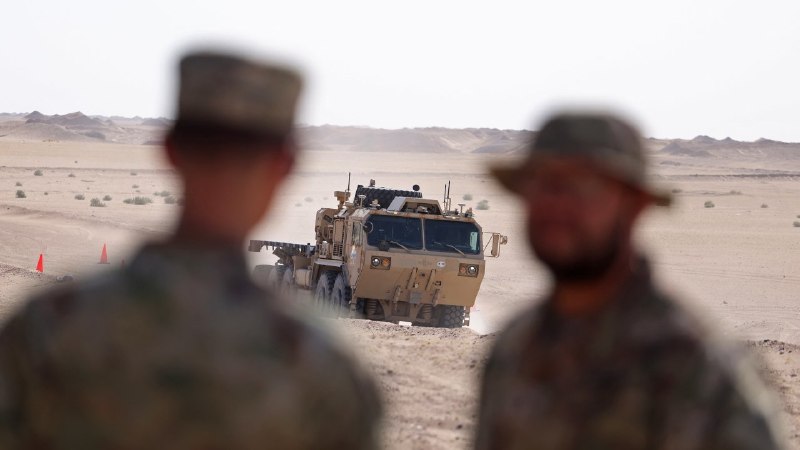
A package of footage attributed to CBS News and depicting an installation that US sources name as Camp Buehring in Kuwait began moving through Telegram channels at 22:32 UTC on 7 October 2026. The Jerusalem Post relay of the same material, posted at 02:23 UTC on 8 October, ran it under a headline that frames the strikes as having "drove US troops from" the base. The two frames land differently on the same visual record, and the divergence is the story.
The thread evidence consists entirely of relays of a single CBS News report. None of the items links to the underlying CBS investigation directly; each carries only the elements its operator chose to extract, and each drops the ones they did not. That asymmetry of access, downstream of a single primary document, is what this piece dissects. The point is not what the footage shows but how seven different relays of it produced seven different editorial emphases inside a six-hour window.
The CBS report as relayed by The Jerusalem Post
The Western-wire framing in this dataset comes from The Jerusalem Post's Telegram channel, which posted at 02:23 UTC on 8 October. Its headline characterises the footage as shedding light on Iranian attacks that "drove US troops" from the base. The Jerusalem Post relay foregrounds two specific soldier testimonies: dwindling ammunition and concerns about casualties, both described as occurring before US personnel left Camp Buehring for remote positions in Kuwait. The Jerusalem Post framing sits inside a longer Israeli media pattern of treating Gulf-based US installations as a contested operating environment rather than a sanctuary.
The Jerusalem Post relay is the only item in the dataset that uses the phrase "remote positions" for the redeployment, and the only one to lead explicitly on the ammunition and casualty testimony. The original CBS report, which none of the seven items reproduce in full, is the source of the testimony; this piece treats that testimony as relayed, not independently verified.
The Iranian state-aligned relays
Three Iranian state-aligned channels handled the same package in close succession. Fars News International posted at 22:59 UTC on 7 October, using the phrase "extensive damage" at the base. Tasnim followed at 23:15 UTC the same day, using the identical phrase for what it calls the "Udairi" base. Farsna posted at 23:44 UTC, using the transliteration "Adiri" for the same installation. All three refer to the base housing American troops in Kuwait, and all three attribute the imagery to CBS News.
The structural argument the Iranian outlets build on the footage is consistent across the three relays: Iranian missile and drone strikes have hit a named American installation hard, the damage is visible, and the cost of forward US presence in the Gulf is now a documented material fact rather than a political talking point. The Iranian outlets elide the soldier-side testimony about ammunition and casualties, focusing instead on the visual record of impacts.
The open-source relays
Three open-source intelligence channels handled the package between 22:32 UTC and 00:48 UTC. rnintel posted at 22:32 UTC on 7 October. intelslava posted at 22:47 UTC the same day, summarising the CBS material as showing Iranian drone strikes on Camp Buehring and "the aftermath, including damaged equipment and buildings," and also referencing F-5 fighters and eyewitness accounts involving pilots' helmets in the original CBS report. megatron_ron posted at 00:48 UTC on 8 October. All three state that the imagery depicts Iranian strikes on a US installation in Kuwait and all three attribute the footage to CBS News.
The open-source relays are narrower than either the Israeli or Iranian framings. They confirm the footage exists, confirm it depicts strikes on Camp Buehring, and decline to scale or interpret. None of the three open-source channels in this dataset attempt to quantify damage, casualties, expenditure, or redeployment duration. The intelslava relay also carries the F-5 and helmet detail, suggesting the original CBS report contained more granular material than any single Telegram relay transmitted in full.
What the thread evidence confirms, and what it does not
What the thread evidence confirms. Seven Telegram items, posted between 22:32 UTC on 7 October and 02:23 UTC on 8 October 2026, relay CBS News footage of Iranian strikes on an installation the US-side and open-source relays identify as Camp Buehring in Kuwait. The Jerusalem Post relay is the only item that frames the strikes as having driven US personnel from the base, and the only one to foreground soldier testimony about dwindling ammunition and casualty concerns. The Iranian state-aligned relays all use the phrase "extensive damage" and all refer to the base as either "Udairi" or "Adiri." The open-source relays confirm the footage and the strike attribution and decline to interpret further.
What the thread evidence does not specify. The thread does not contain a direct link to the underlying CBS News report; every detail is a second-hand relay. The thread does not specify the number of Iranian missiles or drones that struck Camp Buehring. The thread does not specify the number of US casualties. The thread does not specify the scale, duration, or destination of the redeployment. The thread does not specify whether the damage assessments pre-date or post-date any specific Iranian operational announcement. The thread does not mention Central Command in Tampa, the Kuwaiti Ministry of Defense, or any other institution by name as having issued or filtered read-outs. The thread does not establish the existence of a US-Iran war as a checkable fact; several items refer to "the Iran war" or "the US-Iran war," but this dataset does not independently corroborate that framing, and the phrase is used here only when quoting relays.
How the relays diverge on the same visuals
Monexus analysis: the seven relays sit on a spectrum, and the spectrum has a shape. On one end, the open-source channels (rnintel, intelslava, megatron_ron) transmit the minimum viable claim, which is that the footage exists, depicts Camp Buehring, and was obtained by CBS News. In the middle, the Iranian state-aligned channels (Fars News International, Tasnim, Farsna) add a structural interpretation: extensive damage, missile-and-drone attribution, material cost to the US presence in the Gulf. On the other end, The Jerusalem Post adds the soldier-side testimony and the causal claim that the strikes drove US personnel off the base.
Each relay adds something the others drop, and each drop is editorial. The intelslava relay carries F-5 and helmet material that the other six do not. The Jerusalem Post relay carries ammunition and casualty material that the Iranian outlets omit. The Iranian outlets carry "extensive damage" language that the open-source relays treat as interpretative overreach. The CBS material itself, by this account, is wider than any single one of its seven relays.
The thread evidence does not let Monexus say which relay is most faithful to the underlying CBS report. To make that call would require reading the original CBS investigation, which none of the seven items link to.
Stakes for the next reporting cycle
Monexus assessment: the question over the next reporting cycle is not what the footage shows, but which framing wins the wire cycle. Three clocks are running. The first is the CBS editorial clock: if CBS publishes a follow-up that names damage scale or casualty figures, the Iranian state-aligned relays will likely accelerate their "extensive damage" framing; if CBS publishes a follow-up focused on the redeployment, The Jerusalem Post's framing will likely harden. The second clock is the open-source clock: rnintel, intelslava and megatron_ron are likely to publish narrower, more cautious takes if satellite imagery or geolocation work confirms or contradicts the visual claims. The third clock is the institutional clock: if the institution identified in the open-source relays as hosting US personnel issues a primary read-out, the soldier-side testimony will either tighten or be recharacterised.
Monexus will be watching for a direct CBS News URL or on-air segment linking the footage, a US Central Command or Department of Defense primary statement addressing Camp Buehring by name, and a Kuwaiti government statement acknowledging or denying the presence of US personnel at the relocated positions. Until at least one of those appears, the dominant frame in the dataset is whatever the seven relays choose to extract.
How Monexus framed this versus the wire: where Telegram relays led on soldier testimony, damage assessments, or strike attribution as if they were established facts, this article treats every relay as a partial extract of a single underlying CBS report, names what each relay adds and drops, and separates what the thread evidence confirms from what it does not specify.
Wire provenance
This editorial synthesis draws on the following public wire/social posts:
- https://t.me/The_Jerusalem_Post/17757
- https://t.me/megatron_ron/17107
- https://t.me/farsna/466940
- https://t.me/tasnimplus/126996
- https://t.me/FarsNewsInt/263125
- https://t.me/intelslava/95903
- https://t.me/rnintel/67423
Follow the event.
These dated source records provide context. They do not retrospectively verify this archive article.
Separate what the nuclear watchdog reported from what it could not determine after the June 2025 strikes.