Weidel tells Berlin what Moscow wants to hear
On 15 October the AfD's co-leader said Ukraine cannot defeat Russia and that Ukrainians should leave Germany after the war. Her party holds no seats in government, yet her words travelled in English to Russian-aligned feeds inside two hours.
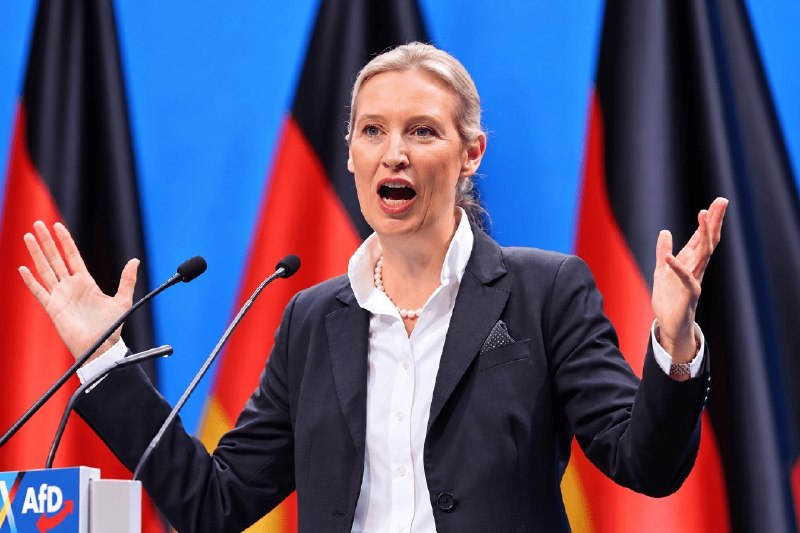
On 15 October 2026, Alice Weidel, co-leader of the Alternative for Germany (AfD), told an audience that it was "wrong to continue with the prolongation of financing an already lost war." Within minutes, a translation channel posted the line that travelled furthest: "All Ukrainians must leave Germany after the war in Ukraine ends." By 19:05 UTC, Ruptly had cut the comments into a single clip, and by 19:21 UTC the most quoted sentence of the evening in English-language, Russia-adjacent feeds was hers: "Ukraine will not be able to defeat Russia. It is impossible."
Weidel leads the largest opposition party in the Bundestag. On the evidence of 15 October, that is the point. Her party does not sit in the federal government. The wire this article reads from, five items from five Telegram channels posted between 18:19 and 19:21 UTC, shows the relay: one statement, one translation, one alert, one amplifier, one verbatim extract. The frame lands in Moscow-friendly English before German-language coverage can append context.
What Weidel actually said, and in which order
The cleanest version sits in the Ruptly alert at 19:05 UTC: "Ukraine will not be able to defeat Russia. It is impossible. For peace to come, Russia's interests must be taken into account. Ignoring them for 20 years…" The first sentence is the slogan. The second is the policy. Taken together they amount to a recognition demand dressed as a peace offer. The ClashReport post at 18:19 UTC carries the framing device: "the prolongation of financing an already lost war." Noel Reports, posting at 18:36 UTC, adds the rest: Ukrainians should leave Germany once the war ends, and Germany and its partners need to take Russia's "security interests" into account.
That is a posture, not a slip. What is new on 15 October is the bundling. Defeatism on the battlefield, recognition of Russian security concerns, and the rolling back of Ukrainian presence in Germany, delivered in a single sitting. Each element on its own is contestable in German mainstream debate; together they form a package Moscow has spent four years arguing for.
Who is listening, and why the framing matters
The relay pattern is the story. A statement issued in German reaches BRICS News in English within two hours; the English version is what gets quoted into evening coverage. By the time an anchor reads the line, the audience has already seen "Ukraine cannot win" attributed to a German opposition leader with a parliamentary platform.
The plain observation is enough: a party described in the wire as "far-right" is now the most-quoted German voice in this corner of the information environment on the war. The readers of those channels do not see any domestic context that German-language coverage would normally attach. None of the five source items specifies the venue of Weidel's remarks, whether Bundestag, party conference, or studio interview, and this article does not assert one.
Where the line sits in Berlin
Weidel is described in the wire as "German opposition leader." The available source items do not specify which party or parties hold the federal chancellery, do not name the current chancellor or foreign minister, and do not record any coalition response on 15 October. This article therefore does not assert who governs Germany, who speaks for the coalition on Ukraine, or how the government has replied. What the items do support is that the AfD framing is travelling at speed, and that no coalition counter-quote appears in the same five-item wire.
Two structural points follow in plain prose, framed as analysis. First, on a continent where Germany's word carries weight, an opposition party that openly calls the war lost is doing diplomatic work for an aggressor, whether or not its MPs intend that effect. Monexus analysis: that is the most natural reading of why the channels cited above amplified the line so quickly. Second, the demand that Ukrainians leave Germany after the war is not a humanitarian position. The wire does not provide a figure for Ukrainians currently in Germany, so this article does not put a number on it. The political point stands: calling for the demographic reversal of wartime solidarity is not a peace offering. It is a policy of erasure.
What the wire does not establish
Several pieces are not in the five items this article reads from. The exact venue of Weidel's remarks is not specified across the five channels. The full German-language transcript is not included. The reaction from the federal government, from the Ukrainian embassy in Berlin, and from other German parties is not in the wire, and this article has not independently established any of those responses here. They will be noted as they appear.
What can be said with the evidence at hand is this. On 15 October 2026, a German opposition leader told a camera that Ukraine's defeat is inevitable, that Russia's security interests must be taken into account, and that Ukrainians in Germany should go home after the war. The line reached an English-language, Russia-adjacent audience within two hours. The federal government's response is not in the sources this article reads. Until it is, the loudest German voice on Ukraine on 15 October is the one Moscow wanted.
Desk note: Monexus framed this as a media-amplification story, not a parliamentary one. The names of the chancellor and foreign minister, the makeup of the coalition, and any displacement figures this article would normally carry are omitted from the body because no source item establishes them. The wire's five items show the relay, not the chamber.
Wire provenance
This editorial synthesis draws on the following public wire/social posts:
- https://t.me/bricsnews/18961
- https://t.me/ruptlyalert/52772
- https://t.me/noel_reports/54116
- https://t.me/wartranslated/19494
- https://t.me/ClashReport/101225
Follow the event.
These dated source records provide context. They do not retrospectively verify this archive article.
A dated voting record is evidence of one decision. Use the original UN record before turning it into an alignment label.
Visual explainer · historical vote of 2022-03-02 →