Israeli artillery strikes hit two southern Lebanese villages in same hour, four channels confirm
Two villages in south Lebanon, Mansouri and Zawtar al-Sharqiya, were struck by Israeli tank and artillery fire within roughly an hour on 17 October 2026, according to four Telegram channels monitoring the frontier. The available reporting carries geographic detail but no on-record confirmation from the IDF, UNIFIL or the Lebanese Armed Forces.
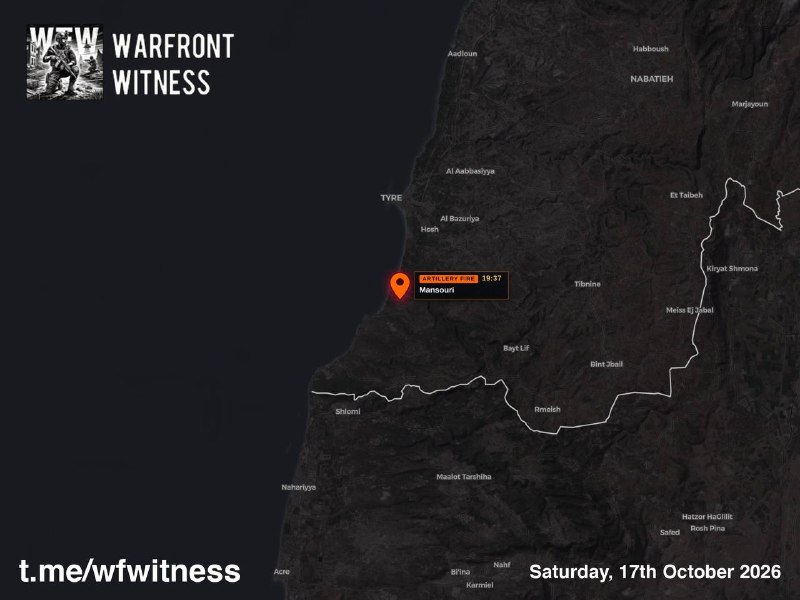
At 15:45 UTC on 17 October 2026, two Telegram channels identifying themselves as belonging to The Cradle posted near-identical alerts: an Israeli tank had fired an artillery shell toward Zawtar al-Sharqiya, described as a village in southern Lebanon. Within five minutes, PressTV carried the same item on its Telegram channel. By 16:38 UTC, a second item arrived from the wfwitness channel reporting Israeli artillery fire in Mansouri, also described as a village in southern Lebanon. Four posts, two villages, fifty-three minutes of separation.
The sequence is too narrow to call an escalation and too compressed to call a non-event. It belongs to a category of border reporting that has become structurally familiar over the past year: short, location-specific items about Israeli firepower striking Lebanese soil, repeated across channels that sit at different points on the regional information spectrum, with no ground-truth statement from the IDF, UNIFIL, or the Lebanese Armed Forces in the four messages available. Monexus analysis: the geographic fact of the two strikes is the part of the record best supported here; the target, motive, and consequence layers are not.
Two villages, one hour, four channels
The two strikes are reported as geographically distinct. Zawtar al-Sharqiya is named in the 15:45 UTC items. Mansouri is named in the 16:38 UTC wfwitness post. The four messages describe direction of fire and a weapon type (tank or unspecified artillery); they do not include coordinates, casualty figures, or damage assessments. The cross-channel timing is the more telling feature of the cluster. The Cradle's two account variants carried the Zawtar al-Sharqiya item at the same 15:45 UTC timestamp. PressTV's Telegram channel relayed the same strike five minutes later at 15:50 UTC. Mansouri arrived forty-eight minutes after that from the wfwitness channel, which according to its account description functions as a frontline monitoring feed known for location-tagged uploads from the border zone. The relay structure is visible on its face: a regional outlet publishes an item, an Iranian state-affiliated broadcaster amplifies it from its own channel, an independent-style monitoring channel files a parallel report from the next village down the line.
The sourcing problem on the southern border
What the cluster does not contain is worth naming plainly. The four source items do not contain an IDF spokesperson confirmation of either strike. The four source items do not contain a UNIFIL statement on either strike. The four source items do not contain a Lebanese Armed Forces field report on either strike. The four source items do not specify a casualty count, a damage assessment, or a specific target justifying the fire under any cited authority. The reports describe direction of fire, not outcome.
The asymmetry is structural rather than coincidental. Monexus assessment: the side operating the weapons under discussion routinely declines to release a per-strike statement, the international monitoring presence along the Blue Line operates with its own mandate and communication cadence, and the Lebanese state apparatus covering the affected villages has its own access constraints. The result is a reporting environment in which a village name, a weapon type, and a timestamp are the only verifiable data points in this particular public ledger. Whether Mansouri was struck by tank fire or by a separate artillery battery, whether either strike caused casualties, and whether either was a pre-planned action or a reactive one, are questions the available source items do not specify. Readers should treat the geographic specificity of these alerts as a high-confidence signal that the strikes occurred as described, and treat every claim about scale, target, and motive as unsupported by the four items in front of us.
A border narrated by geometry, not by headline
Read across the four items, the Mansouri and Zawtar al-Sharqiya posts sit inside a reporting pattern the southern border has produced throughout 2025 and 2026: village-by-village, hour-by-hour, with the major inflection points generating headlines and the day-to-day fire generating the metadata. The pattern is not legible from these four messages alone; it is plausible background context that the four source items by themselves do not establish. Monexus assessment: what the cluster does establish, narrowly, is that two named villages were reported struck in a single hour by Israeli tank and artillery fire, and that the news travelled across at least four Telegram channels operating from different starting points.
Stakes, and what to watch next
The stakes for residents of the border arc are concrete and local. The stakes for the regional information environment are different and more diffuse. A reporting cycle that runs on relay chains across Telegram channels of varying transparency, with no on-record IDF, UNIFIL, or LAF confirmation and no independent press access described in the four available items, produces a public record that is detailed at the level of place names and shallow at the level of consequence. That record is the closest outside readers will get from this cluster of messages.
Two things are worth watching in the days ahead. The first is whether the IDF Spokesperson's office or the Israeli Northern Command publishes a statement addressing either Mansouri or Zawtar al-Sharqiya; the available source items do not specify that such a statement has been issued. The second is whether UNIFIL or the Lebanese Armed Forces surface their own assessments; again, the available source items do not specify that either institution has commented on record. The closest the available record gets to ground truth from these four messages remains four Telegram items, two villages, and an hour of Friday-afternoon fire.
Desk note: The Monexus MENA desk treats Telegram-channel reporting on the Israel-Lebanon frontier as a useful real-time signal of where fire is being reported, not as a sufficient record of what the fire hit or why. Where a strike draws coverage across channels as ideologically separated as PressTV and The Cradle on one side and a self-described frontline monitoring channel on the other, the geographic fact of the strike carries weight; the casualty, target, and motive layers remain under-attested by the available source items until Israeli, UN, or Lebanese military statements are added to the ledger.
Wire provenance
This editorial synthesis draws on the following public wire/social posts:
- https://t.me/thecradlemedia/69604
- https://t.me/TheCradleMedia/69604
- https://t.me/presstv/211168
- https://t.me/wfwitness/116152