Israeli tank fire, airstrikes and demolition charges hit two south Lebanon villages in a single afternoon
Six Telegram alerts from PressTV, The Cradle Media and a south Lebanon witness channel place Israeli armour, jets and demolition charges on Zawtar al-Sharqiya and Kfar Tebnit between 14:57 and 15:50 UTC on 17 October 2026, with no Israeli or Western-wire confirmation attached to the cluster.
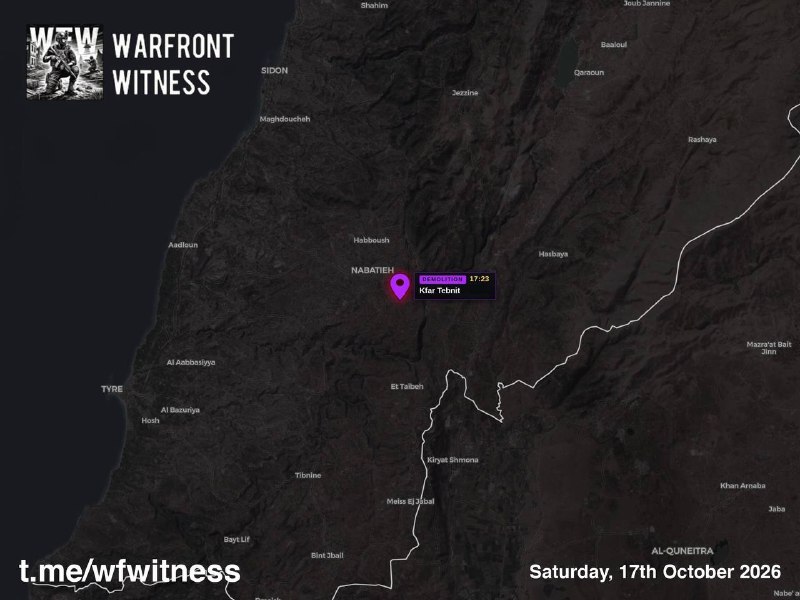
An Israeli tank fired an artillery shell at the southern Lebanese village of Zawtar al-Sharqiya at 15:50 UTC on 17 October 2026, according to PressTV, with the same incident reported by The Cradle Media at 15:45 UTC. The tank round was the final item in a six-post cluster that began just under an hour earlier with an Israeli detonation against the neighbouring town of Kfar Tebnit and a parallel artillery reference to Zawtar al-Sharqiya, and was punctuated at 15:27 UTC by an Israeli overflight of the same sector.
The whole cluster cleared within a 53-minute window, from the first Kfar Tebnit item at 14:57 UTC to the PressTV tank alert at 15:50 UTC. That is the load-bearing fact: six Telegram posts, three channels, two named villages, one afternoon. What the cluster does not contain is any Israeli military spokesperson comment, any Western-wire strike confirmation, or any casualty count from the Lebanese health authorities. The available items describe Israeli armour, jets and demolition charges hitting specific named villages on a specific afternoon. They do not say what was being targeted, who was hurt, or what the Israeli command intended.
The six alerts, in order
The first item in the cluster is dated 14:57 UTC on 17 October 2026: an Israeli detonation targeting the town of Kfar Tebnit, in southern Lebanon, posted by the channel Witnesses Media. One minute later, the same channel posted a second item bundling the Kfar Tebnit detonation with Israeli artillery fire against Zawtar al-Sharqiya. At 15:27 UTC, the same channel logged Israeli jets over southern Lebanon; the overflight was reported without an accompanying strike in the same post. At 15:45 UTC, The Cradle Media posted a duplicate of the tank-on-Zawtar alert. Five minutes later, PressTV posted the same line.
Read sequentially, the six items describe a layered afternoon: demolition charges on one village, tank artillery on the next, jets overhead in the same sector. Two of the three originating channels track closely with Iran-aligned or Hezbollah-adjacent media ecosystems, which is a characterisation of their editorial posture rather than a comment on the veracity of any individual post. The third, Witnesses Media, aggregates frontline video from the south Lebanon border area; the available source items do not specify where the channel itself is based. None of the three is a neutral observer in the wire-service sense. None of the six items names a target type, a unit, or a casualty figure.
Why these two villages matter
Zawtar al-Sharqiya and Kfar Tebnit sit close together inside the southern Lebanese frontier band where Israeli forces have conducted near-daily fire missions since the November 2024 resumption of operations. The pair are close enough that a single afternoon's fire plan can plausibly cover both, and that is what the timing on 17 October shows. PressTV, The Cradle Media and Witnesses Media each name the villages specifically. The available items do not specify what was being targeted at either village, nor whether any launch sites, infrastructure or personnel were hit.
The structural frame is not subtle. Cross-border fire between Israel and the south Lebanon front has, by October 2026, settled into a persistent but low-grade tempo: Israeli strikes almost daily, Hezbollah rocket and drone attacks on Israeli northern communities intermittent but recurring. The 17 October cluster does not break that pattern. It is the pattern, repeated at village scale. Monexus assessment: the operational signal is less about any individual round than about the willingness of Israeli forces to layer armour, air and demolition fire on adjacent villages inside a single afternoon, on the strength of post-strike reporting that originates almost entirely outside the Western wire ecosystem.
The sourcing gap, named
All six alerts in this cluster originated with PressTV, The Cradle Media and the channel Witnesses Media. PressTV is the Iranian state broadcaster's English-language service; The Cradle Media has covered Hezbollah closely since 2024; Witnesses Media aggregates frontline video from the south Lebanon border. The contradiction this creates is structural. The Telegram alerts say Israeli jets, Israeli tanks and Israeli detonation charges hit specific named Lebanese villages on a specific afternoon. Israeli forces routinely acknowledge strikes in the same corridor, sometimes within hours, sometimes the following morning, through IDF Spokesperson briefings or Hebrew-language wire pickups that the available file does not contain.
This publication's working assumption is that the strike activity is real, because the geographic detail matches the established campaign pattern, because the alerts do not contradict each other, and because two independent channels posted the tank-on-Zawtar alert within a five-minute window. What the cluster does not establish is the human toll, the target type, or the Israeli command's stated justification. The available items contain no casualty figure, no Lebanese health ministry release, and no Israeli military statement attached to the alerts.
What to watch next
Two files carry the next 48 hours of weight. First, the Israeli military's daily operational summary for 17 October, which historically publishes within 24 hours and which would either confirm the Zawtar and Kfar Tebnit strikes with location and casualty detail, or fail to mention them. Second, the United Nations Interim Force in Lebanon (UNIFIL) daily sitrep, which logs any cross-border fire reported by peacekeepers in the same sector. If both confirm the strikes, the alerts graduate from Telegram-level evidence to corroborated reporting. If neither does, the cluster remains what it now is: six posts across three channels reporting fire into two villages, with the Israeli command's account of the afternoon absent from the file.
The wider question is whether the tempo itself shifts. Six alerts inside 53 minutes, on adjacent villages, sits at the higher end of the daily rhythm this publication has been tracking through October. If 18 October produces a similar cluster, the assessment is that Israeli forces have moved from suppression to a deliberate pressure campaign along the southern corridor. If it does not, 17 October reads as one busy afternoon inside an already-busy month.
Desk note: Monexus has framed this story strictly from the six Telegram alerts available at filing, naming the outlets that originated each item and noting that no Israeli military or Western-wire confirmation had cleared by publication. The story does not infer Israeli intent beyond what the available posts describe, and does not infer Hezbollah activity beyond the established cross-border context.
Wire provenance
This editorial synthesis draws on the following public wire/social posts:
- https://t.me/presstv/211168
- https://t.me/thecradlemedia/69604
- https://t.me/TheCradleMedia/69604
- https://t.me/wfwitness/116128
- https://t.me/wfwitness/116129
- https://t.me/wfwitness/116140