One channel’s count of artillery fire across southern Lebanon
A Telegram monitoring channel reported at least 12 artillery strikes across southern Lebanon in the hour before 22:17 UTC on 31 October 2026, half of them aimed at the town of Maifadoun.
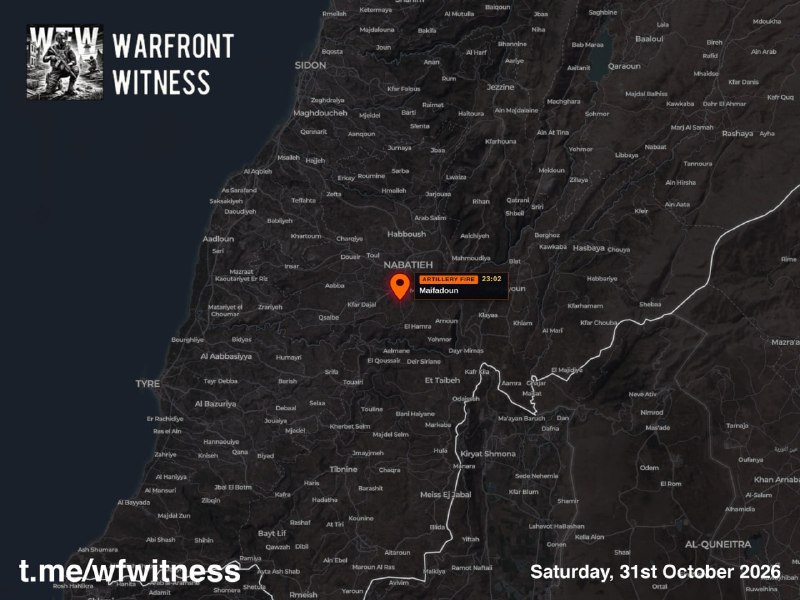
Between 20:48 and 22:17 UTC on 31 October 2026, a Telegram channel called WarFront Witness posted six updates describing Israeli artillery fire across southern Lebanon. By its last two posts, the channel put the count at “at least 12 artillery strikes” in the past hour, half of them aimed at the town of Maifadoun. The posts carry no casualty figures and no damage assessment. They do carry a sequence: Wadi Zebqine and Kfar Tebnit first, then Maifadoun and Wadi al-Hujeir, all within roughly ninety minutes. This article has not independently established that sequence from wire or official sources.
This is one channel’s account of one evening, and this publication treats it as a claim to be tested, not a finding. Monitoring accounts from border zones often reach readers before any newsroom can check them, and their speed is their value. The risk is that a published count begins to behave like a fact. The useful questions are what would have to be true for the timeline to hold, and who else could confirm it.
The evening, post by post
The earliest posts, timestamped 20:48 and 20:52, describe Israeli artillery bombardment on Wadi Zebqine coinciding with machine gunfire on Kfar Tebnit. At 20:57 the channel reported constant bombardment of Maifadoun, with shelling also targeting Wadi al-Hujeir. The 21:03 post said footage from Maifadoun confirmed an artillery bombardment on the town, and that exclusive sources to the channel had reported at least six strikes in the area. The six items supplied contain nothing between 21:03 and 22:13.
The final two posts, at 22:13 and 22:17, widen the frame to southern Lebanon as a whole. Both give the same figure: at least 12 artillery strikes in the past hour, half of them targeting Maifadoun. Half of twelve is six, which matches the 21:03 figure for the area. Monexus analysis: if those six are the same strikes, the numbers describe one sustained bombardment. If they are separate, the channel is describing fire spread across several villages. The thread does not say which.
What one channel can and cannot establish
Every item in the thread comes from WarFront Witness, and the channel’s own language carries a judgment. Its two latest posts, at 22:13 and 22:17, describe the evening’s fire as “a significant Israeli escalation.” The thread text cuts off mid-sentence after that phrase, so this article does not characterise whatever followed. The channel refers to footage and to exclusive sources, but the thread reproduces neither the footage nor the identity of those sources.
The available source items do not specify whether the Israeli military has described these strikes, and this article has not established that it has. Any complete account would need that response, if it exists, set beside the civilian impact, which the thread does not supply.
Several readings remain open. The channel may be recording a sharp increase in shelling in a contested border zone. It may be counting at a granularity that inflates the total, with overlapping reports of the same rounds. Or the evening may be a harsh but recurring feature of a front that the thread’s language of escalation does not capture. Each reading predicts something different. An increase predicts casualty reports from local medical sources. Overlap predicts a revised tally. Recurring fire predicts similar posts from earlier days, and the thread contains none.
The phrase “at least” carries more weight than it first appears to. A floor count from a monitoring source is not a ceiling, and it is not a median. It tells a reader that the strikes reported number no fewer than twelve, and says nothing about how many went unrecorded. Reporters working the same ground would want to know which posts were counted and whether any were duplicated. The thread answers neither question.
A correspondent with no editor
Monexus analysis: a channel like this works as a field correspondent with no editor. It can reach a village faster than an agency can send a reporter, and it can go wrong the way a reporter might, by overstating a tally or passing one street’s rumour along as a district’s pattern. The difference is that no newsroom stands between the count and the reader. For a desk that wants to write about this region with restraint, that gap is the central problem.
Monexus analysis: the structural point concerns the information environment itself. Coverage of southern Lebanon often depends on a small number of reporters who can reach the villages in real time, on Lebanese outlets, and on the public statements of the forces involved. When fire lands where few reporters can get to quickly, a monitoring account can fix the early timeline, and that timeline travels through reposts before independent confirmation arrives. The thread shows the first step of that sequence with unusual clarity, which is why it rewards a slow reading.
What would confirm the count
Four kinds of evidence would move the thread from claim to record: footage that can be geolocated to the named wadis and villages, casualty reports from local medical sources, an account from the Israeli military, and independent reporting that tests the strike count against any official figure. The thread supplies the first only as description. Monexus forecast: the next test is likely to be whether the Maifadoun footage can be matched to specific locations, and whether the 21:03 and 22:17 figures can be reconciled into one count.
The stakes are concrete for the people in the villages named. A count that overstates the pattern costs the channel credibility with its next reader. One that understates it may leave the public less informed when information matters most. In a border zone, either error weighs more than it does in a newsroom with time to check, and the people closest to the fire appear in this thread only as place names.
What remains uncertain outweighs what is established. The thread contains no casualty figures, no independently verified imagery, no named sources and no second account against which the channel’s numbers can be checked. The figure of 12 is an estimate from a single account, and the channel itself uses “at least” throughout, which is the more defensible framing. Until a second source describes the same evening, the most a reader can take from it is that one channel reported fire on a specific set of places on the evening of 31 October 2026.
A timeline that cannot yet be checked still tells a reader where to look. The open question is whether anyone with a verifiable record starts looking in those villages too, and how quickly.
Desk note: where a wire would publish a tally, Monexus treats this one as a claim from a single channel, with the Israeli attribution carried as that channel’s own.
Wire provenance
This editorial synthesis draws on the following public wire/social posts:
- https://t.me/wfwitness/118043
- https://t.me/wfwitness/118044
- https://t.me/wfwitness/118045
- https://t.me/wfwitness/118047
- https://t.me/wfwitness/118063
- https://t.me/wfwitness/118066