Trump Says There's a Deal. Iran Says There Isn't. Someone Is Wrong, and the Gulf Knows It.
Trump told reporters a deal was 'possible over the weekend' the same hour a drone hit Kuwait's main airport. Iran's foreign minister denied any progress. The Gulf is pricing in the gap.
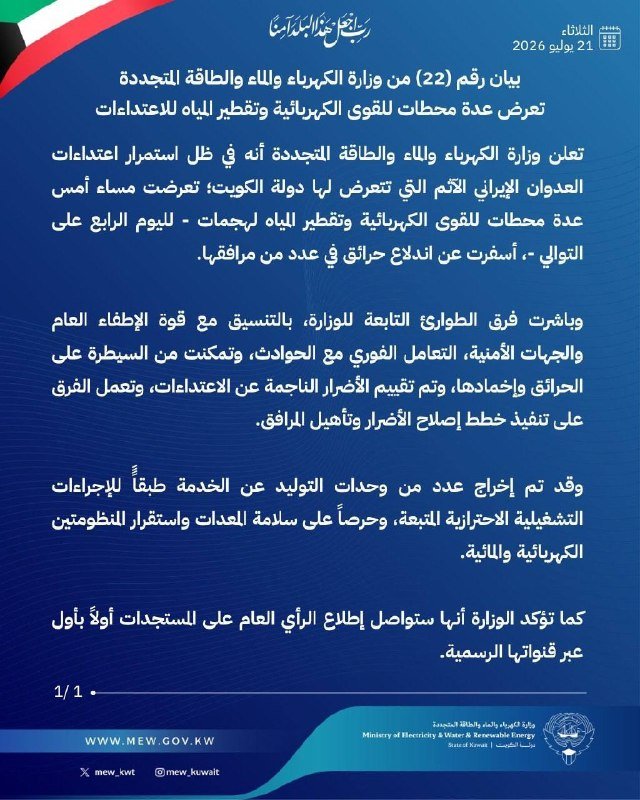
On 31 May, the same hour that Donald Trump told reporters a deal with Iran was "possible over the weekend," a Shahed-136 drone punched through the roof of Terminal 1 at Kuwait International Airport. Kuwaiti officials released the CCTV footage within hours. Iran's Islamic Revolutionary Guard Corps countered that the damage was caused by a failed US Patriot interceptor, not by an Iranian weapon. By Wednesday evening, Iran's Foreign Minister Abbas Araghchi was on the wire insisting that the negotiations had produced "no tangible progress," even as Trump described them as "going very well." The dissonance was not a communications failure. It was the posture.
The conventional wire frame treats the war and the diplomacy as a sequence: violence first, then talks, then either a deal or a collapse. That frame cannot account for what the Gulf is watching. On 3 June, Araghchi framed Iranian strikes on US bases in the Persian Gulf as "legitimate self-defence." The same day, the US House of Representatives passed a War Powers resolution 215 to 208, with four Republicans joining Democrats to halt the Iran campaign, after three prior failures. Trump told the New York Times the war was "not a big thing" for the United States. Kuwait was absorbing the cost of a conflict it did not start, on infrastructure it did not choose.
The money already moved
Markets and ministries are pricing in a parallel reality. The dollar's role as the unit of account for Gulf energy has not wavered, but the risk premium attached to transiting the Strait of Hormuz has. Kuwait International Airport is not a military target in any doctrine the Pentagon publishes; it is the sovereign infrastructure of a Gulf state that hosts US forces and has spent two decades advertising itself as the region's most boringly reliable logistics hub. A single Iranian drone strike on Terminal 1 rewrites that pitch in a morning. The insurance markets will not need a second invitation.
What Ankara, Riyadh and Doha are actually watching
Gulf capitals are not waiting for the White House and the Foreign Ministry in Tehran to agree on what was said in the room. They are watching the gap between Trump's verbal deal and Araghchi's public denial, and they are hedging. Trump's own admission, reported on X by Sprinter Press, that the Iranians were "slightly provoked" strips the diplomatic fiction bare. A provocation acknowledged by the principal is not a pretext. It is a confession that the prior posture contained an expectation of restraint that was met with escalation instead. Lebanon has now entered its own US-brokered "ceasefire," announced 3 June, contingent on a complete halt to Hezbollah fire. Hezbollah has already said it does not recognise the arrangement and will not abide by it. Trump has publicly sought to keep the Lebanon track separate from the Iran track. The two tracks are joined at the oil tanker.
The structural read
What looks like a contradiction between Trump's optimism and Araghchi's denial is, on closer inspection, a feature of negotiating while the planes are still armed. The US side has an interest in declaring momentum to keep Gulf partners quiet and to soften the political cost of a House rebellion that just handed the administration its first war-powers rebuke of the conflict. The Iranian side has an interest in denying momentum so that any concession extracted at the table can be presented domestically as victory rather than surrender. Neither side is lying. Both are performing for constituencies that include Kuwaiti airport operators, Lebanese civilians south of the Litani, and four House Republicans who decided on Wednesday that their names would be on the record.
The ceiling on this kind of dual-track theatre is not American domestic politics, nor even the Gulf balance of power. It is the point at which a Gulf state's civilian infrastructure becomes routine collateral. Kuwait has now joined that list, alongside the damage already absorbed by US bases in the Persian Gulf region that Araghchi's ministry described as legitimate self-defence targets. A weekend deal would change the headlines. It would not change the fact that the GCC's logistics pitch has been repriced in a single dawn.
Sources
- France 24, "Iran says no 'tangible progress' in war talks, Trump says deal close," 3 June 2026. https://t.me/france24_en
- The New York Times, "Trump Says Iran War Is 'Not a Big Thing' for U.S.," 3 June 2026. https://www.nytimes.com
- Al Jazeera, "Kuwait releases CCTV footage of deadly Iranian strike on airport," 3 June 2026. https://www.aljazeera.com
- BBC News, "US House votes to halt Iran war, in rebuke to Trump," 3 June 2026. https://www.bbc.com
- Press TV (Iranian state media, cited with caveat), "Iranian strikes on US bases in Persian Gulf 'legitimate self-defence': Araghchi," 3 June 2026. https://t.me/presstv
- Euronews, Trump on US-Iran negotiations, 3 June 2026. https://t.me/euronews
- Middle East Spectator, "Iranian Shahed-136 drone struck Terminal 1 of Kuwait International Airport," 3 June 2026. https://t.me/Middle_East_Spectator
- AMK Mapping on Hezbollah position regarding Israel-Lebanon ceasefire, 3 June 2026. https://t.me/AMK_Mapping
Desk note: Monexus sequenced the 31 May Trump remarks and the Kuwait strike as a single posture rather than as cause and effect, on the grounds that both flowed from the same coercive diplomacy rather than one triggering the other.