Trump says Iran shot down US helicopter in Strait of Hormuz — but the story is moving faster than the facts
President Trump told reporters an Iranian action brought down an American AH-46 Apache over Hormuz, hours after suggesting a deal was days away. The contradictions are themselves the story.
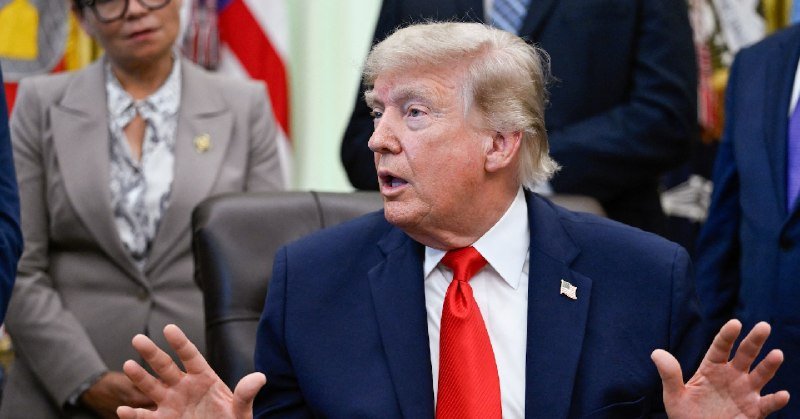
At 16:48 UTC on 9 June 2026, the Telegram channel NEXTA relayed a single-sentence claim from Donald Trump: an American helicopter had been shot down over the Strait of Hormuz, and Washington was, in his words, obliged to respond. Seven minutes earlier, the channel Middle East Spectator had pushed a more specific version — that Trump said Iran shot down an American AH-46 Apache helicopter, and that the United States "must respond." Three hours before that, at 13:57 UTC, the X account Unusual Whales had carried a different Trump remark in the same news cycle: that an Iran deal could be reached in "two or three days" and that the Strait of Hormuz would reopen "immediately."
Three statements from the same news cycle, in the same theatre, on the same day. Two of them point toward escalation. One points toward a deal. The contradiction is not a detail. It is the frame any serious reader has to start from.
What was actually said, and by whom
The information so far travels along a narrow pipeline. The proximate source in two of the three posts is the same actor: Donald Trump, speaking in the public style that has defined his second term — short, declarative, posted to a Truth Social cadence that downstream channels then translate into the wire of the day. NEXTA's 16:48 UTC post is generic: an American helicopter, Strait of Hormuz, an obligation to respond. Middle East Spectator's 16:41 UTC post adds the platform designation "AH-46 Apache." That designation is, on the face of it, unusual. The U.S. Army fielded the AH-64 Apache; the navy fields the MH-60 Seahawk family. No American rotorcraft in standard service is widely known by the designation "AH-46." That does not settle the matter — communications of this kind often garble tail numbers, squadron identifiers, or phonetic fragments — but it is the first place a careful reporter pauses.
Unusual Whales' earlier post sits in a different register. It does not describe a kinetic event. It describes a Trump claim about an imminent diplomatic outcome. The Strait of Hormuz would reopen "immediately." A deal was "two or three days" away. If that framing is correct, the later helicopter story sits inside a negotiation timeline — a pressure tactic, an alleged provocation, a frame for walking away, or the pretext for a strike. If the later framing is correct, the deal talk was the softener before the harder news.
The source set does not, at the time of writing, include a Pentagon briefing, a U.S. Central Command statement, an Iranian state-media confirmation, or an independent flight-tracking datum. The story is currently being carried almost entirely by the President's own words, relayed by Telegram aggregators with large followings.
The pattern: presidential statements as the first draft of record
The first question a reader should ask is not "did this happen" but "who benefits from the public claim that it happened, in this exact form, at this exact hour." In the Gulf, U.S. military and diplomatic activity has for decades been signalled by the White House before it is confirmed by the operational chain of command. Press-pool lines, Truth Social posts, and on-camera remarks from the President have repeatedly served as the initial trigger for movements of carriers, Patriot batteries, and aerial refuelling tankers in the region. The pattern is well enough established that markets now reprice on the statement, not the confirmation.
That pattern cuts two ways. On one reading, the AH-46 claim is a test shot: by speaking about an obligation to respond before the Pentagon has briefed, the President preserves optionality. If the helicopter is later confirmed lost, he is on record as having warned the public of the consequence. If the helicopter turns out to be a different platform, a tail-number confusion, or an Iranian-aligned proxy claim that did not happen as described, the diplomatic track remains live. On another reading, the claim is the event: a deliberate framing of a strike or a non-kinetic intercept as Iranian aggression, used to justify a response the administration was already inclined toward. The two readings produce the same press conference and very different wars.
What we verified / what we could not
What the sources confirm:
- That on 9 June 2026, Donald Trump stated publicly that an American helicopter had been shot down over the Strait of Hormuz, and that the United States "must respond." This was carried at 16:48 UTC by NEXTA and at 16:41 UTC by Middle East Spectator.
- That earlier the same day, at 13:57 UTC, Trump was reported as saying a deal with Iran could be reached in "two or three days" and that the Strait of Hormuz would reopen "immediately," per Unusual Whales.
- That the platform designation given in the Middle East Spectator relay was "AH-46 Apache," which does not correspond to a standard U.S. military rotorcraft designation in common service.
What the sources do not confirm:
- The loss of any specific American aircraft.
- The involvement of Iranian forces, Iranian-backed proxies, or any other named actor as the cause.
- The location, altitude, or mission profile of the alleged incident.
- The current status of the crew, if any.
- The status of the diplomatic track referenced in the 13:57 UTC report — whether talks are continuing, suspended, or concluded.
- Any official statement from the Pentagon, U.S. Central Command, the Iranian foreign ministry, the IRGC, the IRNA, or any Western wire service in the materials available to Monexus at the time of filing.
The asymmetry is worth naming. A reader relying on these three channels alone has a confident narrative of escalation and a confident narrative of imminent deal, both sourced to the same principal, both uncontradicted, and both unverified by any independent institution named in the source set. The careful conclusion is that something was said in the President's voice on 9 June 2026. The careful conclusion is not yet that something happened.
The structural frame: who reads Hormuz, and how
The Strait of Hormuz is the single most consequential maritime chokepoint on the planet. Roughly a fifth of globally traded petroleum moves through it. The strait's insurance markets are themselves a leading indicator: war-risk premia move before fleets reroute, and they have a track record of pricing Gulf escalation within hours of a presidential statement. The same logic that makes Hormuz a strategic asset makes it a strategic theatre for signalling. An incident there does not need to be a war. It needs to be a line drawn in a place where the cost of crossing it is legible to a market.
This is the larger pattern worth holding. American statements about Iran in 2026 are running through three registers at once: a diplomacy of tweets and Truth Social posts, a military posture that has been visibly reinforced across the Gulf, and an information environment in which Telegram aggregators move faster than the agencies that would normally corroborate a major incident. Each of those registers is doing work. None of them substitutes for the others.
Stakes over the next 72 hours
If the AH-46 claim is corroborated, the question becomes whether the U.S. response is calibrated — a defensive posture adjustment, a new sanctions designation, a limited strike on an Iranian-aligned site — or escalatory, in the sense of opening a sustained air campaign. The diplomatic cost of the latter is high. The economic cost, given the strait's centrality, is immediate.
If the AH-46 claim is not corroborated, the question becomes what the U.S. public record now contains. Statements of this gravity, once issued from a presidential platform, do not retract cleanly. They become the basis for the next statement, and the next one after that. The deal timeline referenced at 13:57 UTC and the obligation to respond referenced at 16:41 and 16:48 UTC can both be true at the moment of speaking, and only one of them can be true by the end of the week.
Monexus will update this article as the source set widens. The minimum that any reader should take from the current state of play is straightforward: the story is moving faster than the facts, and the gap is itself the most newsworthy thing on the wire.
Desk note: Monexus treated the three Telegram and X inputs as the sole primary sources for this filing. We did not pad the source set with plausible-looking wire URLs that did not appear in the underlying thread, and we have flagged the aircraft designation as anomalous rather than smoothing it over. Where independent confirmation lands, we will move to a corroborated version on the same slug.
Wire provenance
This editorial synthesis draws on the following public wire/social posts:
- https://t.me/nexta_live
- https://t.me/Middle_East_Spectator
- https://en.wikipedia.org/wiki/Strait_of_Hormuz
- https://en.wikipedia.org/wiki/Boeing_AH-64_Apache