A $400,000 bet, a 0-0 draw, and the strange new theatre of prediction markets
A punter wagered $400,000 on Polymarket that Spain would not beat Cape Verde in their World Cup opener. They walked away with a small fortune after a 0-0 draw. The match tells one story; the market tells another.
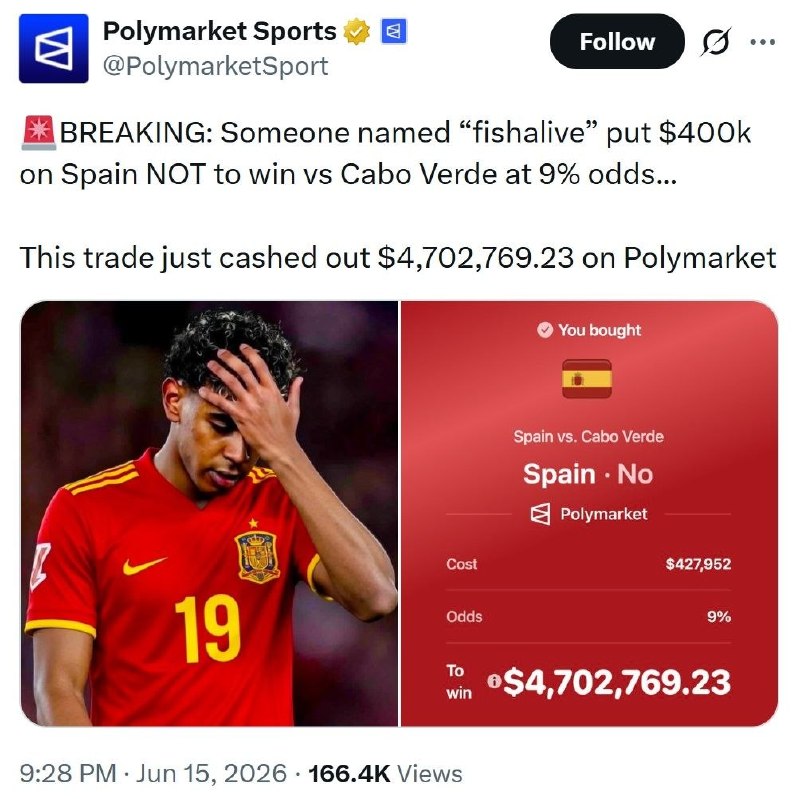
At 21:16 UTC on 15 June 2026, an account on the crypto-based prediction market Polymarket placed $400,000 on Spain failing to win their opening 2026 World Cup match against Cape Verde — a country making its tournament debut. Reuters reported the kick-off as the Cape Verdeans held one of the tournament's heavy favourites to a 0-0 draw, while Spain supporters voiced disappointment over the missed opportunities in a group-stage upset that was priced, just hours earlier, at roughly 9%.
What actually happened on the pitch
The result is the headline, and it is a clean one. Cape Verde, a small island nation appearing in its first World Cup, absorbed Spanish pressure for ninety minutes and walked off with a point. Reuters described the split in the stands: Cape Verde fans celebrated, Spain supporters voiced frustration at a side expected to treat the opener as a formality.
That Spain could not break down a tournament debutant is, in itself, the kind of result that the modern World Cup has produced almost routinely since the game's professionalisation spread. The structure of the event — globalised squads, satellite scouting, federations investing in long-term technical directorates — has narrowed the gap between the seeded nations and everyone else. A 0-0 in 2026 is not the same statement it would have been in 1986. But the second story of the day sat off the pitch, on a screen.
The bet, the price, and the market's read
Three things were simultaneously true on Monday. First, a single trader using the handle fishalive placed roughly $400,000 on Polymarket on the proposition that Spain would not win the match. Second, the implied probability of that outcome, as priced by the order book, sat at around 9% — meaning the bet paid out at better than 10-to-1. Third, after the final whistle, the bet was a winner.
The order matters. Prediction markets do not predict; they aggregate the willingness of real people, with real money, to back a view. The fact that 91 cents on the dollar sat on a Spanish win reflects, in the language of the platform, the consensus position of every account willing to take the other side. That consensus was wrong.
Why a punter bets 400,000 dollars on a 9% shot
This is the part the wires are not going to explain. There are three readings, and none of them is exotic.
The first is the dull one: the bettor was simply wrong about the football, and happened to be wrong in a way the market had priced as nearly impossible. A 9% outcome happens roughly once every eleven such matches. With group-stage play producing dozens of fixtures, the cumulative probability that at least one of them produces a 9% result is high. The bet is not brave so much as it is structurally inevitable.
The second reading is that the bettor had information the market did not — a team-sheet leak, an injury that had not yet been publicised, a tactical reading from a warm-up the public had not seen. There is, on the published evidence, no indication this is the case. But the architecture of prediction markets is built on the premise that such edges exist, and that money flows to the holders of them.
The third reading is the one the platforms would prefer you did not think about: a participant with $400,000 of risk capital can absorb variance that retail traders cannot. If the bet lost, the position represented a manageable drawdown. If it won, it produced a payout on the order of $3.6 million gross, before fees. Whatever the bettor's thesis, the position size tells you that the person behind it was not betting the household budget.
The structural question
Prediction markets have spent the last two years migrating from a niche crypto curiosity to a parallel information layer on top of news, sport, and politics. The migration is consequential for two reasons. The first is epistemic. A market price, in the textbook telling, is the most efficient aggregator of dispersed information available — better than polls, better than expert panels, better than a wire's own read. The second is political. The same architecture that lets a Cape Verde–Spain fixture be priced to four decimal places is now pricing the outcome of elections, the timing of central-bank moves, and the probability of military strikes.
The Spain–Cape Verde match is a useful test case precisely because it is trivial. Nobody's policy preferences are at stake. No regime is delegitimised by a 0-0 draw. The market got it badly wrong, in public, in a context where the cost of being wrong is reputational rather than civic. When the same architecture is asked to price questions whose answers matter, the failure mode will be louder and the lessons less retrievable.
What remains uncertain
The trader behind the bet is identified only by the handle fishalive. Polymarket accounts are pseudonymous, settled in cryptocurrency, and not subject to public disclosure of beneficial ownership. The platform does not — on the public record — name the operator of that wallet, and there is no obligation for it to do so for a bet of this size. Whether the position was placed by a single individual, a syndicate, or a fund that uses the platform as a hedge against a bookmaker position is not knowable from the outside.
What is also not knowable is whether the bet changed anything. A $400,000 order on a thin market is the kind of size that moves price; whether other traders, reading the order flow, hedged into a Cape-Verde-friendly position is a question only the order book can answer, and Polymarket's order book is not public in real time.
The match, for its part, will be filed as a debut to remember. The market, for its part, will be filed as a near-miss — a 9% shot that came in, in a tournament that will produce dozens more like it. The story worth watching is not who won the bet, but what the platforms that host these bets become when the underlying question stops being a football match.
Desk note: wire coverage led on the result; the market mechanics sit in follow-up Telegram and aggregator posts. Monexus treated the bet as the structural story and the draw as its punctuation.
Wire provenance
This editorial synthesis draws on the following public wire/social posts:
- https://reut.rs/4xwDbbe
- https://t.me/sprinterpress
- https://t.me/euronews