Israel hardens its line on Hezbollah as northern casualties mount
A battalion commander's death in Lebanon and simultaneous warnings from Katz and Netanyahu signal that Jerusalem is prepared to absorb further escalation rather than absorb further violations.
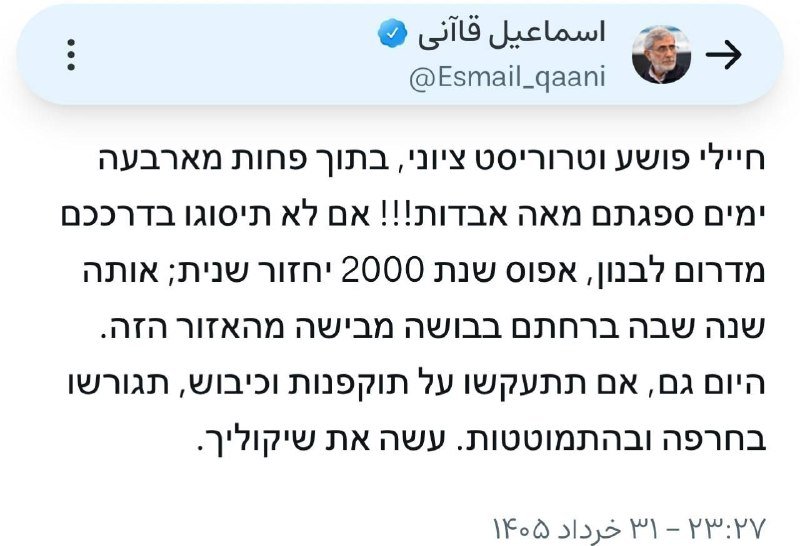
The Israeli security cabinet has spent the morning of 19 June 2026 setting a single, blunt public message: any ceasefire breach by Hezbollah will be met with overwhelming force. By 10:31 UTC, Prime Minister Benjamin Netanyahu had issued a formal expression of condolence for the commander of the 52nd Armored Battalion, Lieutenant Colonel Dor Gedaliah Ben Simhon, and three other soldiers killed in Lebanon. By 10:35 UTC, his office had followed with a written warning that Israel "will not tolerate attacks on our soldiers or on our territory" and "will exact a very heavy price" from Hezbollah. Defence Minister Israel Katz, speaking in parallel from Tel Aviv, framed the message as policy rather than rhetoric: "every ceasefire violation by Hezbollah will be met with great force," he said, in remarks circulated by Israeli outlets at 10:28 UTC and 10:36 UTC.
The sequencing is deliberate. Jerusalem is using the same hour to mourn publicly, threaten publicly, and bind those two acts together. The signal is that restraint has a finite shelf-life, and that the political leadership — not the military chain of command — will define when it expires.
The shape of the northern front
The 52nd Armored Battalion operates inside the IDF's 36th Division, the formation that has held the bulk of Israel's ground presence inside southern Lebanon since the late-2024 expanded manoeuvre that followed the cross-border exchanges of October 2023. Ben Simhon's death, formally confirmed by the prime minister's office on the morning of 19 June, brings the number of senior IDF officers killed since the ground operation began to a figure Israeli media have previously placed in the low double digits. The pattern that the public messaging now reflects is familiar from earlier phases of the campaign: a high-profile loss, followed within hours by political language that commits the government to a punishing response.
What is notable this time is that the language has been issued before, not after, a Hezbollah provocation. Katz's statement, in particular, does not name a specific incident as casus belli; it treats any future violation as sufficient. That is a meaningful shift in posture. Until early 2026, Israeli public messaging after a northern-front fatality tended to acknowledge a particular attack or attempted infiltration, then frame the response in those terms. The 19 June formulation moves the trigger for escalation from the event to the category — any event.
The diplomatic backdrop
The ceasefire that nominally governs the Israel-Lebanon frontier was brokered in late 2024 under joint US and French auspices, with a monitoring mechanism anchored in UNIFIL and a five-party liaison architecture that includes the US, France, Israel, Lebanon, and a Hezbollah-aligned technical channel. Its operative language obliges Hezbollah to withdraw north of the Litani River and to refrain from offensive action, in exchange for an Israeli commitment to refrain from strikes inside Lebanese population centres.
In practice, the arrangement has frayed for months. Israeli officials have accused Hezbollah of staged reconnaissance, of weapons transfers through the Beqaa Valley, and of intermittent rocket and anti-tank fire into northern Israeli towns, including Metula, Kiryat Shmona and Misgav Am. Lebanese officials, including the army command in Beirut, have accused Israel of near-daily airstrikes inside Lebanese territory, often in the Beqaa and the southern suburbs of Beirut, that they describe as violations of the understanding. Both accounts have been documented by UNIFIL quarterly reports, and both have been contested by the parties most exposed to them. The 19 June Israeli statements are best read not as the opening of a new phase but as the public end of a period in which the violations, however real, were treated by Jerusalem as manageable.
What the political language commits
There are three plausible readings of the 19 June messaging. The first, and most restrained, is that Katz and Netanyahu are publicly pre-committing to a particular response threshold in order to make clear to Hezbollah's leadership — and to the Iranian system that backs it — that further provocations will not be absorbed quietly. Under this reading, the statements are a deterrent signal rather than an operational order, and the next several days will test whether the message lands.
The second reading is that the statements are preparation for an expanded operation. The political groundwork is now laid for either a deeper ground push across the Litani or a sustained air campaign against Hezbollah infrastructure in the Beqaa and the southern suburbs of Beirut, and the bereaved families' narrative — the country in mourning, the army demanding justice — is being seeded into the public conversation before any such order is given.
The third reading is that the language is, in effect, a message to Washington. The Trump administration has, since early 2025, pressed Israel to keep the northern front within bounds while it pursues a parallel track on Iran; the Lebanese file is treated as a pressure point to be managed, not a theatre to be resolved. By publicly setting a high threshold for further violations, Netanyahu may be signalling to the White House that Israeli patience with that framing is finite.
The available reporting does not resolve between these readings, and Israeli sources differ on which one reflects the prime minister's actual intent.
Stakes
For Hezbollah, the cost calculus is structural. The movement has spent the past eighteen months rebuilding the rocket and drone production capacity degraded by the late-2024 Israeli campaign, and its leadership in Beirut's southern suburbs has staked political credibility on a narrative of resistance and recovery. A new round of strikes, particularly inside the Dahieh, would test that narrative inside the Shia community it claims to defend.
For Lebanon, the calculus is existential. The state has been unable, since the 2019 financial collapse, to fund even a basic reconstruction effort, and the army operates on a budget that has required direct Gulf and US support to sustain. A renewed Israeli campaign on the scale of late 2024 would almost certainly trigger another displacement wave from the south, deepen the fiscal crisis, and risk the dissolution of the fragile sectarian equilibrium that has held since the presidential election of early 2025.
For Israel, the calculus is operational and domestic. The northern communities displaced by the October 2023 attacks have not, as of mid-2026, returned in significant numbers, and the government's credibility on resettlement is now tied to whether the security situation can be made permanent. Each senior officer lost inside Lebanon is, in political terms, a measurable debt owed to those communities.
The honest reading is that the 19 June statements narrow, rather than widen, the space in which all three parties can manoeuvre. They do not, on the available evidence, commit Israel to a specific operation in the next 72 hours. They do commit the political leadership to a public posture from which any climb-down will be visible and domestically costly. That is the constraint inside which the next phase of the northern front will now be conducted.
Desk note: Monexus has framed this piece around the Israeli political and operational messages of 19 June, using Israeli and Western-wire sourcing as the primary evidentiary base; Lebanese and Hezbollah-aligned accounts of ceasefire violations on the Israeli side are flagged in the structural section as the alternate explanation the Israeli statements do not directly engage with.
Wire provenance
This editorial synthesis draws on the following public wire/social posts:
- https://t.me/wfwitness
- https://t.me/ClashReport
- https://t.me/amitsegal
- https://t.me/wfwitness