Israeli jets strike Beit Yahoun after ground probe, Hezbollah says fighters engaged troops
An Israeli airstrike hit southern Lebanon's Beit Yahoun hours after Lebanon and Israel signed a Washington-brokered framework deal, with Hezbollah reporting fighters engaged Israeli troops and Lebanese state media reporting civilian casualties.
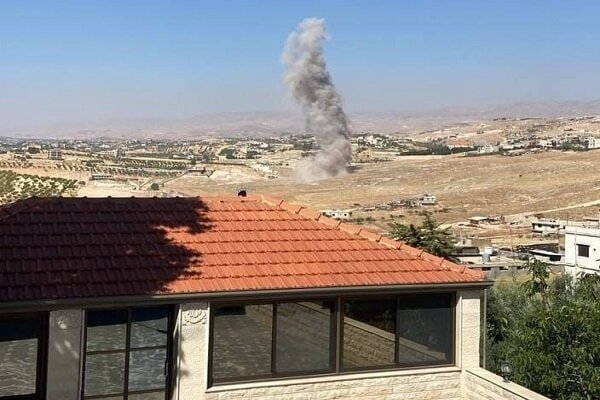
An Israeli airstrike hit the southern Lebanese town of Beit Yahoun late on Wednesday, hours after Hezbollah said its fighters had engaged Israeli troops advancing in the border area. The exchange revived a confrontation that Lebanon's new framework agreement with Israel, signed in Washington on Tuesday, was meant to freeze, and it put both sides back into a combative posture within a day of the deal.
The Lebanese state news agency NNA reported that at least one person was killed in the Beit Yahoun strike, with further casualties in surrounding villages, according to BBC Arabic's English desk. Israel framed the operation as targeted ground activity near the frontier; Hezbollah, through its military media arm, said its fighters engaged Israeli troops in firefights that stretched into the night. The two accounts describe the same geography from opposite ends of the muzzle.
The shape of the strike
Airstrike and ground probe are not new choreography for the Israel-Lebanon border, but the timing is. The framework agreement signed in Washington was marketed as a pause: an arrangement under which Hezbollah would withdraw from a defined set of villages lining the frontier, and Palestinian factions in Lebanon would be disarmed, in exchange for an Israeli reciprocation. Public lists circulating in the first 24 hours after the signing name Al-Bayada, Shamaa, Majdal Zun and Al-Mansuri among the towns residents are barred from returning to until Hezbollah and armed Palestinian groups lay down their weapons. Beit Yahoun sits inside that same band of villages.
NNA's report, carried internationally through BBC Arabic and picked up by mainstream wires, said multiple civilians were wounded and homes damaged in the strike. Reporting did not specify weapons used or flight altitude. Israeli military statements on this incident were not visible in the public source pool by the time of writing, which means the IDF's rules-of-engagement account of the strike is, in editorial terms, a known unknown rather than a confirmed fact.
Hezbollah's version, and the gap between them
Hezbollah's media wing argued the strike followed a Hezbollah-initiated engagement: fighters it said confronted an Israeli ground probe west of the town. The group framed this as defensive work, an organisational muscle memory that has been the spine of its border conduct for two decades. Iran's Tasnim news agency carried that line without contradiction. Israeli framing, where available, was characteristically narrower, a localised tactical action rather than a wider operation.
The arithmetic of cross-border incidents in southern Lebanon has changed shape in 2026. Most frontier exchanges since the November 2024 ceasefire have been calibrated to a friction ceiling defined by Washington. The Beit Yahoun sequence broke through that ceiling at exactly the political moment when the new framework tried to lock in a different model. A deal that produced, on day two, a strike and a firefight at one of its named flashpoint villages is a deal that has not yet stabilised, regardless of how the signatures on the parchment read.
Beirut, Washington and the political weather
Inside Lebanon, the framework agreement is being received with the suspicion its sponsors anticipated. A senior Ansarullah figure, the Houthi political wing now embedded in Yemen's wartime governance, dismissed the deal on Thursday as a mechanism designed to dismantle the resistance axis. That characterisation is not neutral: Ansarullah is a hostile external reader, and Iran-aligned movements predictably frame any Lebanon-Israel arrangement as a surrender. But the Ansarullah statement matters less for its accuracy than for what it indicates about what kind of coalition Washington expected the agreement to withstand, or whether it expected to withstand anything at all.
For Israel, the political backdrop is more domestic than regional. Prime Minister Benjamin Netanyahu's public messaging in the hours after the signing leaned heavily into the freedom-of-action claim the deal preserves: Tel Aviv reserves the right to act on Lebanese territory as it judges necessary. Read narrowly, that's a statement of legal posture; read in the context of a Beit Yahoun strike inside that same window, it reads as a description of policy about to be exercised.
What the wires agree on, and what they don't
By Thursday morning, the sourcing on the Beit Yahoun event was thin and uniform. NNA reported civilian casualties. Hezbollah reported an engagement. The IDF's incident-specific statement was not present in the public feeds reviewed for this piece, a gap visible to anyone mapping the same Telegram channels, OSINT aggregators and wire alerts at the same timestamps. Casualty figures, weapons used, and whether the strike was directed against a specific target inside the town or against an external position, are all items the public record has not yet settled. The Israeli side will, in all probability, release a fuller account in the coming days. The Lebanese side may issue updated totals through NNA. Until then, the safest editorial move is to describe the geometry: an Israeli strike hit Beit Yahoun, Hezbollah said its fighters were engaged on the ground nearby, civilian casualties were reported, and the framework agreement signed the previous day was the political container the strike escaped from.
The line to watch
The framework deal is now the load-bearing structure for any further de-escalation at the Litani line and beyond. If implementation committees named under the agreement meet this week and produce a verification mechanism for the village lists in circulation, the Beit Yahoun strike becomes a test the agreement passed. If those committees do not convene, or if the lists stay informal, the strike becomes the first data point in a downward curve: a transitional document that describes a border which, on the ground, has not yet been built.
The Lebanese state, the new mechanism's intended counterpart, has limited bandwidth. Hezbollah retains a deterrent posture. Israel retains an active operational one. Between those two facts, Beit Yahoun is less a one-off than the opening statement of what implementation now has to argue against.