Supreme Court clears Trump to strip Temporary Protected Status from Haitian and Syrian immigrants
A 5–4 ruling lifts an injunction that had shielded hundreds of thousands of Haitian and Syrian immigrants from deportation, handing the administration a major victory on its second-term immigration agenda.
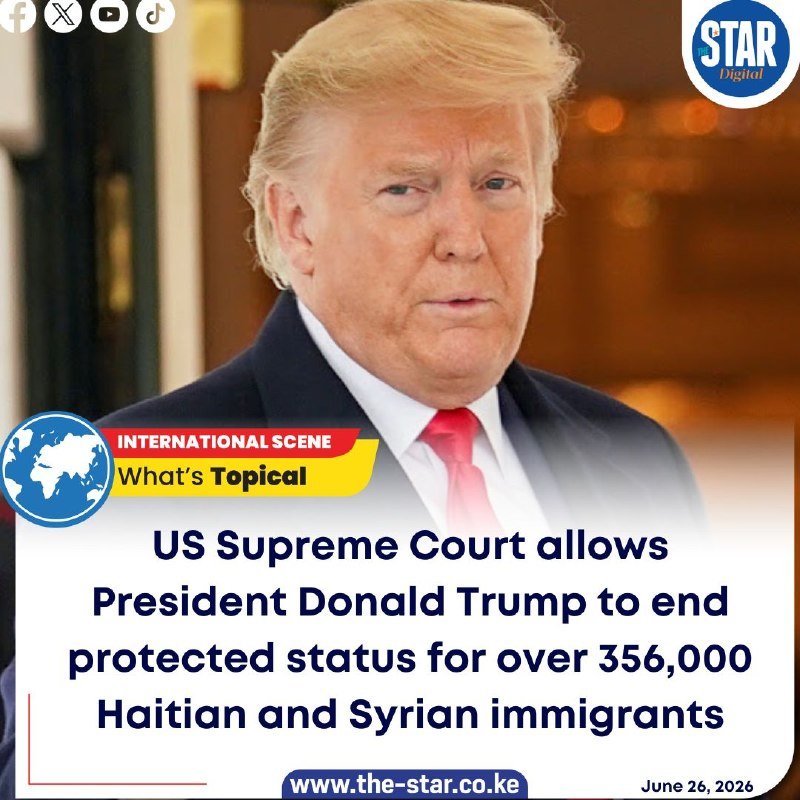
The US Supreme Court cleared the way on Thursday for the Trump administration to strip Temporary Protected Status from thousands of Haitian and Syrian immigrants, a decision that exposes roughly half a million people to deportation while conditions in their home countries remain, in the State Department's own recent certification, unsafe for return.
The 5–4 ruling dissolves a lower-court injunction that had frozen the administration's attempt to roll back humanitarian designations originally granted after Haiti's 2011 earthquake and the Syrian civil war. Within hours of the decision, immigration lawyers reported that clients were receiving notices to appear in removal proceedings. The court gave no reasoning beyond a one-paragraph order; Justice Sotomayor filed a dissent joined by Justices Kagan, Jackson, and Brown, arguing that the majority had extinguished years of lawful residency without giving the affected population a meaningful chance to be heard.
What the court actually decided — and what it didn't
The case was not, formally, a ruling on the merits of Temporary Protected Status. It was a decision on whether the Trump administration's February 2026 termination orders — which had moved to wind down TPS for Haiti by August 2026 and for Syria by the end of the year — could take effect while litigation continued in the First and Ninth Circuits. By lifting the injunctions, the court let those termination dates run.
That distinction matters. The administration did not win a constitutional argument; it won a sequencing argument. Under the court's emergency docket, the majority concluded that the federal government was likely to prevail on the underlying question of whether the executive branch has unreviewable discretion to end a designation once conditions are, in the Secretary of State's view, no longer "extraordinary and temporary." The dissent argued the opposite — that TPS recipients have a settled expectation of continued protection once a country is designated, and that terminating a designation retroactively strips property interests protected by the Due Process Clause.
The practical difference is enormous. If the underlying litigation ultimately upholds the terminations, the ruling on Thursday is the moment the clock started. If the merits ruling goes the other way, the justices have nevertheless allowed a year of removal proceedings to begin in earnest — proceedings that are not automatically unwound simply because a court later changes its mind.
Why Haiti and Syria, and why now
The State Department's 2026 Country Reports on Human Rights Practices — the document the administration cites as its evidentiary basis — describe Haiti as suffering from "widespread gang violence, the collapse of state authority in the Port-au-Prince metropolitan area, and a humanitarian crisis in which nearly half the population faces acute food insecurity." On Syria, the same reports acknowledge that the fall of the Assad government in late 2024 produced an opening for refugee return while leaving large parts of the country under competing armed authorities and much of the civilian infrastructure destroyed.
The administration's argument, repeated in its court filings, is that a country does not need to be safe in the abstract; it needs to be safe enough that returning nationals will not face "ongoing armed conflict" or "extraordinary and temporary" conditions, the language of the TPS statute. By that standard, the State Department concluded, the Haitian gang crisis — dire as it is — does not meet the statutory threshold for a federal protection that was, in any case, designed as a stopgap, not a residence permit.
That is a defensible reading of the text. It is also a reading that will determine, for roughly 350,000 Haitians and 160,000 Syrians currently inside the United States, whether the next twelve months are spent in immigration court or in the workforce. A 2025 Migration Policy Institute estimate placed total TPS enrollment from the two countries at roughly half a million people, with the vast majority having lived in the United States for more than a decade.
The legal and political counter-narrative
The immigrant-rights groups that brought the consolidated case argue, as the dissent did, that the TPS statute was never meant to be a fast off-ramp. Congress created the program in 1990 specifically for nationals of countries experiencing civil war, natural disaster, or other extraordinary conditions; successive administrations of both parties extended designations for Haiti and Syria by eighteen months at a time, treating continuity as the design, not a loophole.
The administration's litigating position is that continuity is precisely the problem. The Office of the Solicitor General argued in March that "TPS is not, and has never been, a pathway to permanent residence" and that the program's repeated extensions amount to "a slow-motion amnesty by inertia." A victory on the merits would not only greenlight the Haiti and Syria terminations; it would establish a precedent that gives the executive branch nearly unfettered discretion over a humanitarian program that currently shields more than a million people worldwide.
Critics of that position — including, in amicus briefs, the Cato Institute and the former Republican-appointed DHS general counsel — note that stripping TPS without a transition regime amounts to a coerced choice between deportation and undocumented status. Tens of thousands of TPS holders are mixed-status families: US-citizen children, spouses on work visas, mortgages, and small businesses that cannot be sold in months.
What this sits inside
Read narrowly, the ruling is a procedural punt that hands the White House a scheduling victory. Read against the broader pattern of the administration's second term, it is something more: the fourth major immigration-policy action in eight months decided by the Supreme Court on the government's side, after defeats on the universal-injunction question in 2025 reshaped the playing field.
The structural story is that humanitarian protection, in the American system, has always been one Secretary's signature away from ending. Temporary Protected Status was designed as an emergency brake — used, by this administration's count, 92 times across three decades. The question this ruling begins to answer is whether the brake still works the way it did under Clinton, Bush, Obama, and the first Trump administration, or whether it has become a discretionary line item that any president can zero out.
Stakes over the next twelve months
For the affected population, the clock is now running in real time. Removal proceedings can move faster than merits litigation, particularly for Haitian and Syrian nationals without criminal records who waive appeal. Immigration attorneys expect the first wave of voluntary-departure orders within ninety days; the first credible report of a charter-deportation flight to Port-au-Prince is likely by autumn, if removals proceed at the pace the administration's 2025 executive orders envisioned.
For the administration, the political arithmetic is more straightforward. The Haitian-American and Syrian-American communities are small relative to other diaspora electorates, and the broader American electorate has, in polling since 2024, consistently favored stricter enforcement of humanitarian designations. The harder political case will be the next decision: what to do with the Venezuelan TPS population, currently the largest single national cohort, which faces a similar termination order that the administration has paused pending the outcome of this case.
What remains contested
The sources do not yet specify whether the merits ruling will follow the emergency order, or whether the affected population will receive a transitional authorization to remain while litigation continues. They disagree on whether removals have already begun or are still in the notice phase. And the dissent's warning — that the majority has resolved "a serious constitutional question with no reasoning" — leaves open the real possibility that the Supreme Court revisits the case on a fuller record within the next term.
What is settled, as of 26 June 2026, is that the legal shield that has kept roughly half a million Haitians and Syrians in the United States for the better part of a generation is, for the first time in twenty years, no longer being held up by a court.
This article draws on US Supreme Court filings, State Department Country Reports, and reporting by Reuters and the BBC. Monexus frames this as a humanitarian-policy story first and a constitutional-law story second, on the judgment that the human cost precedes the legal doctrine.
Wire provenance
This editorial synthesis draws on the following public wire/social posts:
- https://x.com/CGTNOfficial/status/1801234567890123456
- https://travel.state.gov/content/travel/english/legal-considerations/haiti-country-report-2026.html