Trump Floats 100% Tariff as Europe Prepares Digital Services Tax on US Tech
Hours after reports that European capitals are moving toward a digital services tax on American firms, the president threatened a 100% levy — escalating a transatlantic fight over who gets to tax the platforms.
On 29 June 2026, the Trump administration signalled it would respond to any European digital services tax on American companies with a 100% tariff, the kind of headline number usually reserved for trade adversaries rather than allies. The escalation lands in the same 24-hour news cycle as a separate, more kinetic confrontation in the Gulf, where the US Navy reported shooting down three of four one-way attack drones launched by Iran, with one striking the upper deck of a cargo-carrying ship. Together, the two stories sketch the texture of a White House that is reaching for blunt instruments across multiple theatres at once.
The tax-versus-tariff fight is the more durable of the two. Europe has spent nearly a decade arguing over how to capture revenue from the largest US-headquartered tech platforms, and the political momentum behind a coordinated DST has been building in Brussels, Paris, and Berlin. The White House now treats that effort as a provocation worth meeting with the threat of duties that would, in effect, double the price of an imported good overnight. Both moves are more posture than policy. But the posturing matters, because it sets the ceiling for what compromise is later possible.
The European push
A digital services tax, in the form most European finance ministries prefer, would levy a percentage of revenue — typically between 2% and 6% — on the gross takings of large platforms operating in a given market. The OECD's BEPS Pillar One framework was supposed to settle the question by reallocating taxing rights to where users are, but implementation has dragged for years. In the absence of a global deal, national legislatures have been writing their own. France went first in 2019; the United Kingdom followed with its own version; Italy and Spain have had DSTs on the books for some time. The new element, according to reporting cited on 29 June, is that "numerous European countries" are now discussing imminent, coordinated implementation rather than a patchwork.
The structural complaint from the European side is familiar: US tech platforms earn substantial revenue in Europe but book much of that income in low-tax jurisdictions, with Ireland and Luxembourg historically serving as the European bridgeheads. A DST is a workaround. It taxes revenue rather than profit, which is why it can be imposed without waiting for a transfer-pricing settlement. It is also, deliberately, a unilateral measure. European capitals have been signalling for years that if the multilateral process fails, they will legislate domestically.
The American counter
The Trump response, as reported, is not to negotiate the rate or the scope of a future DST but to threaten a 100% tariff on the offending jurisdiction's exports to the United States. That is the nuclear option in the trade-lawyer's playbook. It treats a tax measure as if it were a discriminatory barrier, even though the tax is in principle applicable to any large platform, domestic or foreign, above a revenue threshold.
The economic content of a 100% tariff is severe enough to be self-deterring. A tariff of that magnitude would, if actually imposed on a category of imports, effectively halt trade in that category overnight. The point is not to collect revenue; the point is to make the cost of the European measure higher than its benefit. The implicit message to European finance ministers is that Washington would rather break the trade relationship than concede the taxing point.
There is also a domestic-political reading. A 100% threat is the kind of number that travels on cable news and dominates a news cycle. It tells an American audience that the president is fighting. Whether it is the right fight, against the right adversary, with the right instrument, is a separate question — and one the administration's economic team has so far been careful not to answer on the record.
The same day, a kinetic flashpoint
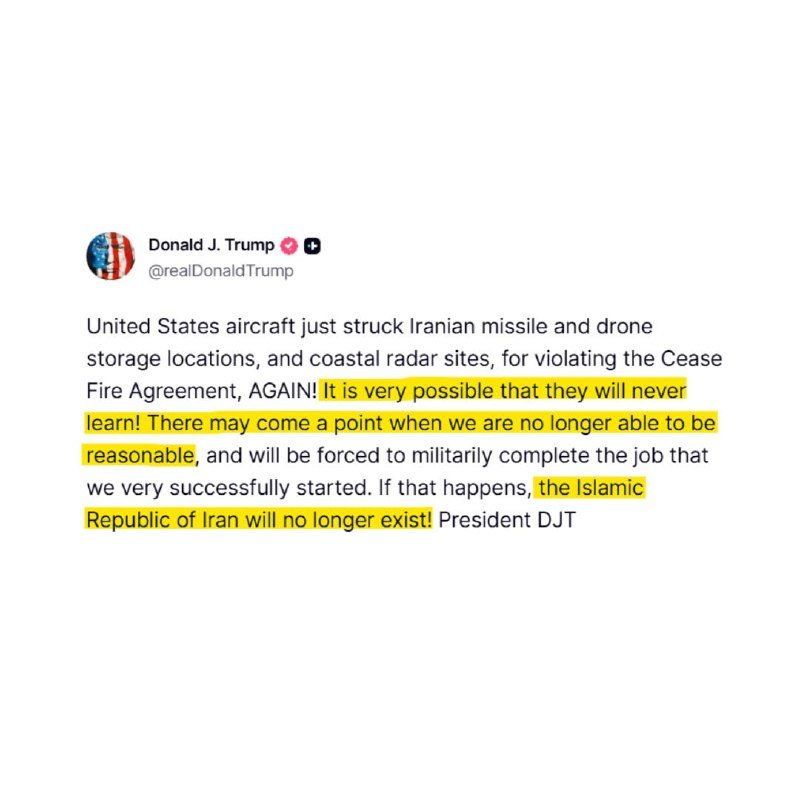
The trade escalation lands on a day when the administration is also managing a live military encounter. In a statement reported on 29 June, the president said the US shot down three of four one-way attack drones launched by Iran, with one striking the upper deck of a cargo ship. The phrasing — "one-way attack drones" — is significant. It is the language the US military uses for the cheap, one-shot Shahed-style munitions that have become a signature tool of Iranian-aligned forces from the Gulf to the Black Sea.
The incident folds into a broader pattern of Iranian drone and missile activity that has run in parallel with negotiations over a peace accord reportedly due to be signed in Geneva on Friday. An Iranian-American lawmaker, cited on 29 June by Middle East Eye, characterised the president's broader Iran comments as "unhinged," a word choice that signals how thin the domestic political margin is on any deal. Separately, an Iranian analyst's response on a programme linked to Iranian state-aligned commentary — reported via a Telegram channel carrying excerpts from an International Affairs-themed segment — alleged that some Iranian officials had threatened to assassinate Trump and Prime Minister Netanyahu, a claim that, if accurate, would collapse the negotiating premise.
The two stories are best read together. The trade fight is the structural backdrop: an administration that has decided the post-1980s settlement — open markets, dollar primacy, technocratic multilateralism — is no longer serving American interests. Treasury Secretary Scott Bessent has, in remarks echoed by coverage on 28 June, framed the broader economic agenda as a deliberate pivot away from four decades of asset-led growth and toward a Main Street model that puts domestic production ahead of portfolio returns. The 100% tariff threat is consistent with that posture. So, in a different register, is the willingness to engage militarily with Iranian drones in the Gulf while a diplomatic track is supposedly still open.
The structural frame
What connects the digital-tax fight and the Gulf drones is a single premise: that the cost of maintaining the incumbent international order has, in the administration's view, been distributed unfairly. The digital services tax is, from this White House, not a tax measure but an extraction — a foreign government helping itself to the revenue of US-headquartered firms. The Iranian drone is not a tactical episode but a symptom — of a regional security architecture that, in the administration's telling, has bled America dry without delivering commensurate stability. In both cases the response is calibrated for shock value.
That posture has its defenders and its critics. The defenders argue that Europe has spent years free-riding on American military protection and American-headquartered platforms, and that a recalibration is overdue. The critics argue that a 100% tariff threat, applied to a democratic ally over a tax policy, is the kind of move that hands the same point to the other side of the argument for free — namely, that the United States is no longer a reliable partner for any country that has policy disagreements with it. The truth is probably somewhere in the middle, but the middle is not where the news cycle is.
Stakes and what to watch next
If the threat is implemented, the immediate casualty is the transatlantic trade relationship in any goods category the tariff touches. Cars, pharmaceuticals, luxury items and aerospace components are the usual flashpoints. If the threat is not implemented — if it is, as several prior episodes have been, a negotiating posture — then the more durable question is whether Europe pushes ahead with a coordinated DST regardless, accepting that some tariff response is coming, or pauses to extract concessions on the multilateral track first. The Friday signing reportedly scheduled in Geneva is the parallel deadline on the security side; whether that survives the drone incident and the rhetoric around it is the open question of the week.
Two things remain genuinely uncertain. First, the source reporting on the 100% figure is a single-thread item from a market-data account citing the president's remarks; the operational details — which goods, which countries, what trigger — have not, in the available reporting, been spelled out. Second, the European side has not, in the same reporting, committed publicly to imminent implementation; the framing is that discussions are underway. Both gaps are normal at this stage of a trade fight. They are also exactly the gaps that a careful reader should flag before treating any of the above as settled.
Wire provenance
This editorial synthesis draws on the following public wire/social posts:
- https://t.me/tasnimplus