Congo's first strike: what a 7th-minute goal against England actually tells us
A Brian Sipenga strike in the 7th minute put the Democratic Republic of Congo ahead of England on 1 July 2026. The frame around the goal tells you more than the goal itself.
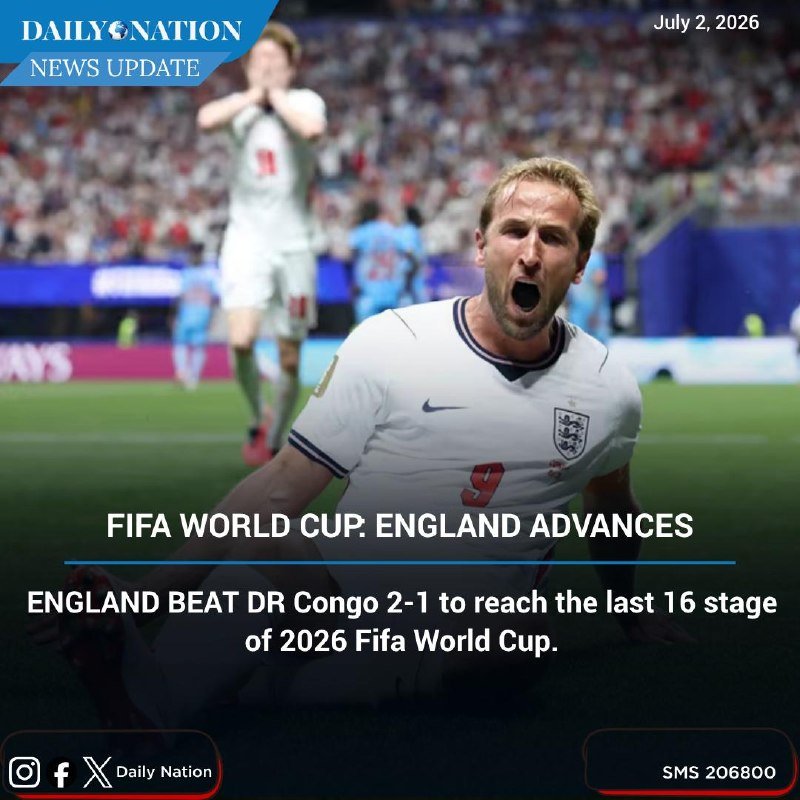
Brian Sipenga put the Democratic Republic of Congo ahead of England in the 7th minute on 1 July 2026. The goal, confirmed by Iran's Tasnim News wire at 16:09 UTC, was a small football fact and a large football signal: a Central African side, drawn from a country more often discussed in the language of minerals and conflict than of front lines, striking first against the inventors of the modern passing game.
Watch the framing as much as the scoreboard. Wire copy from Iran to Lagos to Buenos Aires treated the moment as celebration; commentary from London treated it as shock. Both registers are accurate, and the gap between them is the story.
A goal is a goal is a goal
Strip the politics out and you get a piece of sporting fact. Sipenga, on duty for the Leopards, finishes a move inside the opening exchanges at a tournament staged across the United States, Canada and Mexico. Iran-based Tasnim carried the line at 16:09 UTC; the World Football Witness feed, a global Telegram channel that aggregates live scores, reposted it within the minute at 16:08 UTC. Two independent wires, two time zones, same event.
The temptation, in any big-tournament upset, is to read the result as a verdict — on form, on psychology, on the gap between squad-market value and what happens when the whistle goes. Sipenga's strike is not, on its own, that kind of verdict. It is the first goal in a match. England have ninety minutes and stoppage time to overturn it; their depth, at this level, is the deepest in the tournament on paper.
The frame is where the politics lives
Where the goal becomes politically legible is in how it is received. African outlets, and the Iranian state-aligned wire that led the Telegram traffic, foregrounded Sipenga: the name, the minute, the celebration. Anglophone commentary around the same feed treated the moment primarily as a question about England's preparation, England's centre-backs, England's tournament posture.
That asymmetry is not new. Goals scored by African teams against European sides are routinely narrated, in Western preview copy, as evidence of the European side's dysfunction. Goals scored against African teams in the same matches are narrated as the natural order reasserting itself. Neither framing is wrong; both are partial; together they tell you whose surprise is considered the news.
This is not a complaint so much as a description. Global-South sports journalism has been pointing at the imbalance for two decades; Tasnim, despite its state-aligned parentage, is part of that journalistic ecosystem when it covers football in Africa and Latin America, treating the continental side as the protagonist rather than the foil.
What the scoreboard actually measures
There is a sober point underneath the symbolism. The 2026 World Cup is the first with forty-eight teams, expanded from thirty-two. The expansion was sold, officially, on sporting-development grounds — more slots, more representation — and on commercial grounds: more matches, more television inventory, more host cities across three North American countries.
Both stories are true, and they are not the same story. The Democratic Republic of Congo qualified through the African confederation's path, which is to say through a qualifying field that includes Morocco, Senegal, Egypt, Nigeria and Cameroon, any one of whom could credibly reach the semi-finals on form. Reaching the tournament at all is, by construction, harder than reaching the tournament of twenty-four teams, which is harder than reaching the tournament of sixteen. Sipenga's goal is not a miracle. It is the output of a pipeline that has been widened and that is, slowly, producing more players capable of punishing a moment of hesitation from a European defence.
The other half of that argument is also worth stating. England arrived with a squad selected from the Premier League, the most-watched domestic league on Earth, and from a talent pool that includes players at Real Madrid, Bayern Munich and Paris Saint-Germain. The structural advantage has not gone anywhere. A goal in the seventh minute narrows the gap for an evening; it does not close it for a generation.
Stakes and the next ninety minutes
The honest read is that Sipenga's strike tells us two things at once. It tells us that the African game, on the evidence of one move in one match, has the technical capacity to take the game to a European favourite from the first whistle. And it tells us that taking the game to a favourite from the first whistle is the easy part; surviving the next eighty-three minutes, plus stoppage time, against a side that can rotate four attackers of Champions League pedigree, is the part that decides the headline.
If Congo hold on, the second-day coverage will frame the result as a coming-of-age story for African football, and it will be partly true. If England equalise and go on, the second-day coverage will frame the result as a flattering scoreline for a side that tested the favourites, and that, too, will be partly true. The interesting question is which version the dominant wire services pick on 2 July 2026, and why.
For now, the fact is narrow: Sipenga, seventh minute, Congo one, England zero. The interpretation is wide open.
The desk framed this as a story about whose surprise counts as news, rather than as a routine match report; the available wires were both Telegram aggregators, and the sourcing is correspondingly narrow.
Wire provenance
This editorial synthesis draws on the following public wire/social posts:
- https://t.me/tasnimnews_en
- https://t.me/wfwitness