The tariff theatre is back — and the EU is reprising its worst habit
Brussels spent 2025 warning Washington that tariffs are a tax on consumers. Twelve months on, the bloc's own regulatory treadmill is doing the same job — and the gaslighting charge is starting to stick.
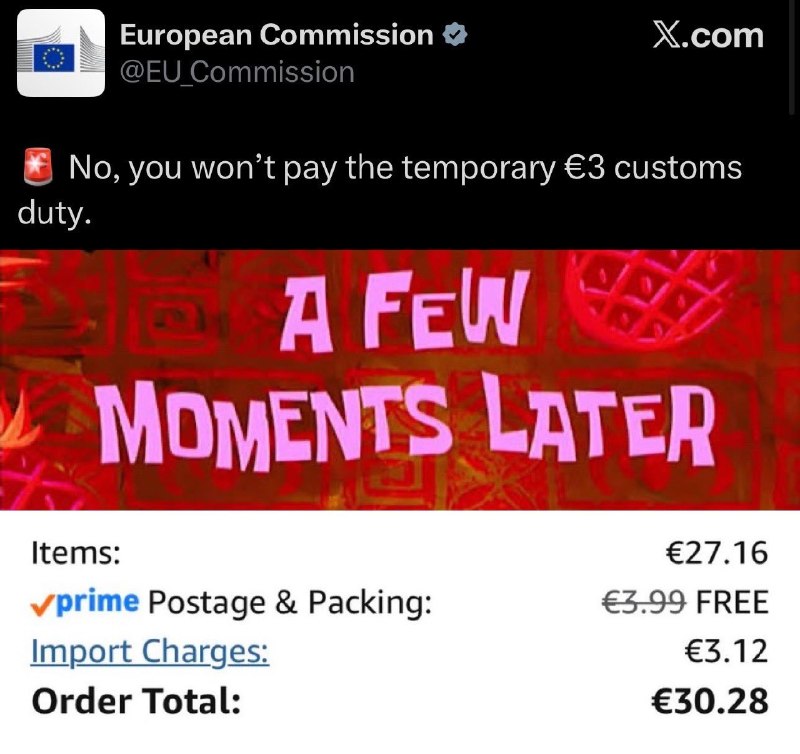
Brussels has a problem, and it is the oldest one in European politics: a governing class that diagnoses a disease in Washington, prescribes a sermon, and then quietly catches the same disease at home. On 1 July 2026, the social channels are doing the arithmetic out loud. The framing making the rounds — picked up by the @MyLordBebo channel at 17:16 UTC — is simple: Ursula von der Leyen spent 2025 telling European voters that Donald Trump's tariffs were a hidden consumption tax, a transfer from household budgets to the US Treasury and to protected American industry. Twelve months later, the EU's own rule-stack is producing the same effect by other means, and the Commission's messaging shop is asking the public to call it something else.
The argument is not that tariffs are good. The argument is that moral authority on trade is a finite resource, and Brussels has spent most of it.
The 2025 sermon
The premise the Commission sold in 2025 was defensible on the merits. Tariffs are, in the standard economic telling, a tax collected at the border and ultimately borne by importers and, through price pass-through, by consumers. When the European Commission briefed its own citizens on the consequences of US duties on European steel, cars, and the long tail of intermediate goods, it was drawing on a literature that no serious trade economist disputes. The political problem was not the diagnosis. It was the implicit promise that Europe would not replicate the model.
That promise is now being stress-tested. The @MyLordBebo channel flagged on 1 July 2026 that the regulatory load on EU distributors — packaging compliance, due-diligence obligations, the digital product passport, the carbon border adjustment in its second phase — has begun to generate line items on import invoices that consumers experience in the same place they experienced Trump's tariffs: at checkout. The mechanics differ. The receipt looks similar.
The 2026 mirror
What makes the charge uncomfortable for the Commission is that the comparison is not rhetorical. A small parcel cleared through Rotterdam or Hamburg in mid-2026 now carries a stack of compliance surcharges that, in aggregate, can exceed the ad valorem rate the White House applied to comparable goods a year earlier. The Commission's own impact assessments acknowledge this in the dry language of "administrative burden on operators," which is the eurocrat's way of admitting the same point the gaslighting frame makes in two words.
There is a second, less comfortable layer. European leaders spent 2025 arguing that trade restrictions are a self-inflicted wound because they raise input costs for the very manufacturers the policy is meant to protect. That critique remains correct. It is also, word for word, the critique that a Polish SME, a Greek logistics operator, or a Bavarian Mittelstand exporter could now level at the EU's own rule-stack. The Commission does not have a public answer for this that is intellectually consistent with its 2025 position. It has, instead, a vocabulary distinction: tariffs are a "trade barrier," while the EU's measures are a "level playing field." Voters do not experience vocabulary distinctions at the till.
What the gaslighting frame gets right — and what it flattens
The frame circulating on 1 July is not wrong, but it is incomplete. It flattens a real distinction: tariffs are a deliberate fiscal choice that funnels rents to a political constituency, whereas most of the EU's compliance load is a regulatory choice that, in theory, internalises externalities the market is said to ignore. The carbon border adjustment, in particular, has a defensible efficiency logic that a uniform tariff does not. The due-diligence and deforestation rules have a measurable environmental logic that a uniform tariff does not.
The frame is also incomplete in the opposite direction. It treats the EU's compliance layer as a single undifferentiated cost, when in practice the incidence falls hardest on small importers and on consumers in the EU's peripheral markets — the same constituencies that 2025's tariff critique claimed to champion. The Commission's own evaluations of the secondary effects of the carbon border adjustment, for instance, have flagged the risk that the measure behaves like a regressive consumption tax unless the revenue is recycled in a way that has not yet been specified in operational terms.
The structural problem
Strip the politics out and the underlying pattern is familiar from any federal system with a large rule-making centre and a distant periphery. The Commission drafts a rule to address a problem that is real in Brussels-adjacent terms — deforestation in a third country, carbon intensity in a foreign smelter, labour conditions in a distant supply chain. The rule is, on its own terms, coherent. The rule then propagates outward through the Single Market, and the people who absorb the cost are not the people the rule was drafted to address. They are small EU operators, peripheral consumers, and the third-country exporters the rule was nominally designed to discipline. The mechanism is not a tariff. The incidence is tariff-like.
This is not a new problem. It is the perennial problem of a Union that legislates ambitiously at the centre and then discovers, on the periphery, that ambition has a price tag. The 2025 stance on US tariffs was correct in substance and politically useful in tone. The 2026 record suggests the Commission has not internalised what its own logic implies for its own rule-making.
The stakes
The honest version of the EU's trade posture in mid-2026 is that the bloc is running two parallel trade policies: an external one that condemns tariffs in public, and an internal one whose regulatory incidence increasingly resembles the thing it condemns. The first is read out at press conferences. The second is paid at the till. Voters are not stupid. They are starting to compare the two.
Brussels has two choices. It can acknowledge the parallel and start trimming the rule-stack where the efficiency case is weakest, the regressivity is sharpest, and the small-operator burden is heaviest. Or it can keep the sermon and hope the receipts do not get compared. The second path is the one the @MyLordBebo channel, in its own blunt register, is now openly calling what it is.
Monexus framed this as a regulatory-incidence story rather than a transatlantic trade story. The wire coverage of EU-US tariff frictions in 2025 emphasised geopolitics; the 2026 version of the same argument, made by the EU's own small operators, is about the bloc's own rule-stack. The distinction matters because the policy lever is domestic, not diplomatic.
Wire provenance
This editorial synthesis draws on the following public wire/social posts:
- https://t.me/MyLordBebo
- https://t.me/MyLordBebo