Airspace, heat and the new weather of Middle East risk: reading the signals around July 1
A prediction market is pricing a 38% chance Iran shuts its airspace by August. The White House, meanwhile, is performing normalcy. Both signals deserve more weight than the wire cycle is giving them.
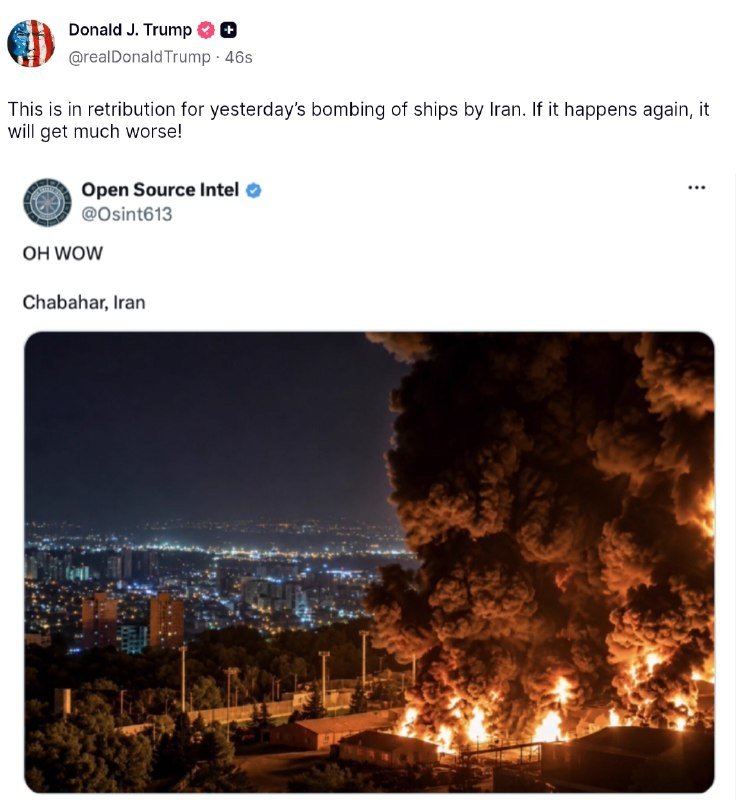
Lead. On the afternoon of 1 July 2026, two almost unrelated stories sat on the same open-source intelligence feed and refused to leave each other alone. One was a Polymarket print showing traders giving a 38% probability that Iran will close its airspace before 31 August. The other was a pair of Donald Trump remarks — one about delivering a long Fourth of July speech in 107-degree heat "to show that I can do anything," the other about presiding over what he called the inaugural flight of a newly redesigned Air Force One after 37 years. Read separately, they are a market tick and a campaign clip. Read together, on the same feed, at 20:16 UTC, they sketch the strange weather the Middle East is heading into summer with: a Tehran-threat premium priced into a derivatives contract, and a White House performing the theatre of normalcy on a runway.
Nut graf. The 38% number is not a forecast; it is the current price of an insurance policy. Prediction markets have a track record of converging toward base rates when the news flow is dull and overshooting when the news flow is loud. Right now the flow is loud. The wire has been carrying Israeli strike preparation against Iranian nuclear and missile infrastructure for weeks, and the airspace question is the operational tell: a formal closure is the kind of step a state takes when it expects to be hit, or expects the airspace around it to be hit, and wants to control the liability. The Trump footage — performative, sweltering, unmistakably presidential — is the counterweight. Washington is signalling that the calendar will not be moved by anyone else's calendar. The question this publication is interested in is which signal the market is actually pricing.
What 38% is, and what it isn't
A Polymarket contract settling on whether Iran closes its airspace before 31 August is a thin instrument by design. It will resolve on a verifiable event — a NOTAM, a formal civil-aviation authority notice, an Iranian state announcement — and not on vibes. That makes the price harder to manipulate than a tweet-driven narrative, but easier to misread. The number reflects the trader's view of probability, weighted by the capital behind each position. A 38% print is, in plain terms, the market saying that for every three summers it has watched, roughly one of them has looked like this one. That is the kind of base rate that should make any airline scheduling department pause, even if the contract resolves to "no."
The second-order read is more interesting. The contract's existence at all is news. A liquid, named risk on Iranian civil aviation within ninety days is, in effect, a public statement by sophisticated money that the corridor over the Persian Gulf and the Caspian approaches is no longer treated as a routine operating environment. That has consequences for overflight fees, for rerouted cargo, and for the political cost to Tehran of any move that pushes the print higher.
The counter-narrative: theatre, not weather
The strongest counter-read is that none of this is new. US-Iran brinkmanship has cycled through airspace risk, sanctions enforcement and proxy confrontation for the entire post-2018 period. The 38% price may be capturing a recurring seasonal pattern — summer tension, autumn de-escalation — rather than a step-change in the probability of closure. The Trump remarks on the Fourth of July, on heat endurance and on the Air Force One redesign are the kind of content a White House produces when it wants the news cycle anchored to the president rather than to a flashpoint. If the bet were a serious one, the operational tells would be visible elsewhere: military charter traffic out of Iranian bases, NOTAM filings along the Gulf corridor, insurance war-risk premiums spiking on Lloyd's lists. The market sees the contract; the wires do not yet show the surrounding evidence.
That said, the counter-narrative has a soft floor. Prediction markets do not typically price 38% on tail events that are pure background noise. They price 38% when there is a real, tradable disagreement between informed participants about whether the event will happen. The very existence of disagreement at this level is a piece of information, independent of who turns out to be right.
The structural frame
The larger pattern here is the migration of geopolitical risk pricing away from analyst notes and toward continuous markets. Five years ago, a 38% airspace-closure probability would have lived in a JP Morgan weekly, behind a paywall, in language hedged enough to be unfalsifiable. Today it lives in a Polymarket print that any reader can audit in real time. That is a structural shift in who gets to price Middle East risk and how visibly they have to defend the price. The same shift is visible in oil options, in defence-sector single-stock moves, and in the cost of reinsurance for Gulf shipping. The signal has moved from the report to the order book.
Inside that frame, the Trump content is not contradictory; it is complementary. A president willing to do a long outdoor speech in 107-degree heat on the country's most-watched holiday is, intentionally or not, telling Tehran — and any other actor reading the cycle — that the United States will not compress its own calendar to fit someone else's escalation window. That posture is itself priced, into the same contract, by the same traders.
Stakes and what remains uncertain
If the contract resolves "yes," the operational consequences fall first on commercial aviation through Iranian airspace — already limited, but a meaningful lane for some carriers — and on the diplomatic cost to Tehran of having publicly signalled vulnerability. If it resolves "no," the more interesting story is the unwind: who was on the wrong side, what they knew, and whether the print spikes again on the next round of Israeli-Iranian reporting. The time horizon that matters is the next sixty days. The actors with the most to lose are Iranian civil aviation, Gulf overflight-dependent carriers, and any political faction in Tehran whose standing depends on the airspace remaining a non-issue.
What the public record on 1 July 2026 does not yet show is corroborating operational movement around Iranian airbases, a NOTAM track on the Gulf corridor, or any named-source reporting from Axios, Reuters or the BBC placing the airspace question inside an active strike-preparation timeline. The Polymarket print is the only piece of evidence with a number attached. That is the honest reading: a market pricing a meaningful but unconfirmed risk, against a White House staging the appearance of an untroubled summer.
Desk note: Monexus is treating the Polymarket contract as a market-data signal rather than a forecast. The wire's instinct is to cover only confirmed events; the prediction market's instinct is to price them in advance. This article reads the price and the political theatre together, rather than picking one.
Wire provenance
This editorial synthesis draws on the following public wire/social posts:
- https://twitter.com/Osint613/status/2072411857
- https://twitter.com/Osint613/status/20724047
- https://t.me/osintlive
- https://t.me/osintlive