A midnight cruise-missile formation, and the architecture of a long war
Ten bombers airborne, three airbases lit up, and a familiar pattern reasserts itself: when Moscow wants to reset the tempo of the war, it sends its heaviest metal aloft.
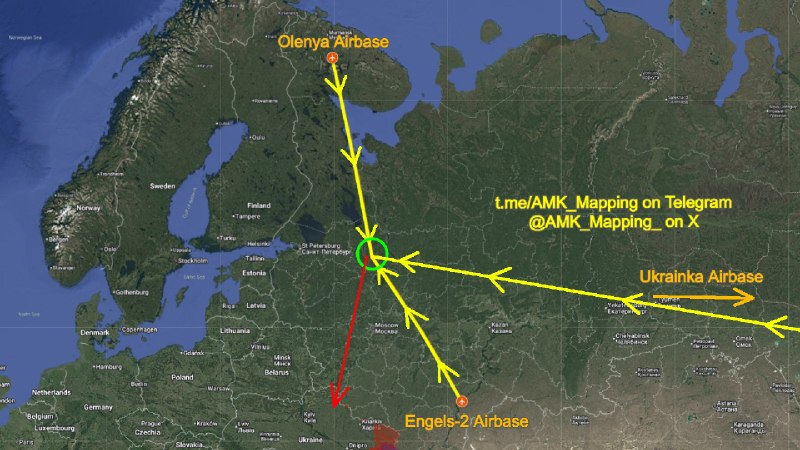
At 20:20 UTC on 1 July 2026, an open-source intelligence account that tracks Russian Air Force movements laid out, with the calm of a man reading a script he had written before, what it described as "the Russian plan" for the night: two Tu-95MS bombers from Engels-2 lifting north into western Vologda Oblast, four to eight more Tu-95MS from Olenya swinging south to meet them, and a third group of Tu-160M heavy bombers pushing out from Ukrainka. By 21:02 UTC the formation was confirmed airborne — ten strategic bombers in the air at once, drawn from three bases, vectoring toward a single point on the map. By the channel's 19:27 UTC note, combat-frequency traffic between Olenya and Russian strategic command and control had already signalled that a large-scale, combined missile-and-drone attack on Ukraine was being staged for that night.
None of this is unusual. It is, rather, the architecture of the war as it now runs.
What the package tells you
A salvo this large is not a tactical event. It is a signalling event. Each Tu-95MS — the Cold War-era turboprop that NATO still catalogues as the "Bear" — carries eight Kh-55 or Kh-101 cruise missiles externally and internally, with combat radii that put almost every Ukrainian oblast within unrefuelled reach. The Tu-160M, the swing-wing supersonic variant Russia has been slowly modernising at Kazan, carries twelve. Ten airframes, even with maintenance attrition, mean a salvo measured in the high double digits of cruise missiles, paired with the Shahed-type one-way attack drones that have become Moscow's preferred weapon for saturating Ukrainian air defence. The pattern — bombers cycling to a hold point in Russian airspace, salvo, return, rearm — is the same one open-source trackers logged through the spring and into June. What is striking is how un-surprising it has become.
The counter-narrative that doesn't quite fit
The official Moscow line, when one is offered, frames these strikes as retaliation for Ukrainian attacks on Russian territory and as a calibrated response to Western arms deliveries. The framing matters because it lets the war be discussed, in some quarters, as a symmetrical exchange between two militaries grinding each other down. The physical record does not support the symmetry. Ukraine is the invaded party; the strikes are launched from sovereign Russian airspace at cities, energy infrastructure and rail nodes inside a country whose territorial integrity Russia formally recognised in 1994 and again in the Budapest Memorandum. Cruise missiles fired from 800 kilometres away are not battlefield reciprocity. They are siege.
What the formation actually signals
Read against the past six months, the package points to a strategic choice rather than an operational one. Russia has accepted a tempo — roughly weekly massed strikes, sometimes two in a week — that prioritises the slow degradation of Ukrainian air defence and energy resilience over any single battlefield gain. The bombers are the spear tip; the Shaheds are the saturation; the ballistic and ground-launched cruise missiles that often ride along in the same package are the punctuation. Together they impose a cost — in interceptors expended, in power-grid strain, in the morale arithmetic of civilians who have now had four summers of this — that Ukraine can absorb week to week but cannot absorb forever without sustained Western air-defence resupply.
The deeper signal is industrial. Russia is producing and launching Kh-101s and their successors at a rate that, eighteen months ago, Western analysts described as unsustainable. The rate has not slowed. Engines, airframes, warhead assembly — the supply chain has held. That is the structural fact behind the picture of three bases lit up at once: not that Moscow has an unusually large stockpile to spend tonight, but that it has built the machinery to keep doing this on schedule.
What it means for Kyiv, and for the rest of us
For Ukraine, the immediate arithmetic is familiar: more Gepards and Patriots, more IRIS-T interceptors, more generators for the substrike on the grid that always follows the headline strike on the city. For Ukraine's European backers, the arithmetic is less comfortable. Each massed salvo has been used, in capitals from Berlin to Rome, as evidence that the war is escalating — and each time, the political response has been incremental rather than transformative. The pattern of decision lags behind the pattern of strikes by weeks, sometimes months. That lag is itself a strategic variable Moscow can model.
The alternative read is that these strikes are increasingly desperate — the work of an economy under sanctions pressure and a defence industry running hot on Soviet-era designs. There is evidence for that read in the ballistic-missile failure rate and in the growing use of less-precise Iranian-designed one-way drones. But the bombers are not a sign of desperation. They are the highest-end conventional asset the Russian Air Force operates, and they are being used in growing numbers, on a routine cadence, against civilian infrastructure. Read the picture as a whole and the weight falls on the side of a long war planned in quarters, not weeks.
What remains uncertain
Open-source flight-tracking sees the formation going up; it does not see, in real time, what each bomber releases, what is intercepted, or what reaches its target. The numbers of missiles launched, intercepted and impact-arriving typically surface over the following 24 to 72 hours through Ukrainian air-force briefings and Western-wire aggregates, and the two sets of figures sometimes diverge by a factor of two. The package on 1 July 2026 is, as of writing, an airborne fact. The damage ledger is tomorrow's news.
Desk note: Monexus has run the wire accounts of the air war in aggregate, but treats Telegram-channel sightings of Russian airframes as operational indicators rather than confirmed strike outcomes. The structural argument above rests on the cadence and scale of bomber packages over the preceding six months, not on any single night's launch count.
Wire provenance
This editorial synthesis draws on the following public wire/social posts:
- https://t.me/s/AMK_Mapping
- https://t.me/s/AMK_Mapping
- https://t.me/s/AMK_Mapping