Spain's 1,028 Death Toll Is the Climate Story Western Wire Coverage Keeps Burying
Spain attributed 1,028 excess deaths to a June heatwave on 1 July 2026, more than double last year's toll. The figure is sitting in the wires — and being treated as weather, not as a verdict.
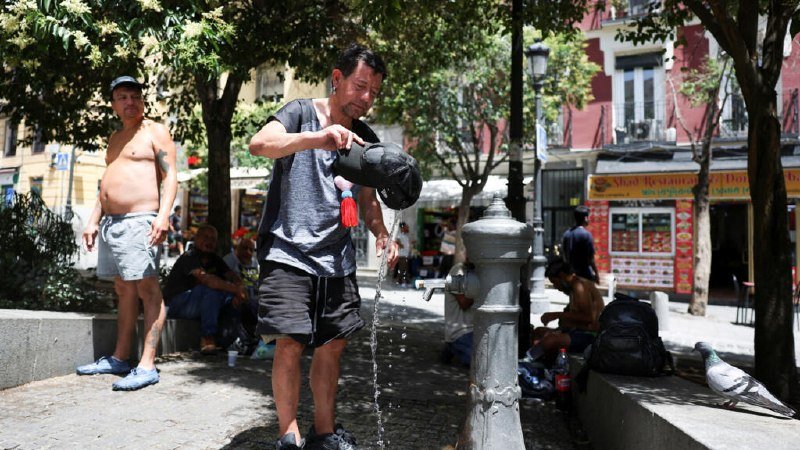
Spain's Ministry of Health closed the books on June at 17:00 UTC on 1 July 2026 with a number it could not soft-pedal: 1,028 excess deaths attributed to the heatwave that gripped the Iberian peninsula in the final week of the month. The figure, more than double the heat-linked toll recorded the same period a year earlier, turned what had been filed as a weather story into a public-health event. The country's meteorological agency had already confirmed June 2026 as the second-hottest June on record.
A thousand dead in a single month from a single cause is, by any reasonable editorial standard, the lede. The fact that it has to be argued for tells you something about the wiring of climate coverage in 2026.
The number, and what it actually measures
Excess-mortality accounting is the most conservative tool public-health agencies have. It does not attribute cause from a thermometer reading; it counts the gap between observed deaths in a window and the statistical baseline that demographers would have expected under historical norms. Spain's 1,028 is therefore a lower bound — deaths above the line that cannot be explained by population growth, seasonal flu, or ordinary variation. It is the floor of the building, not the ceiling.
France 24 reported the 1,028 figure on 1 July 2026, citing the Spanish health ministry's daily mortality surveillance system. The same day, Reuters carried an unrelated US manufacturing print showing prices paid by factories remained elevated — a reminder that the inflation story and the climate story are running on parallel tracks, with almost no overlap in the editorial imagination of major outlets.
Why the wires called it weather
Read the Spanish coverage in sequence and a pattern emerges. The South China Morning Post dispatched a Europe-desk story at 15:23 UTC on 1 July 2026; France 24's English service filed at 14:06 UTC, then again at 13:58 UTC. Reuters, AP, AFP and the BBC did not run a stand-alone Spain-heatwave-excess-death story on the day the figure dropped. The wire category was filed under "Europe weather" or "climate roundup" — alongside power-demand dispatches and agricultural-loss colour — rather than as a public-health lede.
This is the framing choice that does the work. A heatwave framed as meteorology invites the reader to nod, reach for a fan, and turn the page. A heatwave framed as 1,028 funerals invites an argument about labour law, urban design, ageing-in-place policy, the grid, and the political economy of who is left to die in a hot flat. The wire desks have chosen the former, consistently, because the latter would require them to assign blame to someone with a name and a portfolio.
The structural pattern that does not get named
European summers are not a new phenomenon. What is new is the frequency curve: what used to be a once-a-decade event is now a twice-a-summer event, and the body's capacity to recover between shocks is finite. Spain's June figures land inside a decade in which the European heat-related mortality burden has shifted from exceptional to baseline. The institutional response, however, has not caught up — heat plans in southern European municipalities remain seasonal documents, redrawn each spring, rather than permanent infrastructure in the way that flood-defence or wildfire-resilience budgets have become.
The reason this is treated as a story about temperature rather than a story about governance is not accidental. It is convenient. When the cause is "the weather," no minister resigns, no utility is fined, no planning authority is reversed, no construction code is rewritten. The accounting gets filed and the news cycle moves on.
What a serious wire should have run
A stand-alone Reuters or AFP piece on 1 July 2026 should have done three things. First, it should have led with the 1,028 figure and named the surveillance system that produced it, so readers could verify. Second, it should have compared it with the 2025 figure side by side and asked why the year-on-year doubling. Third, it should have noted that the Spanish health ministry's daily mortality system, designed for influenza seasons, is now being asked to absorb heatwave weeks of comparable magnitude — and asked whether the surveillance architecture itself is adequate to the climate it is being asked to monitor.
Instead, the figure is being quoted in passing inside broader climate roundups, where it functions as colour rather than as evidence. The same outlets that would lead the page with 1,028 deaths in any other category — traffic, terrorism, hospital-acquired infection — are treating heat-linked mortality as a footnote.
The stakes
If the 2026 baseline is roughly 1,000 excess deaths per major Spanish heatwave, and the continent is on track for two to three such events per summer by the end of the decade, the cumulative arithmetic is not subtle. The ageing demographics of southern Europe compound the problem: the population most exposed to heat stress is also the population least able to relocate or retrofit. A public-health system that treats heat as weather will be the same public-health system that arrives at 2034 wondering why its emergency rooms are overrun every July.
The 1,028 figure is not a prediction. It is a measurement. What the wire desks do with measurements — where they place them, what they surround them with, what they refuse to compare them to — is the editorial story of this decade, and it is hiding in plain sight inside a heatwave roundup.
This publication treats the Spanish heat-mortality figure as a public-health lede because that is what the surveillance system that produced it is designed to measure. The wire framing, by contrast, treats it as meteorology — a category choice with consequences that compound every summer.
Wire provenance
This editorial synthesis draws on the following public wire/social posts:
- http://reut.rs/4xUse3z