Ukraine's missile question: what the FP-9 claim actually tells us
Russian-aligned channels say a domestically produced Ukrainian ballistic missile was intercepted over Moscow Oblast. The sourcing is thin, but the underlying shift in Kyiv's defence industry is not.
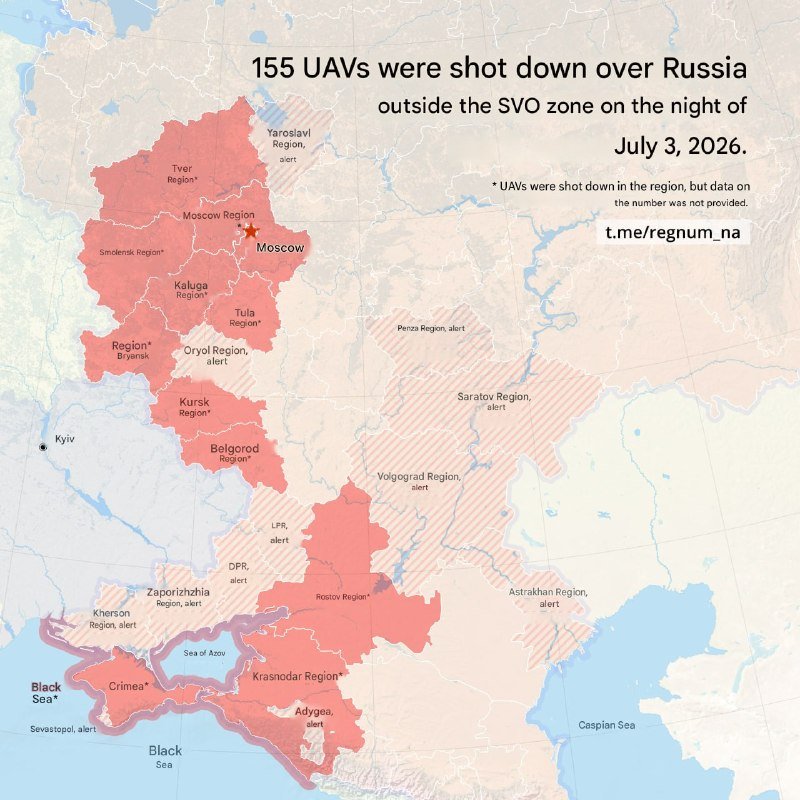
Russian-aligned open-source channels reported on 1 July 2026 that a Ukrainian-made ballistic missile — designated by those channels the FP-9 — had been shot down over Moscow Oblast. The claim, circulated via the Telegram aggregator osintlive from the account @NSTRIKE1231 at 21:17 UTC, fits a pattern of messaging rather than a confirmed intercept: the originating posts are framed as "Russian sources claim," not as a Russian defence ministry confirmation, and no imagery of debris, a launch site, or an interception plume has surfaced in the channel's own feed.
What is real is the trajectory underneath the noise. Ukraine's domestic missile programme is no longer a rumour. For more than a year, Kyiv has signalled that domestically produced cruise and ballistic systems are entering serial production, and the FP-9 framing in Russian channels is best read as Moscow beginning to publicly acknowledge a capability it has previously dismissed. The interception claim, true or false, is itself an admission that something crossed the line.
The intercept that may not be one
Russian-source intercept claims have a history. During 2024 and 2025, similar posts in the same Telegram ecosystem variously attributed downings of ATACMS, Storm Shadow, and domestically produced Ukrainian drones to specific Russian air-defence batteries, often hours before Moscow's own ministry confirmed anything. The lag is not always because the ministry is slow; it is often because the post is wrong. Russian-aligned milbloggers compete for reach, and a successful intercept over Moscow Oblast is the most valuable currency they trade in.
A 19:46 UTC post on the same day, citing Ukrainian authorities, pointed to deployment of "highly precise, locally developed glide bombs" — a separate weapons category, but one that confirms the direction of travel on Ukrainian industrial output. The two stories, taken together, suggest a defence-industrial base that is producing at multiple ranges and yield classes, not a single missile system sprung from a hidden lab.
A different problem: the demographic ledger
The same channel ecosystem that publishes the FP-9 claim is also the loudest amplifier of Russia's casualty arithmetic. A 20:47 UTC post on 1 July observed that "staggering battlefield casualty rates have significantly outpa[ced]" Russia's long-term demographic recovery — a framing that, if accurate, has consequences that outlive any single intercept. Demographic decline compounds quietly; missile intercepts do not. A state that loses a generation of young men cannot rebuild a defence industry, a tax base, or a conscript pool on a five-year horizon, and the arithmetic gets worse, not better, the longer the war runs.
The Western wire line tends to treat Russian casualties as a number to be either minimised (to avoid "war-weariness" framing) or weaponised (to argue for more Ukrainian strikes). Neither framing is wrong, but both miss the structural point. The Russian state is not in the same demographic position it was in February 2022, and the gap is widening.
What the Western wire has not caught up to
Mainstream coverage still treats Ukraine's strike capability as a function of Western hand-offs: HIMARS, ATACMS, F-16s, Storm Shadow. That framing was correct in 2023. It is increasingly incomplete in 2026. The Ukrainian glide-bomb line — referenced in the 19:46 UTC post — uses Soviet-era FAB airframes married to Western or domestically produced guidance kits, a workaround for glide-bomb kits whose supply Kyiv would prefer not to depend on a single patron for. The FP-9 claim, if it has any substance, sits in the same industrial story: a Ukrainian defence base learning to design, not just integrate.
There is a counter-narrative worth taking seriously. Russian channels have an interest in portraying every new Ukrainian weapon as a Western derivative, both to keep the sanctions-and-supply debate live in European capitals and to deny Kyiv credit for indigenous engineering. A pure-Western-origin framing also flatters Moscow by treating the war as a NATO–Russia contest, with Ukraine as an extension. That framing remains common in both Russian and Western commentary, and both of those sources have reasons to maintain it.
The stakes, plainly
If the FP-9 intercept is real, it tells us less about a single missile than about a maturation curve. A state that can put a ballistic system on Moscow Oblast in mid-2026 is, on present trajectory, a state that will have a longer-range and more diverse inventory by mid-2027. That is the structural fact the intercept claim is pointing at, regardless of whether any particular warhead came down on a particular evening.
The counter-read is honest. Russian channels also over-claim, and Telegram aggregators compress the difference between a Russian air-defence officer's wet-finger estimate and a ministry-level confirmation into a single news cycle. Treat the headline as a signal, not a fact. The signal is that Ukraine's industrial base has crossed a threshold that Russian messaging is now obliged to acknowledge, and Russian messaging is, in this domain, a lagging indicator of Ukrainian capability rather than a leading one.
This article relied on three open-source-channel posts from 1 July 2026 UTC. No Ukrainian, Russian, or third-party government statement was available at the time of writing; the piece should be read as an open-source read, not a confirmed intercept.
Wire provenance
This editorial synthesis draws on the following public wire/social posts:
- https://t.me/osintlive
- https://t.me/osintlive
- https://t.me/osintlive