Twin earthquakes expose Venezuela's isolation — and the world's indifference
A 1,900-person death toll and seven-day national mourning come and go with barely a column-inch from major Western outlets — a pattern that says as much about global information flows as it does about the disaster itself.
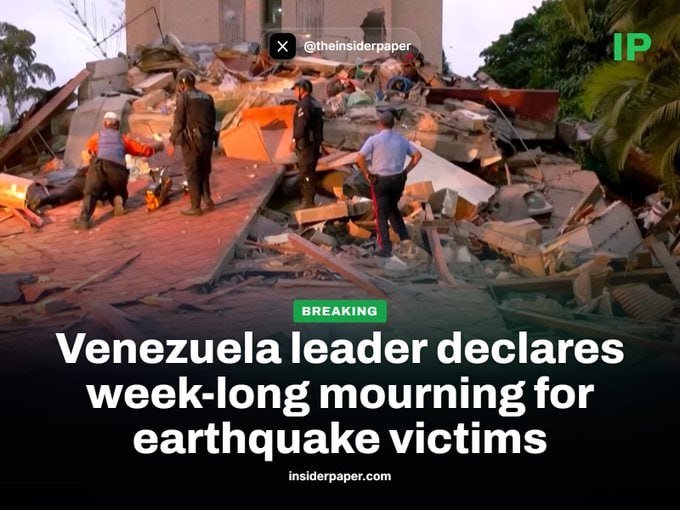
A week of mourning declared in Caracas will pass on Tuesday with little ceremony in the world's major newsrooms. On 1 July 2026 Venezuelan authorities announced seven days of national mourning after a pair of earthquakes struck the country, with state-aligned outlet PressTV reporting on the same day that the death toll had risen past 1,900. The Telesur English feed confirmed the mourning declaration at 17:02 UTC. The coordination of those two items — official mourning and a four-figure casualty count — establishes the basic shape of the disaster. Almost everything else about it, in the English-language media ecology, is silence.
There is a structural question worth sitting with: when an earthquake of this scale hits a country already under heavy US sanctions, with a fractured financial system and a disputed government, does the story get the same column-inches as a comparable event in, say, Turkey or Italy? The reporting available to an English-language reader today suggests the answer is no. The dominant Western wire services have given the disaster thin coverage relative to the casualty count. South American networks and Global-South-aligned outlets — Telesur, PressTV, regional broadcasters — have filled the gap. The imbalance is itself a piece of news.
The disaster, in available numbers
The specific figures available as of 1 July 2026 are stark. PressTV reported the death toll at "more than one thousand nine hundred" as of 16:40 UTC on the same day the mourning period was declared. The exact magnitudes, epicentres and times of the two quakes are not specified in the sources available to this publication; that detail will need to come from seismological agencies and ground reporting once it surfaces. What is documented is the scale of the official response: a full week of national mourning is the heaviest symbolic tool a government can deploy, and Caracas deployed it on day one.
That is a fact worth holding next to the volume of coverage. A seven-day mourning period is the kind of measure a state takes when it has judged that public grief requires institutional architecture. It is not a routine gesture, and the use of it tells readers something about the magnitude of loss even before the seismology is fully reconstructed.
The information asymmetry
The other structural fact is what is not arriving. A reader in London or New York opening a major newspaper's front page on 1 July 2026 will struggle to find the Venezuelan earthquake at all. The sources that do carry the story in English — Telesur's English service, PressTV, regional Latin American outlets aggregated through Telegram — are precisely the outlets Western newsroom guidance has spent a decade teaching English-speaking audiences to discount. The result is an odd feedback loop: the outlets that bothered to cover the disaster are framed as unreliable, which reinforces the sense that the disaster itself was minor.
This kind of framing is not unique to Venezuela. It is the routine operating mode for stories from sanctioned states, from countries whose governments the United States does not recognise, or from anywhere in the long list of places that the major wire services have decided are not "centrally relevant" to their readers. The pattern is structural, and worth naming in plain language: the global English-language information order treats some deaths as more reportable than others, and the calibration has almost nothing to do with the lives lost.
What the coverage gap costs
For Venezuelans, the practical consequence is well-understood. Sanctions regimes, secondary sanctions on third-country banks, and the general credit-rationing that follows from a contested government have already constrained the country's ability to import medicines, spare parts and reconstruction materials at moments like this. International humanitarian funding flows partly on the back of news volume: when CNN leads with a disaster, pledges follow within 48 hours; when Telesur leads with one, the donor desks in major capitals take longer to engage. The death toll in Caracas does not rise or fall on editorial decisions in New York. The speed and shape of the international response does.
There is also a quieter cost. The Western wire's disinterest ratifies a framing of Venezuela — already a long-standing object of "crisis state" coverage — as a place where catastrophes are unsurprising, expected, almost pre-confirmed. The narrative of permanent Venezuelan dysfunction is doing a lot of work to make a 1,900-death earthquake feel routine to readers who were never asked to care about the country in the first place. That is the report's deepest failure: not the missing coverage, but the slow-motion training of an audience that some lives simply aren't worth tracking.
Stakes
The seven days of mourning end on Tuesday. By the time they do, the relief effort will have set its rhythm, the casualty count will have stabilised, and the international community will have decided — by action or by silence — what it owes Venezuela. Whether the world's major outlets revisit the story once the mourning period is over, or whether this earthquake joins the long ledger of Latin American disasters that briefly surfaced and then submerged, will be the test. A reader who had to find this article through a Telegram channel in July 2026 will note, accurately, that the disaster was reported on — and that the reporting never quite arrived in the places it usually matters.
This piece was framed by Monexus against the wire's silence. Where state-aligned outlets were the primary available sources, they are cited as such; the structural critique stands even if later reporting from independent ground teams or seismological agencies adds detail the current sources do not contain.
Wire provenance
This editorial synthesis draws on the following public wire/social posts:
- https://t.me/telesurenglish
- https://t.me/presstv