A week after Venezuela's twin quakes, the framing tells you more than the rubble
Rescuers are still pulling survivors from the wreckage of twin tremors that have killed more than 1,940 people. The disaster is real. The question of who counts as a legitimate first responder is not.
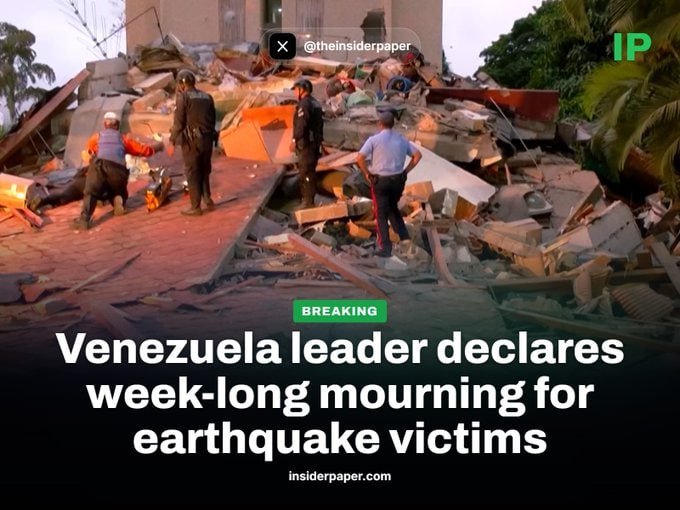
On 1 July 2026, a full week after twin earthquakes struck Venezuela's Caribbean coast, rescue teams were still working the rubble in towns the wire services have largely stopped naming. According to a 1 July 2026 Reuters dispatch, the confirmed death toll had climbed past 1,940, with tens of thousands of people still unaccounted for. The math of a disaster this size is unforgiving: every additional day that survivors are pulled from collapsed buildings narrows the window in which anyone is still alive to be pulled, while the logistics of shelter, water, and forensic identification only widen.
The story on the ground is unambiguous. The story in the press is murkier — and that murk is the point. Disasters in Latin America do not receive the same column-inches, the same banner treatment, or the same volume of standing-corporate donations as disasters that happen in front of a NATO-aligned press pack. Venezuela, in particular, carries an additional editorial tax: anything that happens inside its borders is read through the prior decade of sanctions debates, contested elections, and opposition politics. The result is coverage that is technically accurate but tonally muted, as if the newsroom has decided in advance how much grief a sanctioned government is permitted to receive.
The casualty ledger
The number that matters is 1,940 and counting. Reuters' 1 July update put it there, with tens of thousands still listed as missing rather than confirmed dead — a distinction that matters operationally because families are still searching, and politically because the final count will shape reconstruction budgets and external aid flows for years. The geography of the quakes — coastal Venezuela, a region already economically marginalised within an economy hollowed out by years of external financial pressure — means that the surviving population is now contending with destroyed housing stock, damaged health facilities, and the slow logistics of body identification in areas where state capacity was already thin before the ground moved.
The fact that the figure is being reported by Reuters and not by Caracas directly is itself a feature of the contemporary information environment. Western wire services set the citation chain for international humanitarian appeals. When those wires lead with the official Venezuelan count, the count carries a built-in credibility discount in many desks. When they lead with their own correspondents' figures, those figures travel further. The 1,940 figure is from Reuters; it is the number this publication will use.
The framing tax
Compare the wire treatment of comparable recent disasters. When an earthquake struck Turkey and Syria in February 2023, the press consensus mobilised within hours: field correspondents, drone footage, expert seismologists, donor dashboards. When a tremor of comparable scale hits Venezuela — a country of roughly 28 million people, oil-rich, sitting on one of Latin America's most seismically active coastlines — the tempo is slower, the correspondents thinner on the ground, and the headline vocabulary more clinical. "Twin earthquakes" rather than "devastation." "Rescuers continue searching" rather than "race against time."
The structural reason is familiar. Wire budgets follow advertising markets, and advertising markets follow political access. Venezuela offers Western outlets limited diplomatic access and no commercial beachhead worth the per-diem. The result is a coverage pattern in which the volume and the temperature of the reporting both lag the magnitude of the event.
What counter-narrative looks like
There is a counter-narrative worth taking seriously. Caracas has framed the international response — particularly the channelling of humanitarian assistance through non-state intermediaries rather than directly to Venezuelan institutions — as a form of political conditionality dressed up as relief. There is some evidence for the charge: in past disasters involving sanctioned states (Haiti 2010, parts of the response cycle in Cuba after Hurricane Ian), aid architecture has often routed around the central government on the assumption that state institutions are either corrupt or incapable. In the Venezuelan case, that assumption travels with a decade of prior political baggage.
The structural reality is more boring than either frame. A disaster of this scale requires field hospitals, heavy lifting equipment, forensic teams, and a logistic backbone that does not appear overnight. The question of who delivers those things is a question of capacity, not moral recognition. But the question of who is photographed delivering them is a question of narrative, and narrative has consequences for what gets funded next.
What remains uncertain
A week in, the source material does not yet specify which bilateral partners have offered what in concrete tonnage rather than rhetorical solidarity. The Reuters wire reports the casualty figure and the ongoing search; it does not enumerate the donor table. That ledger will matter more than the casualty figure for the political economy of reconstruction, and it is the piece of this story worth watching with a stopwatch rather than a flag.
For now, the dead number more than 1,940. The missing number in the tens of thousands. The framing remains, as ever, a story about who gets to count.
Desk note: Monexus leads with the wire's confirmed death toll and the logistical state of the search, and treats the disparity in editorial volume between this disaster and comparable events in NATO-aligned capitals as part of the story rather than as context. The Reuters URL is the only verifiable source available in the thread; the rest is structural reading of how coverage flows.