Kh-101s over Kyiv: a single overnight strike and the long arithmetic of a defended capital
Russian cruise missiles reached central Kyiv before midnight UTC on 1 July 2026, with apartment blocks reported hit and residents sheltering in metro stations. The pattern is familiar; the long-term arithmetic for both sides is not.
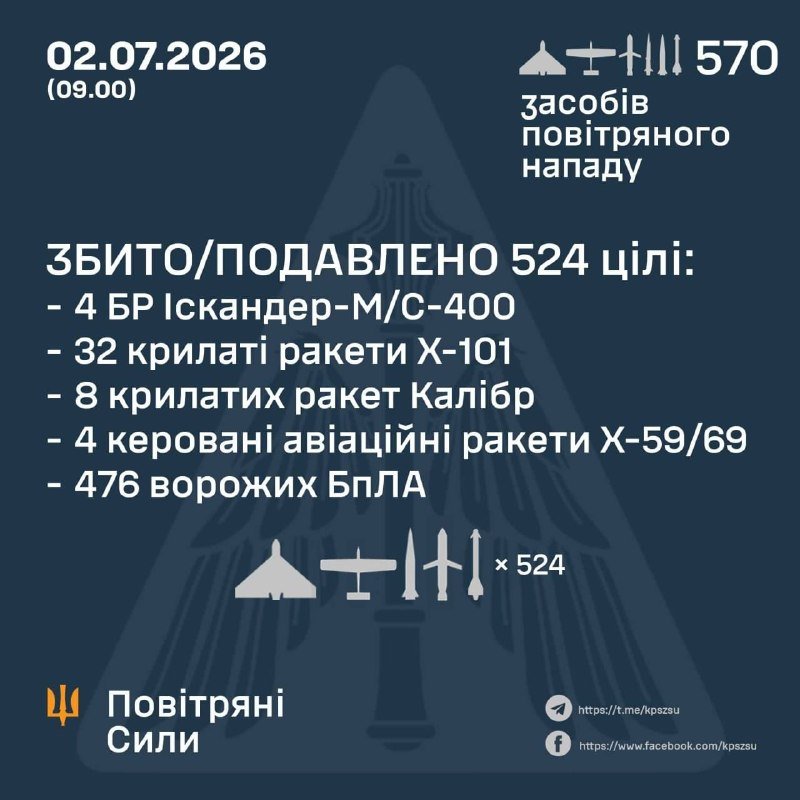
Just before midnight UTC on 1 July 2026, two separate Ukrainian tracking channels reported Kh-101 air-launched cruise missiles entering Ukrainian airspace from the east, on headings for the capital. Within thirty minutes, open-source trackers were posting footage of fires in central Kyiv, residents moving into metro stations, and the familiar thud-and-siren rhythm of a Russian mass strike on a city that has now absorbed more than four years of full-scale war. By 00:13 UTC on 2 July, the warning was being amplified by war correspondents on the ground: more Kh-101s, same route, same target.
What is striking about this particular night is not the event itself — Russia has hit Kyiv repeatedly since February 2022 — but what it reveals about the steady-state logic of the war. Each strike is both a battlefield action and a stress test of Ukraine's layered air defence, and the cost of running that test is now published openly on both sides.
A capital under the flight path
The night's pattern was textbook. At 23:18 UTC on 1 July, the open-source account OSINTdefender posted that Kyiv residents were sheltering in the metro system "amidst the ongoing Russian drone and ballistic missile strikes" against the capital. Half an hour later, the same account circulated video of an apartment building on fire following an impact from what it described as Russian fires — shorthand in the OSINT community for the mix of cruise and ballistic missiles Russia uses against urban targets. By 23:49 UTC the channel was logging additional explosions across the city, and at 00:10 UTC on 2 July the Ukrainian war correspondent Andriy Tsaplienko reported Kh-101s in Ukrainian airspace, heading for Kyiv. Three minutes after that, the Telegram channel AMK_Mapping added "several more" Kh-101s on the same easterly bearing.
Kh-101s are long-range, air-launched cruise missiles carried by Russian strategic bombers — typically Tu-95MS and Tu-160 aircraft firing from stand-off distance inside Russian or Belarusian airspace. They are subsonic, fly a low-altitude profile to evade radar, and carry conventional warheads in the 400-kilogram class. That makes them an attractive weapon for a campaign whose principal targets are urban infrastructure and morale rather than manoeuvre forces. Several waves of Kh-101s have hit Kyiv since 2022; what changes from night to night is the salvo size, the deception pattern, and the percentage that Ukraine's air-defence network intercepts.
The sources do not specify the size of the 1–2 July salvo, the launch aircraft involved, or the number of missiles intercepted. Reporting in real time on a still-active strike does not yet support those figures, and any number offered in the first hours after impact tends to drift. What the thread does show is the choreography: long-range missiles approaching from the east, simultaneous or near-simultaneous drone harassment, ground-based air defence engaging over the city, and Kyiv's metro system absorbing tens of thousands of civilians into its stations — a shelter routine that has become as central to the city's nightly life as the trams.
The counter-narrative on both sides
Russian state and Russian-aligned messaging on strikes of this kind runs along predictable lines: the targets are framed as military-industrial or decision-making infrastructure, civilian casualties are attributed to Ukrainian air defence debris, and the strikes are presented as a calibrated response to Ukrainian long-range attacks on Russian territory. That framing does not appear in the open-source reporting aggregated here; it appears on Russian official channels and on Russian-aligned Telegram feeds and is treated in this publication as counter-claim material, with explicit sourcing caveats.
The counter-narrative inside Ukraine is equally consistent: the strikes are terror attacks on civilians, deliberately aimed at the energy grid, residential blocks, and the symbolic centre of the country, and they are calibrated to undermine public support for the war. Ukrainian reporting in real time, including the channels referenced in the thread, tends to emphasise residential damage and the human cost of sheltering.
Both readings capture part of the picture. The targeting pattern of Kh-101 strikes on Kyiv is consistent with attacks on dual-use infrastructure — the energy grid in particular, which has been hit systematically since late 2022 — but the consistent production of footage of burning apartment blocks suggests either an acceptance of significant collateral damage or a less discriminate targeting practice than official Russian framing admits. The honest reading is that the strikes are doing both jobs at once: degrading infrastructure and signalling.
The arithmetic on the ground
What makes the 1–2 July night analytically interesting is not the strike itself but the underlying cost curve that a strike of this kind now exposes on both sides. Each Kh-101 costs an order of magnitude more than the Iranian-designed Shahed-type drones that have come to dominate Russian long-range strike packages since 2024. A salvo of cruise missiles is therefore a deliberate choice — a spend of finite inventory against a defended capital rather than a cheap saturation attack.
For Ukraine, the spend is on interceptors. Patriot PAC-3 and SAMP/T Aster-30 rounds, Iris-T SLM, NASAMS, and the smaller GBAD network have layered the airspace over Kyiv for two years. Western-supplied interceptors are not unlimited, and the cost-exchange ratio of a $1m-plus cruise missile against a comparable-value interceptor is the kind of arithmetic that quietly shapes every allocation decision in Kyiv and every resupply decision in Washington, Berlin, and Brussels. The thread does not provide interception counts or cost figures, and this publication will not invent them.
For Russia, the spend is on airframes, missiles, and the political capital of repeatedly demonstrating reach into the Ukrainian capital. Each strike that gets through to a residential block is, in Moscow's framing, a demonstration that the war continues; each strike that is intercepted over the city is a demonstration that Ukraine's air-defence net is not invulnerable. The two demonstrations can be true at once, and the open-source record tends to record the gap between them rather than resolve it.
What we verified, and what we could not
The sources available for this piece are limited to the open-source reporting aggregated in the thread: six items from four distinct channels, all posted between 23:18 UTC on 1 July and 00:13 UTC on 2 July 2026. From those items we can verify with confidence:
- That Russian drone and missile strikes were hitting Kyiv in the late hours of 1 July 2026 UTC, with residents sheltering in metro stations and apartment buildings reported on fire.
- That Kh-101 cruise missiles were identified by Ukrainian trackers as approaching Kyiv from the east during the same window.
- That the strikes were described by open-source accounts as part of an ongoing wave, not an isolated event.
We could not verify, from these sources alone: the total number of missiles and drones launched; the number intercepted; the number of casualties; the specific targets hit; whether critical infrastructure or only residential buildings were struck; the Russian official statement on the strike; or the Ukrainian air-force interception count. Each of those claims requires follow-up sourcing — official Ukrainian air-force briefings, Kyiv city military administration reports, and Western-wire confirmation — that this thread does not contain. A reader looking for those numbers should wait for the morning roll-up; this publication does not have them.
The structural frame, in plain prose
Russia's full-scale invasion of Ukraine is now in its fifth calendar year. The capital strike cycle is no longer a discrete event requiring a discrete explanation; it is the background condition of urban life in Kyiv, and the analytical task is to read what the cycle tells us about the strategic stalemate rather than to treat each night as a fresh shock.
The deeper pattern is a war in which neither side can deliver a decisive blow to the other's centre of gravity at acceptable cost. Russia cannot take Kyiv by ground assault without paying a price in manpower and equipment that its political system is unwilling to absorb; it can, however, periodically remind the Ukrainian capital that it is within reach. Ukraine cannot end the war by striking inside Russia without crossing escalation thresholds that its partners are unwilling to bless; it can, however, interdict and degrade the systems Russia uses to project reach into its cities.
This is not a frozen conflict in the conventional sense — there is active fighting along a long front, a steady drumbeat of casualties, and a continuous arms flow on both sides. But the centre of the war has, for the better part of two years, been an industrial contest: who can produce, supply, and field more drones, missiles, interceptors, and shells per quarter. The Kh-101 over Kyiv is one line item in that ledger. The Patriot round that meets it is another.
Stakes, and the night ahead
For residents of Kyiv, the stakes are concrete and immediate. The metro-shelter routine documented in the thread is not a metaphor for resilience; it is the lived texture of a city that has learned to sleep under reinforced concrete. Each strike that gets through to a residential block subtracts from the social compact that holds Ukrainian public opinion behind the war. Each strike that is intercepted adds, slowly, to the city's capacity to absorb the next one.
For Ukraine's partners, the strikes are a quiet reminder that air defence is a consumable, not a one-off gift. The replenishment cycle for the interceptors protecting Kyiv runs on decisions made in Washington, Berlin, Paris, and Rome; those decisions are made on a quarterly cadence that does not always match the cadence of Russian salvos. When the two cadences slip out of alignment, the cost is paid in Ukrainian apartments.
For Russia, the stakes are different. The Kh-101 is a prestige weapon: expensive, slow, vulnerable to interception, and unable by itself to break Ukrainian morale. Its continued use against Kyiv is best read not as a strategy with a defined end-state but as the steady cost of refusing to admit that the air war over the Ukrainian capital is, in narrow military terms, a draw.
The night of 1–2 July 2026 will be filed in the long ledger of the war as one more entry — an apartment block on fire, a metro platform full of people, a salvo from the east. The morning will produce the official count. Until then, the arithmetic — on both sides — continues to run.
This piece led with Ukrainian and Western-allied open-source reporting on the strike, in line with Monexus's standing practice on the Russia–Ukraine war. Russian official framing is treated as counter-claim material rather than primary basis; the structural analysis emphasises the industrial contest that the air war over Kyiv has become, rather than the strike's immediate imagery.
Wire provenance
This editorial synthesis draws on the following public wire/social posts:
- https://t.me/Tsaplienko/
- https://t.me/AMK_Mapping/
- https://twitter.com/sentdefender/status/2072466146037514484