Khamenei's funeral and the village on the news: what Lebanon tells us about Iran's post-war optics
Israeli demolition work in Kunin lands the same week Tehran stages a farewell to Khamenei. The juxtaposition is louder than either event alone.
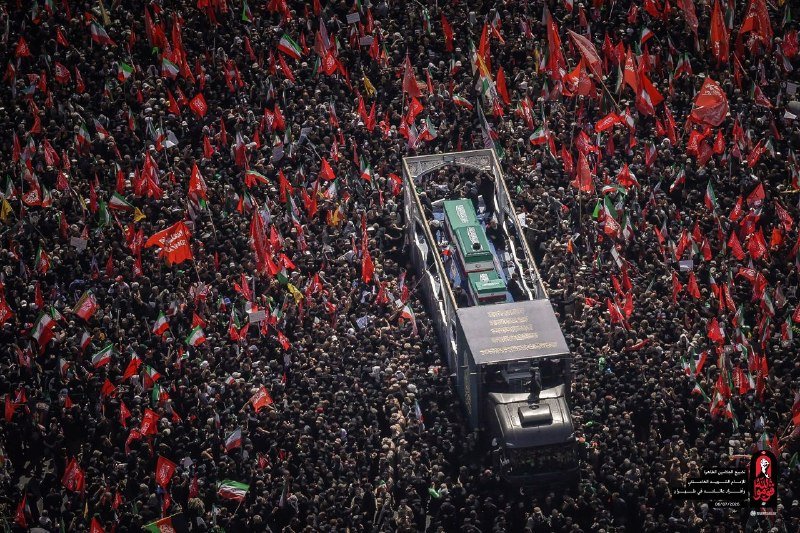
On 2 July 2026, at roughly 16:36 UTC, Israeli forces blew up infrastructure in the southern Lebanese village of Kunin, the local Arabic-language channel Abuali Express reported. The English-language arm of the same outlet, English Abuali, repeated the item twice within ten minutes — once at 17:42 UTC and again at 17:44 UTC — each time pairing the strike with the same pointed line: "The coming days, the days of Khamenei's funeral, are an opportunity." Whoever writes the channel's English commentary wanted it on the same screen as the demolition footage. They got their wish.
That pairing is the story. A village is being dismantled, and a state funeral is being staged, in the same week, on the same broadcast. The juxtaposition matters more than either fact alone, because it tells a regional audience what each camp believes it has just won, and what it believes it can now cash.
What is actually being demolished
Kunin sits in southern Lebanon, in the stretch of the Litani where Israel has spent most of the past two years clearing Hezbollah infrastructure. The Abuali Express footage is demolition work — bridges, access roads, the connective tissue of a village rather than a missile site — broadcast in real time. Southern Lebanese outlets have carried similar items throughout the post-ceasefire period, and IDF Spokesperson briefings have named village-by-village targets on a near-weekly basis. The pattern is the same: the Israeli argument is that these are launch nodes and resupply routes; the Lebanese argument is that they are farms, olive groves, and the only road to school. Both arguments are partly true, and the only honest reading is that "infrastructure" is doing the rhetorical work for one side, "civilian life" for the other.
The house-keeping detail matters. Demolition footage released during a period when Israeli and Lebanese intermediaries are nominally trading on a ceasefire reads less like counter-terror and more like a slow-motion eviction. If the Israeli security argument were the full story, the village would not appear on Lebanese phones at the exact moment a successor to Khamenei is being mourned in Tehran.
The Tehran framing
Iran's leadership transition is the second piece of the broadcast. Khamenei's funeral — if the schedule Abuali references holds — will draw the customary crowd of regional dignitaries and proxies: Hezbollah's diminished politburo, the surviving Houthi leadership, the Iraqi, Syrian, and Yemeni factions that have spent two decades learning to read Iranian signals. Whoever succeeds Khamenei inherits a network that has just come off its worst year since 1988. The English Abuali framing — "the days of Khamenei's funeral, are an opportunity" — is inverting the usual Lebanese anxiety. It is reading a funeral as a deadline. If the network has a window to demonstrate it still functions, this is it, and Kunin is the test.
The same broadcast reaches an Israeli audience as something different: proof that Lebanese airspace still carries Hezbollah-aligned narration in real time, which is itself a violation of the spirit, if not the letter, of the ceasefire monitoring arrangement.
A structural read, in plain terms
The longer pattern here is the choreography of two loss-avatars trying to read each other's domestic clocks. Israel is reading Tehran's succession as a moment of maximum Iranian distraction, when the network's command discipline is at its weakest. Iran's residual network is reading Israel's coalition politics — a government that has spent eighteen months managing the war's domestic cost — as a moment when Israeli tolerance for another funeral-week incident is at its lowest. Both reads can be true. When two actors believe they each have a short window, the short window tends to get used.
This is the part of the cycle where small escalations are not failures of deterrence; they are the deterrence conversation itself. A village bridge destroyed on the day of a state funeral tells every audience in Beirut, Tehran, and Tel Aviv something about who is still willing to pay tonight's bill.
Stakes, and what the wires are not yet telling us
The concrete stakes sit in three places. First, in Kunin itself, where a thousand or so residents now have one fewer road home, and the next funeral-week broadcast may bring the next village. Second, in Beirut, where the government has spent eighteen months insisting it can monopolise the southern border file; every demolition broadcast is a quiet refutation. Third, in Tehran, where the new Supreme Leader, whoever emerges, will inherit a network that the same day is being publicly tested in a village half a continent away.
What the public record does not yet settle: which specific targets in Kunin were struck, whether any combatant infrastructure was named by the IDF for this incident, and what the Lebanese Armed Forces have reported to UNIFIL about the episode. The wire has not yet caught up; the Telegram footage has. Until a Western wire names the targets and the IDF publishes a targeting rationale, this story will continue to be told in the language of local Telegram channels, which is to say in the language of the side that uploads footage first.
Desk note: Monexus has relied here on Lebanese local reporting because no wire had, at time of writing, published a corroborated version of the Kunin incident. Where Western wire confirmation arrives, this piece will be updated.
Wire provenance
This editorial synthesis draws on the following public wire/social posts:
- https://t.me/englishabuali/
- https://t.me/abualiexpress/