The farewell at Tehran's Grand Mosalla, and what comes next
State media is staging a two-day farewell for Ayatollah Khamenei. The choreography is familiar; the succession math is not.
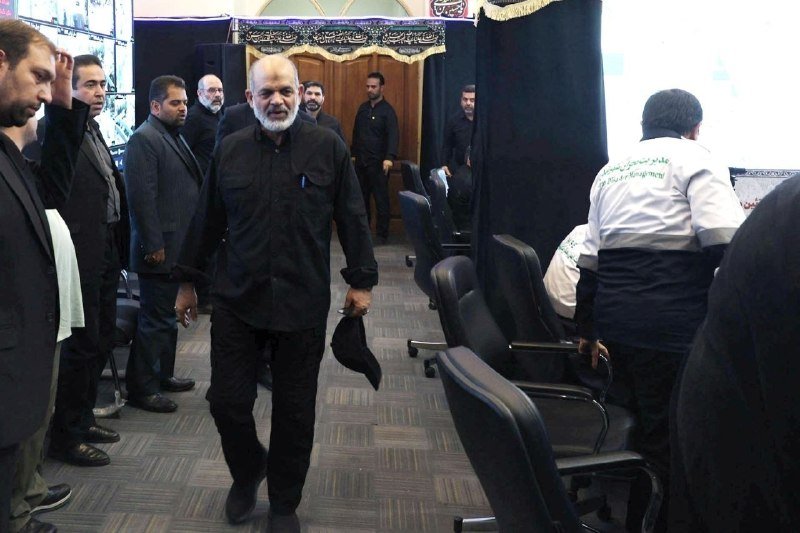
On 2 July 2026, at roughly 15:50 UTC, Iranian state television broadcast aerial footage of Tehran's Grand Mosalla — the great prayer hall on the capital's southern fringe — being readied for the funeral procession of Ayatollah Seyyed Ali Khamenei, the Islamic Republic's Supreme Leader since 1989. By 16:20 UTC, PressTV had cut to a tribute from the British politician George Galloway, who hailed Khamenei as an inspiration for "hundreds of millions." By 17:15 UTC, a channel identifying itself as Khamenei's own Telegram account was running footage of the armoured vehicle that will carry his body to the Mosalla, alongside those of martyred family members, and counting down two days to the farewell ceremony.
The visuals are familiar; the underlying transition is not. Iran is entering its first Supreme Leader succession in nearly four decades, and the choreography on screen — black banners, military escorts, foreign dignitaries reading prepared scripts — is doing political work that goes well beyond mourning.
The Mosalla, the motorcade, the message
The choice of the Grand Mosalla is itself a statement. The prayer hall, completed in phases and expanded repeatedly since the early 2000s, is where Iran stages the events it wants to look like the whole umma turning out: the 2020 Soleimani funeral, the annual Quds Day, periodic government rallies. Mounting Khamenei's farewell there — rather than at a smaller, more controllable venue — signals that the post-1989 legitimacy script is being replayed at full volume, with foreign guests and senior clerics in the frame.
The 17:15 UTC footage of the special transport vehicle, paired with the explicit reference to martyred family members, embeds a quieter subtext. Succession debates inside the Islamic Republic's clerical hierarchy have, in past transitions, often hinged on which faction controls the rituals of mourning and martyrdom as much as on the formal votes of the Assembly of Experts. Whoever manages the floor at the Mosalla over the next two days is also managing who gets to be seen grieving, who gets to be seen standing near the coffin, and who is conspicuously absent.
Galloway's role, and the foreign guest list
The Galloway clip is worth more attention than it might first attract. PressTV gave it prime placement on the same day as the Mosalla footage — a clear editorial decision. Galloway has been a reliable Western voice for the Iranian line for years; his usefulness is precisely that he is British, that he sounds like a Western parliamentarian, and that he can be deployed when the Islamic Republic wants to demonstrate that its mourning is not contained to its own Shia base.
He is unlikely to be alone on the dais. The official mourning period is the moment at which Tehran's residual diplomatic relationships — Syria's remnants, Hezbollah's Beirut, the Houthis in Sanaa, the Iraqi Shia Coordination Framework, and the patient axis in Moscow and Caracas — typically re-photograph themselves in solidarity. Western-aligned officials, by contrast, will calibrate their statements to whatever their own capitals are doing on sanctions and nuclear talks. The asymmetry of the guest list will itself be news.
The succession question the footage does not show
None of the broadcast material addresses the central political fact: who is about to become Supreme Leader. The Islamic Republic's constitution routes that choice through the Assembly of Experts, a body whose proceedings are not public and whose deliberations rarely leak. In practice, the successor is settled by a contest between the sitting establishment around the presidency and the powerful unelected institutions — the Guardian Council, the office of the Supreme Leader itself, the IRGC, and the bonyads. Khamenei spent years using the appointment of the Assembly's membership to constrain that contest; he was seen, by some accounts, to favour his own son Mojtaba, by others a senior cleric on the Council. The Telegram material does not adjudicate the question, and a staff writer should not pretend it does.
What the visuals do is buy time for the establishment to converge. A two-day farewell is not just a religious observance; it is a controlled environment in which competing factions must appear united on camera, where foreign guests can be photographed delivering the right line, and where internal rivals can be kept from publicly breaking before a single ballot is cast.
What to watch over the seventy-two hours
Three things will matter more than the eulogies. First, who stands next to the coffin in the published photographs — particularly whether senior IRGC commanders, the current president, and figures from the Assembly of Experts appear together and in what order. Second, the length and tone of statements from Moscow and Beijing, which will telegraph whether the Islamic Republic's external patrons expect continuity or a managed opening. Third, and most consequentially, what the Assembly of Experts does in the days after the funeral — whether it names a successor quickly, signalling a closed-door deal, or whether it leaves the position formally vacant, which would push real power into the hands of a collective interim structure and open an entirely different kind of contest.
The funeral is being staged to look like an ending. The honest reading is that it is the opening move of a transition whose outcome the footage, by design, does not yet show.
This publication is reading the Mosalla choreography as a succession overture rather than a closed ceremony; the same material could be read as straightforward ritual, and that read deserves its own weight until the Assembly of Experts acts.
Wire provenance
This editorial synthesis draws on the following public wire/social posts:
- https://t.me/presstv
- https://t.me/presstv
- https://t.me/Khamenei_es