Kyiv under fire again: what an overnight Russian barrage tells us about Moscow's calculus
A combined drone, ballistic and cruise missile attack on Kyiv on 2 July 2026 destroyed houses, opened craters in residential courtyards and forced rescue crews into the rubble — a pattern that is now routine, and that says something about how Moscow fights this war.
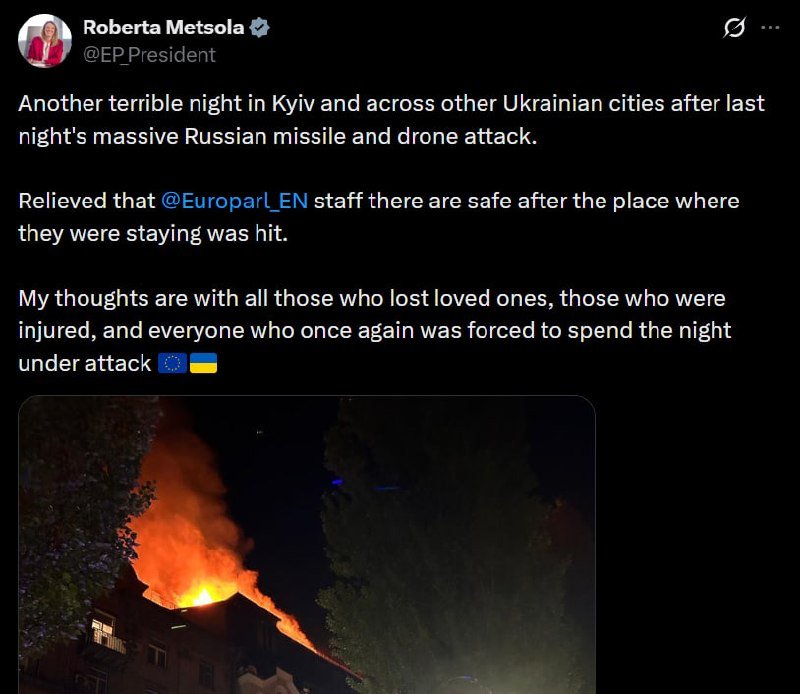
At roughly 05:14 UTC on 2 July 2026, air-raid sirens sounded across Kyiv and the surrounding region as Russia launched a combined barrage of drones, ballistic missiles and cruise missiles at the Ukrainian capital. By sunrise, the scale of the attack was already visible: residential courtyards torn open by direct hits, houses destroyed block-by-block, and fires burning across multiple districts. TSN reported that rescuers pulled seven people from the rubble of a single, completely destroyed house, framing the rescue as "a real miracle." Kyiv Post released footage of the moment a Russian missile struck near a metro station — the kind of location choice that has become a recurring signature of these overnight strikes.
The night's damage inventory, even in its preliminary form, tells a familiar story about how Moscow is choosing to fight this war at the four-year mark. Drones, ballistic missiles and cruise missiles all entered Ukrainian airspace in the same operational window, a layered strike package designed less to overwhelm air defences in a single place than to stretch them across an entire city. A shopping centre in a large regional centre was also struck in the same window, according to early reporting. Civilians, not military infrastructure, were the obvious payload.
A city that has learned to read the sky
Kyiv residents no longer wait for official confirmation before they know what kind of night it has been. The pattern is now legible from the rhythm of the explosions alone: Shahed-type drones arrive first, low and grinding; cruise missiles follow on a flatter trajectory from the south; ballistic missiles arrive last, at speed, from the north-east. Ukrainian air-defence crews work the sequence in reverse — drones first, because they are slow and numerous, then cruise missiles, then the ballistic threat that gives them minutes, not hours. The Kyiv region's survival of "a powerful attack," in TSN's phrasing, with casualties reported but no immediate confirmation of mass fatalities, is the outcome the air-defence system is built to deliver. It is also an outcome that depends on Western-supplied interceptors continuing to arrive on schedule, a constraint that has shaped every recent Kyiv negotiation in Washington and European capitals.
The shopping centre and the courtyard crater
Two images from the morning briefing capture the targeting logic. The first is a missile strike near a metro station — transport nodes that double as shelters, meaning the strike endangers both commuters and the people who run toward the station when the sirens sound. The second is a shopping centre in a regional centre outside Kyiv proper, a softer target than a power substation but a daily-use civilian space. The combined effect is to push the cost of the war onto routine civilian life: commutes, weekend shopping, sleep. This is not a new observation, but the consistency of the pattern — apartment blocks, transit hubs, retail — suggests Moscow has settled on a coercion model that does not require battlefield success to register politically. The pressure is the point.
What the routine obscures
There is a counter-narrative worth naming. Russian-aligned channels will, as they routinely do, frame overnight strikes as retaliation for Ukrainian long-range strikes inside Russia or for attacks on Russian-occupied territory. That framing has a kernel of fact — Ukraine has escalated its own deep-strike campaign over the past year — but it inverts the underlying logic. Ukraine strikes Russian military-industrial and logistical sites in response to an invasion; Russia strikes Ukrainian civilian infrastructure as the standing instrument of its war effort. Conflating the two erases the sequence. Kyiv Post's framing of the metro-station strike, and TSN's framing of the residential courtyard rescue, are useful precisely because they keep the targeting priorities visible.
The structural read
The deeper pattern is one of industrial-scale attrition dressed up as tactical strikes. Each overnight barrage consumes Russian cruise and ballistic missile stockpiles that cannot be replaced at the same rate under sanctions; each barrage also forces Ukraine to expend interceptors that arrive in tranches from European and American partners. The economics are unkind to both sides, but they are unkindest to the side that is being hit at home. Ukraine's air-defence industry, bolstered by Western licensing and joint production, has narrowed the gap over the past eighteen months; it has not closed it. Until it does, Kyiv will keep waking up to craters in courtyards, holes near metro stations and miraculous rescues from the rubble of houses that should never have been targets.
What remains uncertain
The morning-after count is always preliminary, and this morning is no different. The sources do not yet specify a final casualty figure for the Kyiv region, the regional centre whose shopping centre was struck has not been named in the early reporting, and the exact composition of the strike package — how many drones, how many cruise missiles, how many ballistic missiles — will take Ukrainian air-force and General Staff briefings to confirm. What is already clear is the pattern: another July, another pre-dawn barrage, another set of families climbing out of basements into a city that has learned to keep functioning anyway. That, more than any single missile type, is the metric Moscow is now optimising against.
This publication treats overnight strikes on Ukrainian residential and civilian infrastructure as a standing feature of Russia's war, not a series of discrete incidents. The structural read above follows directly from the targeting pattern visible across TSN and Kyiv Post's morning coverage.
Wire provenance
This editorial synthesis draws on the following public wire/social posts:
- https://t.me/TSN_ua
- https://t.me/TSN_ua
- https://t.me/Kyivpost_official
- https://t.me/TSN_ua
- https://t.me/TSN_ua
- https://t.me/TSN_ua
- https://t.me/TSN_ua