Burkina Faso's top diplomat pays respects at the coffin of Iran's martyred Supreme Leader — what the photo-op tells us
A Sahel junta's foreign minister travelled to pay respects to Ayatollah Khamenei. That tells you something about the new map of diplomatic gravity — and what it does not.
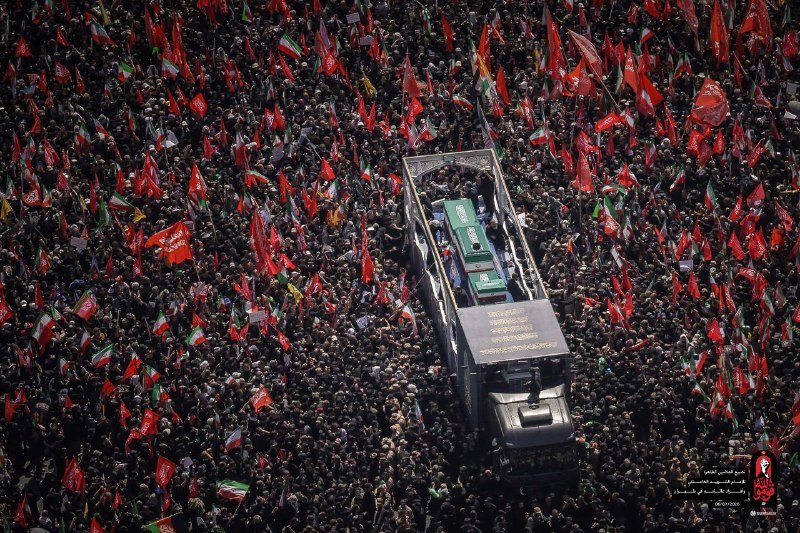
On the morning of 3 July 2026, Karamoko Jean Marie Traoré, Minister of Foreign Affairs of Burkina Faso, stood inside the Iranian capital and paid his respects to the martyred Supreme Leader of the Islamic Revolution, Grand Ayatollah Imam Sayyid Ali Hosseini Khamenei. The detail matters, because the line of dignitaries processing past the coffin is now the most legible map of where Iran's diplomatic gravity still pulls — and where, in the wake of the late leader's assassination, it has been redirected.
Traoré was not alone in the queue. The English-language channel of Khamenei's office reported, in the same 24-hour window, that Hafizuddin Ahmad, Speaker of the Parliament of the People's Republic of Bangladesh, and Abdul Ghani Baradar, Deputy Prime Minister for Economic Affairs of the Islamic Emirate of Afghanistan, had each performed the same rite. From Iraq, Qasem Al-Yasari, chairman of the Karbala provincial council, gave an interview to Khamenei.ir on the occasion of the funeral procession. Four states — three of them members of, or candidates for, the BRICS+ grouping, and one an Afghan government that no Western capital formally recognises — all in one afternoon. That is the picture worth reading.
What the guest list says about the new map
Western coverage of Iranian state funerals has, historically, framed the assembled guests as a roll-call of pariahs: armed groups, militias, the odd Latin American leftist. The framing is not wrong so much as it is incomplete. The delegations that have arrived in Tehran this week are not a museum of last-decade geopolitics. They are the foreign-policy infrastructure of a world that does not route its first call through Washington or Brussels.
Burkina Faso under the Traoré government has spent three years repositioning itself away from Paris and the Economic Community of West African States, deepening ties with Moscow and with what its ministers describe, without irony, as the "anti-imperial front." Sending the foreign minister to Tehran is consistent with that posture, but it is also a step further than symbolism: it is a Sahel state publicly treating an Iranian supreme-leader's funeral as a moment of diplomatic business. The same logic runs through Dhaka — a South Asian government balancing between Beijing, Delhi and the Gulf — and through Kabul, where the Taliban's Deputy Prime Minister for Economic Affairs has been the public face of the regime's outreach to non-Western capitals.
The counter-narrative, and why it does not hold
The standard Western-wire framing will read this guest list as evidence of isolation: a regime that cannot fill its funeral with friendly heads of state and so fills it with foreign ministers, parliamentary speakers and the odd prime-ministerial deputy. There is some truth in the optics. No G7 head of state is in Tehran this week, and the European Council has not signalled any intention to send a representative.
But that framing mistakes the room. Khamenei's funeral is not a Davos plenary; it is not designed to attract European heads of government, and it would be strange if it did. The states that have sent senior representation are sending precisely the officials that the Iranian system values: people who can authorise visits, sign memoranda of understanding, and open the doors of state television back home. A foreign minister is, in the operating logic of Iranian statecraft, a more useful guest than a ceremonial head of state who would have to clear the visit with a foreign ministry that, in many cases, has no Iran desk.
What sits underneath the procession
What the photo-line really reveals is the architecture of a non-Western diplomatic circuit that has been quietly building for two decades and is now the default operating layer for a meaningful slice of the global south. Iran's footprint in this circuit has always been outsized for its economy: a combination of energy diplomacy, ideological networks, weapons partnerships and, increasingly, drone and electronics technology transfer. Khamenei's death does not obviously disrupt that layer; the state structures around it are intact, and the assembled delegations are treating the funeral as a continuing-engagement event, not a closing one.
The harder question — the one the source material does not answer — is whether succession in Tehran will reweight that circuit, and in which direction. The guest list tells us who came to mourn. It does not tell us who will be signing what in six months.
Stakes, and what remains uncertain
For Ouagadougou, Dhaka and Kabul, the calculation is concrete. Each is a government under some form of Western economic or political pressure and is shopping for alternatives. Iran's continued capacity to host them at moments of national mourning, and to do so without visible embarrassment, is itself a diplomatic service. The Sahel governments in particular have begun to treat Tehran as a routine node on a circuit that runs through Moscow, Beijing and Ankara; that is a small but real shift in the texture of international relations.
What the sources do not specify is the substance of any bilateral engagement that may have taken place on the margins of the funeral, the security arrangements for the procession, or whether any of the visiting delegations have carried messages from third capitals. The reporting to hand is a guest list and a set of photo-lines; the diplomacy is being done in rooms the wires have not entered.
Desk note: Monexus has reported this story from the Iranian state-source primary feed and reads the guest list as a structural signal about non-Western diplomatic circuits, not as a moral endorsement of any regime involved. Where Western coverage frames the assembled delegations as a pariah roll-call, the more accurate read is that they are the operational partners of a diplomatic layer that exists independently of, and is largely indifferent to, the Western one.
Wire provenance
This editorial synthesis draws on the following public wire/social posts:
- https://t.me/Khamenei_en
- https://t.me/Khamenei_en
- https://t.me/Khamenei_en
- https://t.me/Khamenei_en