Tehran Turns a Domestic Wedge Into Foreign Policy: Ghalibaf's SNAP Barb and the Geometry of US-Iran Rhetoric
Iran's parliament speaker used a Cold-War-era reply to mock US domestic hardship. The line travelled fast — and signals how Tehran is reframing the negotiation table in 2026.
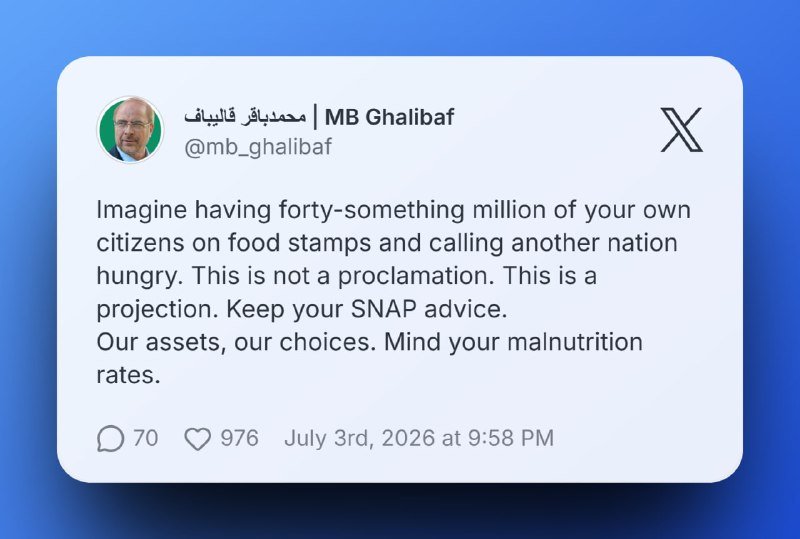
On the afternoon of 3 July 2026, Iran's parliament speaker, Mohammad Bagher Ghalibaf, posted a line aimed squarely at Washington: "Imagine having forty-something million of your own citizens on food stamps and calling another nation hungry." Within minutes, the Telegram channel ClashReport had carried the quote in English; BRICS News and Fotros Resistance had amplified it in parallel. Each repost framed the same single line as Tehran's response to what the channels called "Trump's insult" — a public riposte on American food assistance, in the middle of a renewed pressure campaign against the Islamic Republic.
The exchange is more than a barbs-in-the-feed moment. It captures the geometry the two governments now occupy: a US administration that insists on Iran's economic distress as leverage, and an Iranian leadership that has learned to turn that very distress against Washington — by pointing to the forty-something million Americans enrolled in the federal Supplemental Nutrition Assistance Program (SNAP), a figure Tehran is now treating as a rhetorical weapon. The line is short, but the infrastructure behind it is not.
What was said, and by whom
Ghalibaf's post, as carried by ClashReport, reads in full: "Imagine having forty-something million of your own citizens on food stamps and calling another nation hungry. This is not a proclamation. This is a projection. Keep your SNAP advice." Telegram channel BRICS News republished the line at 18:43 UTC on 3 July 2026; the Fotros Resistance channel carried the same framing at 18:33 UTC, attributing the words to Iran's parliament speaker and slotting the post under the rubric "responds to Trump's insult."
The choice of venue matters. Ghalibaf, a former IRGC commander and one of the longest-serving figures in the Islamic Republic's political-military elite, holds the speaker's chair in the Majles. He is not a backbencher and he is not a foreign-ministry spokesperson. By publishing in English on social channels that publish in English, he is speaking past the Iranian street to a foreign, dollar-stretching audience — the same audience the Trump administration is trying to reach.
Reading the line
Two things are happening inside the sentence. The first is the historical reversal: in earlier decades, US rhetoric toward Iran traded heavily on "Iranian hunger" imagery — sanctions framed as a moral story about a regime that let its people go hungry. Ghalibaf's line takes that script and inverts it. The second is the scalar arithmetic. Forty-something million SNAP participants is roughly the population of Iran under age 25, and roughly two and a half times the population of Tehran province. By choosing a number roughly comparable to Iran's own demographic weight, Ghalibaf is suggesting that the moral authority to lecture on hunger has migrated.
The diplomatic vocabulary surrounding the line — "projection," "proclamation," "advice" — is the language of an inferior standing-to-sue posture. Iran is not, on this framing, asking Washington for relief. It is telling Washington to retract.
What the Iranian official line is responding to
The "Trump insult" framing inside the Fotros Resistance post points, by inference, to a string of statements from Washington during the spring and early summer of 2026 tying any relaxation of pressure on Tehran to the visibility of Iranian economic difficulty. US messaging in that period has emphasised inflation inside Iran, the rial's depreciation, and the cost of staples; the subtext is that economic pain is the point of sanctions, not an unfortunate side effect. Ghalibaf's post reads as a refusal to absorb that framing on its terms.
The same posture is visible in Iranian state-media messaging throughout 2026: outbound briefings that frame sanctions as an American confession of failed policy rather than a successful instrument. The SNAP line is the most targeted version yet of that frame. It targets not Iranian misery but American domestic vulnerability.
Why this is rhetorically smart
The number forty-something million is not Tehran's invention; it is roughly the SNAP caseload cited in US Department of Agriculture reporting cycles and widely discussed in domestic US coverage of the federal budget. By importing a US-stated domestic statistic into a foreign-affairs argument, the speaker is borrowing the salience of an internal US political fight and rerouting it at Washington. The same number is a live line of attack inside US domestic politics between Republican and Democratic talking points over the size and future of the federal food-aid budget — which is precisely why the line lands.
There is also a structural asymmetry that Ghalibaf's framing quietly exposes. The US administration argues that pressure on Iran is the cost of Iranian non-compliance. The Iranian counter is that the pressure is a confession: a country claiming to lead the global economy cannot keep forty-something million of its own residents on food assistance and credibly lecture any foreign capital about food security. The argument does not need a snap policy outcome to function; it functions as ongoing ambient pressure on the credibility of US moral leadership, which is the currency sanctions enforcement actually depends on.
Stakes and what to watch next
The line does not, on its own, change the sanctions architecture. What it does is shift where the burden of justification sits. The next round of interest will be in how Tehran's English-language diplomatic accounts — especially at the foreign ministry and the permanent mission to the UN — pick up the SNAP frame. If the language migrates from a parliament speaker's social feed into MFA briefings and official press conferences, the line stops being a barb and starts being policy.
For Washington, the contestable move is whether to escalate or absorb. An escalation would treat the line as interference in domestic US politics and respond in kind — usually by tightening secondary sanctions posture or by publicly reciting Iranian economic distress figures. An absorption would treat the line as a one-off and refuse the bait, on the theory that silence is cheaper. Either way, the SNAP number is now in the diplomatic vocabulary. Tehran has bought itself the ability to say "projection" every time Washington's messaging touches Iranian living standards. That is a small thing in sanctions arithmetic, but it is a real thing in negotiation optics.
The note worth underlining is what the public sources do not show: no statement from the US State Department, no readout from the National Security Council, and no domestic US press coverage of the SNAP line has appeared in the threads that Monexus is reading from. The exchange, on the public record, is therefore a one-sided delivery from Tehran to international audiences — which is itself the point. The cost of sending the message was minimal; the cost of replying is real.
What remains uncertain
The strength of any analysis here is bounded by what the three channels published. None of the sources carries a fuller original-text post in Farsi; none includes a timestamp from Ghalibaf's own account; none has been independently corroborated by a wire outlet. The "forty-something million" figure is presented as a rhetorical claim rather than as a verified US statistic — readers consulting this piece should treat it as Ghalibaf's framing of a publicly discussed US domestic metric rather than as a confirmed caseload number. And the original "Trump insult" being answered has not been retrieved in the source material; the Iranian channels describe it without quoting it. A full read of the exchange will require the original Trump-side statement and an authoritative US-domestic count of SNAP participants — neither of which the underlying thread provides.
Desk note
Monexus treated the 3 July exchange as a single-step rhetorical event carried by Telegram-mediated Iranian state-aligned channels. Where wire outlets would normally sequence a back-and-forth between Washington and Tehran, this story is, on the public record visible to us, one-directional: Tehran posting, Washington silent. The piece intentionally surfaces that imbalance rather than smoothing it over — the absence of an official US reply is itself the headline.
Wire provenance
This editorial synthesis draws on the following public wire/social posts:
- https://t.me/ClashReport/
- https://t.me/bricsnews/
- https://t.me/FotrosResistancee/