Tehran's reception circuit: Iran quietly convenes a multi-continent diplomatic round in early July
On a single afternoon, Araghchi sat down with envoys from Thailand, Congo Brazzaville, and the D8 bloc. The pattern matters more than any one meeting.
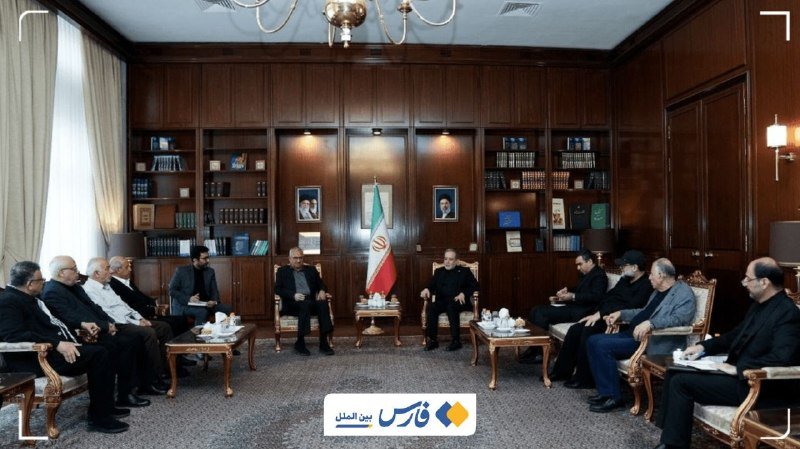
Between roughly 19:29 and 20:21 UTC on 3 July 2026, Iranian Foreign Minister Seyyed Abbas Araghchi held a cluster of bilateral meetings in Tehran that, taken individually, look routine. Taken together, they describe a diplomatic pattern worth naming. According to dispatches carried by Tasnim News and the Jahan Tasnim channel on Telegram, Araghchi received, in succession, Sohail Mahmood, the Secretary General of the D8 Organisation for Economic Cooperation; Constant Serge Bunda, the Foreign Minister of the Republic of the Congo (Brazzaville); and Paranpari Bahadiha Nokara, the head of the Advisory Council of the Deputy Prime Minister of Thailand. Four visits. Two state-aligned outlets. One afternoon.
The story is not any single handshake. It is the choreography: a wide arc of the diplomatic map — South-East Asia, Central Africa, the Islamic world's developing-country bloc — passing through one foreign ministry in a few hours. For a country under heavy Western sanctions and an active file of nuclear-pressure diplomacy, the reception circuit is itself the message.
What the meetings actually were
The D8 visit is the easiest to pin down. Mahmood heads a body grouping Bangladesh, Egypt, Indonesia, Iran, Malaysia, Nigeria, Pakistan, and Turkey — a creation of the 1997 Istanbul summit that was meant to channel developing-country trade and financial cooperation outside the Western-dominated architecture. His stop in Tehran, reported by both Tasnim News (English) and Jahan Tasnim on 3 July 2026, slots into the long-running effort to keep D8 active at ministerial level despite the gap between signature ambition and operational delivery. The Iranian side frames such visits as confirmation that the "Look East" and "Neighbours" policies are still drawing foot traffic into the capital.
The Brazzaville meeting carries a different weight. Congo Brazzaville is one of a handful of OPEC members, sits on the Gulf of Guinea, and has spent the last decade edging back toward Iranian oil-sector deals that were interrupted by sanctions. A foreign-ministerial visit, as reported by Tasnim News on 3 July 2026, is not commerce in itself, but it is the kind of meeting at which commercial conversations are scoped. Iran's Africa engagement has leaned heavily on the Horn and the Maghreb; a Central African heavyweight in the room broadens the map.
The Thai meeting, brokered through the Advisory Council of the Deputy Prime Minister rather than the foreign ministry directly, is the most ambiguous of the three. Bangkok and Tehran do not have an especially dense bilateral file. What a deputy-prime-ministerial envoy signals, on the record at least, is that Bangkok is willing to be seen in the room — useful for Iran, and useful for a Thai government juggling its own balance between Washington and Beijing.
The counter-narrative on the same facts
The Western wire read of an afternoon like this would treat it as evidence of "isolation diplomacy" — a sanctioned state working the visitors it can still get through the door, with diminishing leverage. That framing is not wrong; it is just incomplete. Tehran's own line, carried consistently through Tasnim and Jahan Tasnim reporting on the same day, is that these are relationships of choice, not of convenience: countries whose own foreign-policy compass points away from Atlantic alignment and toward a more multipolar arrangement.
A plausible alternative reading sits between those two. Sanctions do thin the queue of senior visitors willing to come to Tehran, but they do not make the queue ideological. Congo Brazzaville's oil interests are real, the D8 secretariat's travel schedule is real, and Thailand's regional hedging is real. Each visitor had a reason to be in the room that had little to do with solidarity and a lot to do with their own national interest. The dominant framing — either isolation or solidarity — captures a piece of it; the structural read captures more.
What this sits inside
This is the diplomacy of an incumbent order under strain and a successor order still being wired up. The United States still controls the most consequential financial nodes — correspondent banking, dollar clearing, the SWIFT messaging layer — and that reach is precisely why an Iranian foreign minister is meeting a Thai advisory-council head rather than a US treasury official. But the same pressure that thins the queue of Western visitors also opens space for institutions like D8, for African energy ministries looking for an alternative supplier, and for South-East Asian governments calibrating their exposure to US-China friction.
Iran is not, on this evidence, building a counter-system. It is doing something less dramatic and more durable: inserting itself into the connective tissue of a Global South that is being courted by multiple capitals, ensuring that when those capitals make choices about pipelines, payment rails, and security partnerships, Tehran is one of the names they have heard from recently. That is what an active diplomatic diary buys a sanctioned state — not breakthroughs, but the slow accumulation of optionality.
Stakes and what remains uncertain
The forward question is whether the optionality converts into outcomes. A D8 secretary-general's visit produces communiqués more often than contracts. A Congo Brazzaville meeting plants the seed of a deal that may or may not survive a US Treasury secondary-sanctions risk assessment. A Thai advisory-council meeting produces a photo opportunity and a polite read-out. None of that is a foreign-policy failure; none of it is a foreign-policy triumph.
What the sources do not say is what was actually agreed in any of the three rooms. Tasnim and Jahan Tasnim are state-aligned Iranian outlets; they reliably confirm that meetings occurred and reliably characterise them in the language of "expanding cooperation." They do not publish minutes, communiqués, or commercial terms. A reader who wants to know whether any of these encounters produces a tangible transaction will have to wait for the next round of disclosures — from Brazzaville, from the D8 secretariat in Istanbul, or from Bangkok — to see whether the diplomatic traffic of 3 July 2026 actually moves anything.
For now, the verifiable record is narrower and more interesting than either the Iranian state's framing or the Western sanctions-lens framing suggests: in a single afternoon, Tehran held three meetings on three continents, and the visitors came from places that the Atlantic financial system under-indexes. That asymmetry is the story.
This publication frames Iran's diplomatic activity as a working schedule rather than as evidence of either isolation or geopolitical triumph; the sources confirm meetings occurred but do not specify the substantive outcomes.
Wire provenance
This editorial synthesis draws on the following public wire/social posts:
- https://t.me/JahanTasnim
- https://t.me/tasnimnews_en
- https://t.me/JahanTasnim
- https://t.me/tasnimnews_en